
Translated material
"The great fracture of the national ridge"
How the breast children of dispossessed, or to the 90th anniversary of the beginning of collectivization, died in village councils
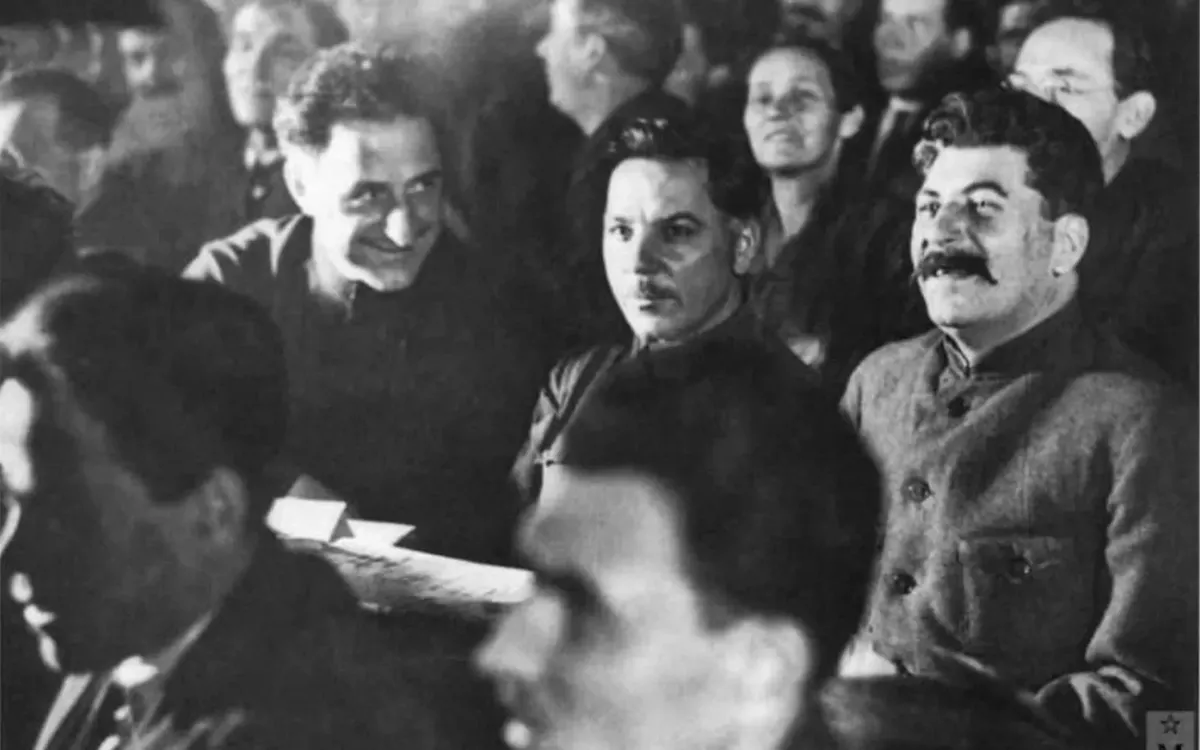
Trying to return to the past
In 1921, Lenin proclaimed a new economic policy (NEP), canceled "military communism", replaced the surplus surplus with firm tax. That is, he introduced free farming, market relations, put the city in direct dependence on the village: the better the city will satisfy its needs, the greater the salary of workers. It was already seditious. According to the Bolshevik teaching, the working class is “revolutionary”, and the village is the counter -revolutionary “peasant Vandeus”. The comrades -in -arms accused Lenin of the "peasant bias." But he was firm, in fact, went to revise the foundations. In fact, he returned to the primary basis.
The peasantry, land, agriculture is the foundation on which the rest is erected. That's why we are still tormented that the foundation was laid with a curve.
NEP saved the country from hunger. But here it is important to recall that the Bolsheviks first destroyed the country. And the Leninist plan of cooperation is only the restoration of the destroyed old, an attempt to return to pre -revolutionary experience. Few people know: the beginning of the 20th century in Russia was marked by the rapid growth of the cooperative movement. According to various estimates, by 1917 there were up to 50 thousand cooperatives of various types in the country. 14 million people participated in them, and 84 million with family members. Most cooperatives are in the village. Rural cooperation included 27.7 thousand primary cooperatives, 500 unions, 6,000 societies, 2400 partnerships, 3000 oil -plate artels. They united 12 million peasant farms - more than 55% of their total.
So, in 1921, the peasants believed the state, began to plow and sow. By 1923, pre-revolutionary sowing areas were restored. In 1925, they received more grains than on average for the most favorable for Russia for five years from 1909 to 1913. By 1927, they reached the pre-war level in animal husbandry.
Life itself has changed: from central Russia to deaf Siberian corners. Here is the data, for example, in the Molchanovsky district of purchase. In 1922, 777 acres were sown here. By 1927-7 times more. Self -organization began in artels, cooperatives. In the mid-20s, 5 seed and 13 machine partnerships operated in the region. Of the 2500 private farms, six hundred were cooperated. They did not drive anyone anywhere: people themselves decided how to develop the economy. In fact, they created joint -stock enterprises.
The same (only on a larger scale) took place in Central Russia. By the summer of 1924, in the Ryazan province there were 16 agricultural complex, 40 agricultural vehicles, 510 partnerships for joint cultivation of land that covered 23% of the population. By 1926, arable land exceeded the pre -war level.
But the Bolshevik authorities decided that private economy and amateur cooperation are incompatible with the Soviet way.
The XV Congress of the CPSU (b), which took place in Moscow from December 2 to 19, 1927, decided: the transformation of small individual peasant farms into a large collective economy is the main task of the party in the village.
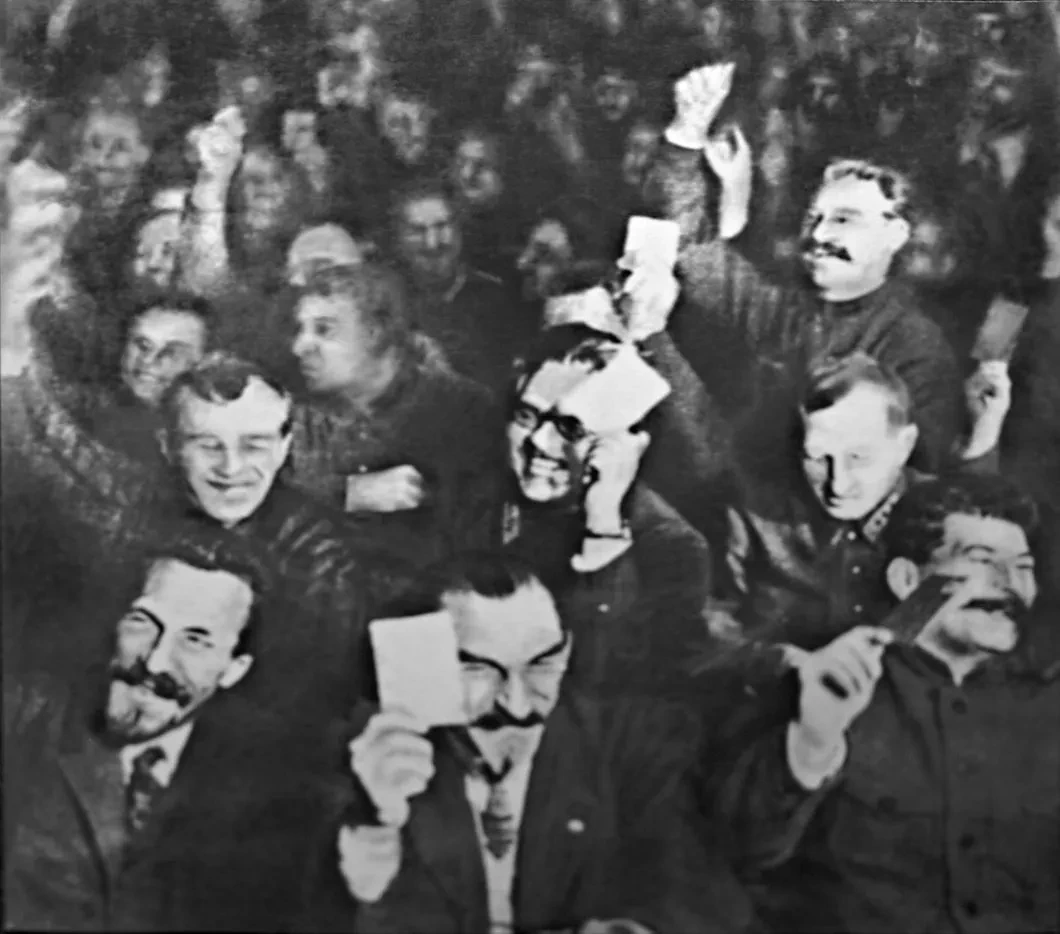
So the collectivization began. It became an integral part of the destruction of the new economic policy of Lenin. It was not only Stalin’s victory over Rykov and Bukharin, over the “right bias”. It was the victory of most ordinary communists, who considered NEP a treason to the ideals of the revolution.
Liquidation
Cooperation is one thing, and parting with centuries acquired farming is completely different. The authorities regarded the refusals to join the collective farm as "wrecking from the fists and brilliants." In 1929, the CPSU (b) announced the "liquidation of the kulaks as a class" and "continuous collectivization." The sole -faced people were put an ultimatum: “Do not enter the collective farm - we will send like kulakov!”
Typical stories of children and grandchildren:
“I remember how we were driven on a barge, how they sailed along the river to Narym. A week later, we were unloaded directly to the taiga shore. There was a guard so that no one escaped. They began to blame the forest, digging dugouts for housing. There was no food. Caught fish. Many died. "
“My grandfather was dispossessed for the crust and horse. In order not to get the wall clock that liked one of the activists, the grandfather broke them on the floor. When they brought to the place, they unloaded in the forest. For housing, special settlers dug dugouts. People were sick, dying. Children are puffed with hunger. "
“They drove two weeks in the summer in cattle wagons. They landed near Tomsk on the banks of the Tomi River, transported to the other side. And there is a field. The dugouts began to dig, who could. Well, half of human height. The roof was from brushwood, instead of the door - a blanket. "
In September 1930, 10 thousand dispossessed from Azerbaijan were taken to the steppe near Akmolinsk. After the cruel Kazakhstan winter, a thousand survived by April.
Stalin called the 1929th "The Year of the Great Breaking." Subsequently, Solzhenitsyn rewritten - "Fracture of the People’s Range."
They dispossessed three "categories". Some were driven to the camps, others were sent to “special settlement” to Siberia and Kazakhstan, and thirdly, they were evicted to their area. There is a certificate of the United State Political Directorate for Combating the political and economic counter -revolution, espionage and banditry (OGPU) of June 6, 1930. In only 4 months, 321,808 farms were dispossessed. There is no summary data.
Let's try to calculate ourselves.
By 1928, there were 25 million private peasant farms in the country. According to the secret instruction of the CEC and the Council of People's Commissars of the USSR of February 4, 1930, 3-5 percent of the total number was subject to dispossession. But local authorities, activists, Komsomol members ravaged everyone who is richer than them. In some areas, up to 20 percent of farms were “dispossessed”.
Take the average number - 10 percent. This means: ruined, plundered 2.5 million farms.
The average size of a peasant family in 1929 is 5.52 people. (The calculation was made according to the Moscow, Leningrad, Tver, Smolensk regions, Western Siberia, the Tatar and Karelian Autonomous Soviet Socialist Republic.) This means 13.8 million (from the elderly to infants) were deprived of property, expelled to the street, sent to camps, in special settlements.
In addition to all socio-political meanings, it was the destruction of meaning in general. The wealthy owner was ruined and referred as an “enemy”. And this is "good." That is, “good” to be a tramp, walk with a rifle, and “bad” - honestly and work hard. The destruction of meaning took place on a country's scale. In parallel with food requisition.
From the letter of Stalin - Molotov: “How is it with German loans? Forced the export of bread in full swing. This is now a nail. If we take out the bread, there will be loans. ”
Grain was sold abroad to buy cars "for industrialization of the whole country." Hunger began.
From the ACPPU SPPU, March 31, 1933:
“In recent months, in some areas of the Soviet Union, a number of cases of cannibalism, the sale of human meat in the markets and murders have been established for this purpose.
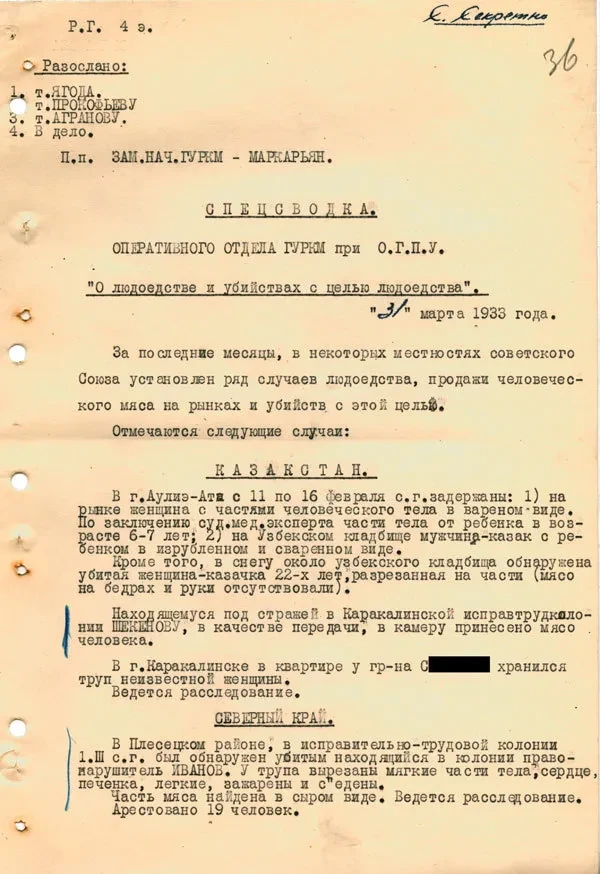
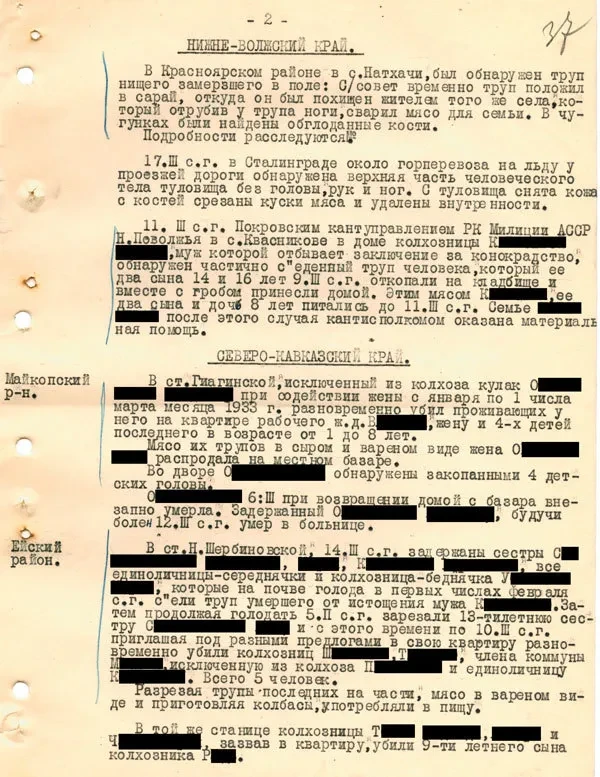
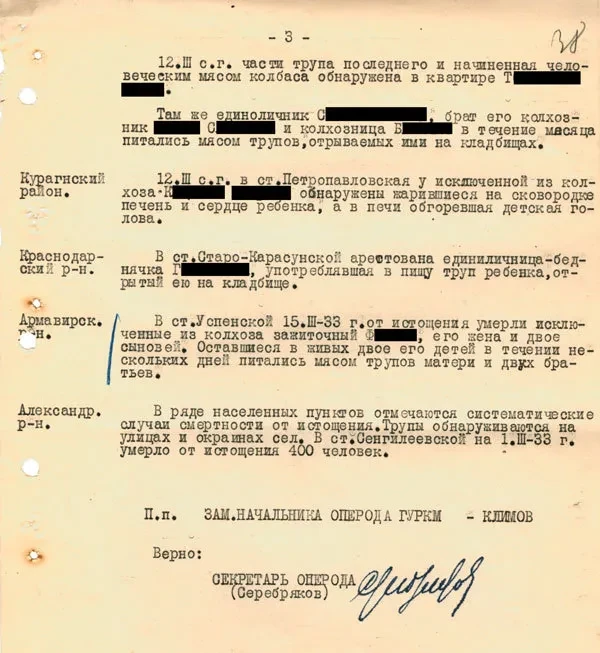
North Caucasus Territory
Krasnodar r. In the camp. The Staro-Karasunskaya was arrested by the lodge-baggage of G., who used the corpse of a child, poured into her cemetery.
Yeisk r. In the camp. Novo-Shcherbinovskaya on March 14 S.G. The sisters of S., K., all-the sole-shells-sednesh, and the collective farm-bagel of U., who are on the basis of hunger in early February S.G. They ate the corpse of the deceased from the exhaustion of her husband K. then, continuing to starve, February 5 S.G. The 13-year-old sister S.
In the same village of the collective farmer T. and Ch., Having called for the apartment, they killed the 9-year-old son of the collective farmer R. ALIGENCH S., the brother of his collective farmer S. and the collective farmer B. for a month fed by the meat of the corpses that were torn off in cemeteries.
Armavir r. In the camp. Uspenskaya on March 15, 1933, the wealthy F., his wife and two sons, excluded from the collective farm, died from exhaustion. The surviving two of his children for several days fed for the meat of the corpses of their mother and two brothers. ”
According to the special commission of the State Duma of the Russian Federation (2008), in the USSR “as a result of hunger caused by violent collectivization in 1932-1933, about 7 million people died.”
"Do not go to the gate - eat!" Kazakh Holodomor
About him - separately, because (unlike the tragedy of Russia and Ukraine) he is little known. And yet - the Kazakh Holodomor had its terrible historical and ethnic features.
Confiscation and requisition began there in 1926. By 1933, 4 million were left out of 40 million heads of cattle. They belonged to the created collective farms and state farms.
For the Kazakhs, total confiscation was more fatal than many times, because then they did not know agriculture. There was superstition that invading the womb of the earth is sacrilege. They only kept the cattle and exchanged meat, milk and oil for flour, sugar, chintz. And if the Russian, Ukrainian, Uzbek, the German, in the spring, at least the spine grown in his courtyard, then the Kazakhs instantly were left without food. Gobby or sheep - not a bag of grain, you can’t hide in the pit.
The Kazakhs began to die out hundreds of thousands.
The writer Kamil Ikramov, the son of the first secretary of the Central Committee of the Communist Party of Uzbekistan Akmal Ikramov, remembered with horror how he, a boy, was driving from Tashkent to Moscow to the Salon-Wagon of his father through the Kazakh steppe-and the whole steppe, from the horizon to the horizon, was covered with corpses.
From the AGPU report, March 31, 1933 (until 1936, Kazakhstan was called Cossackstan, and Kazakhs - Cossacks. - S. B.):
“Kazakstan. In the city of Auli-Ata from 11 to 16 February p. G. Detained: 1) In the market, a woman with parts of the human body in boiled form. According to the conclusion, the court. honey. expert, parts of the body from a child aged 6-7 years; 2) At the Uzbek cemetery, a male Cossack with a child in chopped and brewed form.
A murdered Cossack woman was discovered 22 years old, cut into pieces (meat on the hips and hands were absent). Human to the Karakalinsky professional employment, who was in custody in the Karakalinsky professional, as a transfer to the camera, brought human meat. ”
From the letter of Nurgaliy Duysenbinov, Aulso-Soviet No. 4 Maksimo-Gorkovsky district-to the chairman of the All-Russian Central Executive Committee M.I. Kalinin, February 10, 1932:
“The entire population living in Cossacks dies of hunger. All cattle were handed over to the state, the population has nothing to eat. In the future, the population cannot exist in Kazakstan. ”
From the memorandum of the doctor Kramer (North Kazakhstan region, 1932):
“Children, as a rule, die up to 2-3 years. During the winter, all the youth died out in a number of auls. ”
Writer Gafa Kairbekov:
“Turgai. There are many adults on the streets. They cannot go, crawl on all fours. And some are already motionless, lie on the road like logs. I ran out once a walk, and I grabbed someone's hands. I - break out. And how much was to me ... well, four years.
Well, my grandmother arrived at the aid, the scream raised. That's why she punished several times a day: "Do not go beyond the gate-eat!"
According to the 1926 census, there were 3,713,394 people in Kazakhstan. (Demographers allow arrears in view of the nomadic and semi -nomadic lifestyle.)
After 13 years, according to the 1939 census, 2,313,674.
“As a result of collectivization” in Kazakhstan, 50 percent of ethnic Kazakhs died from hunger. The number of Kazakhs until the level of 1926 was restored by 1970.
Human losses of the USSR
Let's try to calculate ourselves.
According to the 1926 census, the population of the Soviet Union - 147 027 915 people. In 1926-1928, the annual increase - 2.4 percent. The highest in the history of the USSR. Upon preservation of such pace, the population of the USSR in 1939 would be 200,245,035 people. But according to the 1939 census - 170 557 093. Moreover, according to the conclusion of demographers, the data is artificially increased by 3 million. So, the real figure is 167 557 093.
Total, taking into account the unborn, losses of the population of the USSR for 13 years of collectivization - 32,687,942 people.
In the 65th year of Soviet power
In 1963, I, along with other schoolchildren from our virgin, bread (!) North Kazakhstan region, went to Artek. Through Moscow. It was most surprised, it struck the little provincials in the capital of the Motherland, not the Kremlin, not the king-gun or even the metro.
It was completely amazed that in Moscow, bread was sold out of line! After all, our childhood was held at the stores in anticipation of the "Rolling". Parents at work, we are in lines.
Then there was always bread. Milk - with interruptions. In 1982, the Plenum of the CPSU Central Committee adopted a special food program. The report stated: "The food problem has not yet been removed from the agenda." In the 65th year of the Soviet regime-the "food problem." Of course, they did not starve. But the meat, sausages, cheese, buckwheat, fruits in stores (excluding Moscow, Leningrad, Kyiv and the capital of the Baltic Republics) - they did not see. They were not bought, but "got".
In 1985, the USSR (a country with the world's largest arable land and the most fertile soil in the world) imported 23 percent of the total grain and 27 percent of the total volume of the main food culture - wheat.
To the question of the Christian ideal
Despite the obvious history lessons, there are still many apologists of the collective farm system in Russia. Articles are written, books in which the Holodomor is called the "anti -Stalinist myth", it is argued that "the chaos of the NEP was the true cause of hunger." The theory of a special Russian path, our original "collegiality and community" is popular.
In 2014, the chairman of the Synodal Department of the Moscow Patriarchate on the relationship between the Church and Society, the Deputy Head of the World Russian People’s Cathedral (VRNS) Archpriest Vsevolod Chaplin and the head of the Expert Center of the VRNS Alexander Rudakov in the article “On God, Man and Civilization” argued: “The work of labor for the Orthodox person is the work of the monastic community, when the main thing is not so much material The result is how much maintenance of the fraternal spirit. Having rejected the ideals of the world revolution, the communist power partially recreated the pre -revolutionary public model. The collective farms, with all the horrors of collectivization, would not be accepted by people if their idea had not reflected the Christian ideal. ”
Collective farms as a reflection of the Christian ideal, say?
In the late 1950s, comrade N worked at the Institute of World Literature (I don’t name the name, after all, there are grandchildren and great-grandchildren). When he was retired, he was offended and transferred his merits to the authorities, the Communist Party. Among them is the leadership of the dispossession detachment. Here is what N told at the meeting (I set it out from the book of a witness, an employee of that institute). Mother, realizing that the babies would not survive on the road, on the night before the expulsion made their way to the village council and left the children on the porch - in the hope that they would be selected and raised. The founding was brought to the largest room of the largest village council and put on the floor.
The leadership received an order: not to allow them to feed or take them, since, firstly, they are class-alien class, and secondly, they should stop the vicious operational practice of fists to throw their children to the state or poor.
For a while, the babies cried, then tired, fell silent and, finally, faded away from hunger. They were buried in a common grave. This is what he said, this is what the communist N was proud of. So the paths of innocent babies and armed guardsmen of the collective farm system came together.
What fear had to drive into the souls, how to intimidate the people, what system of power to create in the country, so that Russian people dutifully, inactively watched how infants die before their eyes?
January 26, 1934 in the Kremlin, the XVII Congress of the CPSU (b) began work. In Soviet historiography, he was called the “Congress of Winners”.
Sergey Baimukhametov - especially for "New"