
Translated material
The ECHR awarded 60 thousand euros of the Mother of the Petersburger of the Vyzhikovsky, overwhelmed to death in the police
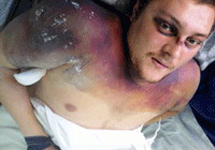
The ECHR ordered Russia to pay 60 thousand euros to a resident of St. Petersburg Tatyana Shmeleva, whose son Denis Rotrzhikovsky died in 2010 after torture in the police. This was reported by the "Zone of Law" with reference to the lawyer of the applicant Ilnur Sharapova.
The collegium admitted that Russia violated Article 2 (right to life) and 3 (prohibition of torture) of the European Convention in relation to the Vyzhikovsky.
On October 1, 2010, the police of the Moscow police department of St. Petersburg detained Olga Zverekov, a girlfriend of Vrzhikovsky, on suspicion of apartment theft. The security forces took the keys from the detained and appeared in her apartment. There was Vrzhikovsky himself. After the search, he was also detained and delivered with Zverekova to the RUVD. In the Office of the Uzzhikovsky, the "swallow" was connected in the pose and beastly beaten. Then both were brought to the 12th police department, telling the local police, as if they had found Rotzhikovsky and Zverekov drunk and beaten on the street. Both were placed in IVS.
In the morning of Rotrzhikovsky was taken to the hospital. There, on October 10, he died.
The forensic expert recorded on the body of the deceased multiple fractures with a rupture of the joint bag and bruises with a softening of soft tissues and bleeding.
TFR opened the case. The defendants were the former head of the department for the fight against property crimes of the Moscow police department, Ilya Galchuk and operatives Dmitry Sitnikov, Alexander Saenko, Ruslan Istalov, Igor Semenov and Sergey Luchitkov. Paragraphs “A”, “B” of part 3 of Article 286 (abuse of authority with the use of violence and special equipment) were charged with all six, and Galchuk and Sitnikov are also part 4 of Article 111 of the Criminal Code (intentional infliction of serious harm to health, which caused the death of the victim by negligence).
On November 9, 2012, the Moscow District Court of St. Petersburg sentenced Galchuk and Sitnikov to 10 years of strict regime, Saenko and Istalov - to 2 years in general, Semenov and Luchitkov - respectively, by 3 and a half and 3 years conditionally. However, on May 8, 2013,the St. Petersburg City Court canceled the verdict , citing small technical flaws.
On March 27, 2014, the Moscow District Court, having repeatedly examined the case, gave Galchuk and Sitnikov 8 years of strict regime , and the rest - the same terms that were appointed according to the results of the first process. Meanwhile, the City Court on October 1 of the same year, on the anniversary of the beating of Rotrzhikovsky, excluded the 111st article from the prosecution of Galchuk and Sitnikov , reducing it of the terms of up to 4 and a half years and 5 years, respectively. They softened punishments to other defendants: Saenko and Istalov - up to a year and a half of the general regime, Semenov - up to three years conditionally, Luchtrunskova - up to a year and a half conditionally.
At the same time, the City Court indicated that Rotrzhikovsky received injuries in the RUVD, and in this regard decided to pretend to be the beating. However, on March 2, 2015, the TFR suspended the investigation, citing the fact that the suspects were not established. Attempts to appeal this decision in the courts were unsuccessful.
In September 2016, the ECHR invited Russia to go to a settlement agreement with Shmeleva, the mother of Rotrzhikovsky. Under the terms of the agreement, Moscow was supposed to not only recognize a violation in relation to the deceased Article 2 and 3 of the European Convention, but also to take system measures to combat violence in the police. The list of measures was presented by lawyer Sharapov in his appeal. Among his proposals were the installation of video surveillance cameras in all police departments and departments, medical examinations of the detainees, and the development of strict rules for communication between police officers with detainees. Sharapov also called the increase in the states of investigators who are engaged in the official crimes of the police.
However, in March this year, it became known that Russia refused to take proposed measures . At the same time, the Commissioner of Russia at the ECHR, George Matyushkin, in his response, recognized the violation of the Virzhikovsky Convention in his response to the Strasbourg court.