
Translated material
International Tribunal - not a decree for Russia
Why did the Russian media hardly noticed the verdict of Ratko Mladich, and the politicians criticized

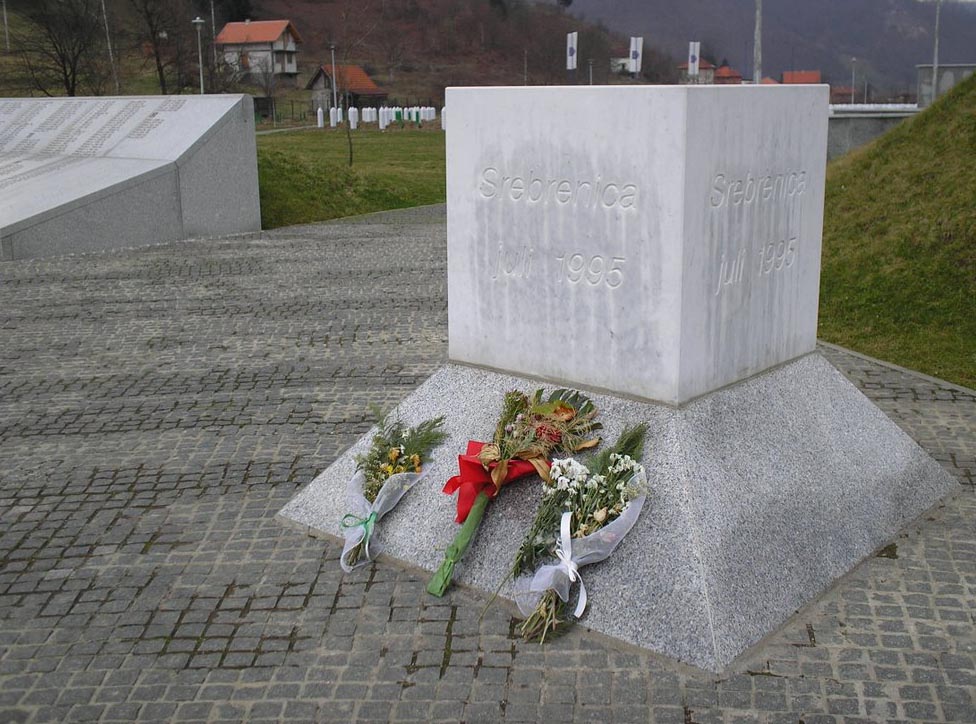
Memorial in memory of victims of war crimes in Srebrenitsa Photo: Yenisafak.com
The verdict, which the international tribunal for the former Yugoslavia (MTBU) took the day to the former commander of the Bosnian Serb army, General Ratko Mladich, one of the main actors of the armed conflict in the Balkans in the beginning and mid-1990s, greatly stirred public opinion and continues to be one of the key topics of the Western press.
The Huffington Post compares him with the serial killer Charles Manson, who died the other day in prison. “They had a common feature - they considered their victims as a subhuman, and saw themselves in the role of God -like saviors,” writes the columnist of the publication.
“Mladich left a terrible inheritance, but the Muslim Muslim Muslims in the Muslim Enclave of the Srebrenitsa in July 1995, one of the main points of the accusation to Mladich. -NT), know that the monster who destroyed their lives will end its life path behind bars,” notes The Mirror.
In the European Union and NATO, a sentence to the “Bosnian butcher”, as the Western media also called it, was called evidence of the rule of law.
"Shoot so that they lose sleep"
Ratko Mladich was sentenced to life imprisonment. The court considered the accusations of the general’s involvement in the massacres in Srebrenitsa and the many years of siege by the Serbian troops of the city of Sarajevo (the capital of Bosnia and Herzegovina), whose victims were more than 10 thousand civilians.
As evidence in the court, she also appeared as a record of his telephone negotiations from the time of the siege of Sarajevo, intercepted by the Bosnian special services. “Shoot on parliament, the presidential palace, in the old city. Shoot so that they lose a dream! " - commanded Mladic in May 1992.
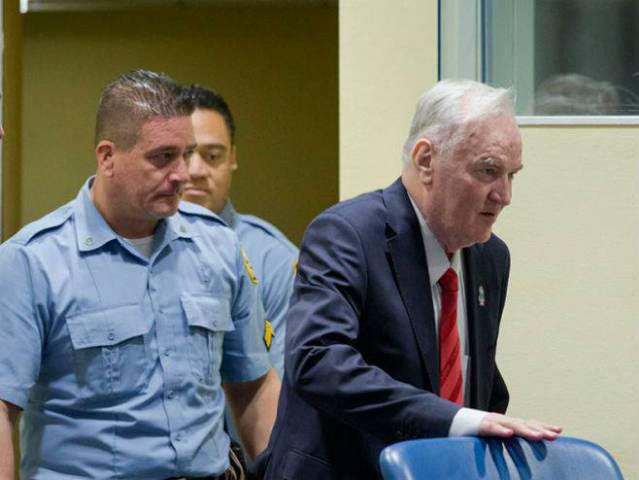
Ratko Mladich during a meeting of the International Tribunal
According to the former Yugoslavia photo: FacebookReporter.org
The evidence was also the results of DNA tests found in mass burials of civilians in the early 1990s in Bosnia.
"This is all a lie, you are all liars!" - Mladich began to scream during the announcement of the sentence. And he was removed from the courtroom.
From the prosecution, 169 witnesses acted during the process, from the defense - 208. Lawyers rested on the fact that Mladic's subordinates were not engaged in ethnic cleaning, but fought in Bosmia with Islamic fundamentalists. According to the defense, the prosecutors presented the general as if he controlled everything and everyone in Bosnia at that time.
The story of "Butcher"
When, in June 1991, federal Yugoslavia began to break up into individual states, Ratko Mladich, Bosnian Serb by nationality, commanded the 9th Corps of the Yugoslav People's Army (Yuna) in Croatia. Under his leadership, Serbian armed groups fought with the Croatian army. On September 8, 1991, Croatia announced a complete break with Yugoslavia.
In early May 1992, Mladic (by that time received the title of Lieutenant General Yuna) was transferred to Bosnia and Herzegovin (Big), where there were already clashes between Muslims and Croats, on the one hand, and the Serbs on the other. The Bosnian Serbs, who refused to recognize the independence of the Big, formed the Republic of Serbian and advocated unification with Serbia and Montenegro. Mladic was appointed chief of the General Staff of the Army of the Republic of Serbian.
"This is all a lie, you are all liars!" - Mladich began to scream during the announcement of the sentence. And was removed from the courtroom
“We will not win anything if we kill 50 thousand Muslims. Our true priority is to get rid of the Muslim population, ”Mladich wrote in his diary.
The war in Bosnia continued until 1995, when, under the pressure of the United States, the leaders of the former Yugoslav republics entered into a peace treaty, and NATO peacekeeping contingent was introduced into the Bosnian territory.
The Hague court was looking for Mladic for 16 years. But while in power in the Union Republic of Yugoslav there was Slobodan Miloshevich, the former general had no problems. In June 2001, Miloshevich himself was transferred to MTBU. Mladich had to go underground. Local intelligence agencies arrested him and issued Hague only in May 2011.
Unhurried justice
Since its creation in 1993, MTBU has charged 161 people from Bosnia, Croatia, Serbia, Montenegro and Kosovo. All of them, one way or another, were related to the operations of the Yugoslav People's Army against Croatia (1991–1995), to the war in Bosnia and Herzegovina (1992–1995) and to the conflict in the autonomous region of Kosovo (1998–1999). Of the 83 accused who were sentenced, more than 60 people were ethnic Serbs. It is precisely this statistics that the critics of the tribunal, accusing the court of bias towards the Serbs.
The defendant of the most high -profile business that Mtbu led, was Miloshevich. He was accused of crimes against humanity - murders, deportation, violations of laws and customs of war. The process was discontinued in connection with the death of Milosevich in March 2006.
In March 2016, the former leader of the Bosniy Serbs, Radovan Karadzhich, received 40 years in prison by MTBU. But the leader of the Serbian Radical Party, Voislav Sheshel, was justified.
Of the 83 accused who were sentenced, more than 60 people were ethnic Serbs. It is precisely this statistics that the critics of the tribunal, accusing the court of bias to the Serbs, indicate the critics of the tribunal
The Mladich case is one of the last, which was considered by MTBU, he will complete his work by the end of this year. The appeal of the lawyers of the former general will already consider the international residual mechanism for criminal tribunals, which is already engaged in the appeal of the verdict is pleased with Karadzhich.
We do not recognize and criticize
Mladich’s sentence in Moscow was commented on by “duty speakers”. Once again they fell on the tribunal in the former Yugoslavia with angry Philippics. The official representative of the Russian Foreign Ministry, Maria Zakharova, stated that the prosecution of Mladich is "a continuation of a politicized and biased line that initially dominated the work of MTBU." Like, the Serbs make up the majority of convicts of the tribunal.
The head of the Federation Council Committee on International Affairs, Konstantin Kosachev, regularly commenting on foreign policy problems, said in an interview with TASS that MTBU verdict is “another reason to think about serious problems with building objective international refereeing”.
But the parliamentary opposition, which in the 1990s so close to the heart of the problems of the Slav brothers, the current sentence actually ignored. In the mid-1990s, the Communists and National Patriots built their political platform and their vision of state interests, regularly appealing to the topic of the “Slavic Brotherhood”, the struggle of the Sedar Brothers with the “insidious West”, etc. As the anti -Western trend began to grow stronger in the Kremlin, the boundaries between the former “pro -Western camp” and the ideological opponents of the West began to wash. And now the phantom of the “external threat” (and the thesis of the unique civilizational path of Russia) is already actively exploited by the authorities itself.
Now the very idea of creating some supranational bodies for the administration of justice causes a sharply negative reaction in Moscow. The activities of international tribunals are “ineffective, costly, is protracted in nature and is extremely politicized,” the Russian Foreign Ministry noted in a statement
Russia initially supported the idea of creating MTBU. “The entire international community in the person of the tribunal will be verdict to those who rudely violate not only the norms of international law, but simply human ideas about morality and humanity,” said Julius Vorontsov in May 1993.
Now the very idea of creating some supranational bodies for the administration of justice causes a sharply negative reaction in Moscow. The activities of international tribunals (referring to the MTBU and a similar body that investigated the genocide in Rwanda) “is ineffective, costly, is protracted in nature and is extremely politicized,” the Russian Foreign Ministry said in July 2015.
In the same month, Russia blocked a resolution in the UN Security Council, which provides for the creation of an international tribunal to investigate the disaster of the Malaysian Boeing near Donetsk in 2014.
In turn, Ukraine is very actively trying to use supranational courts in the confrontation with Russia. Ukrainian Minister of Justice Pavel Petrenko recently stated that the European Court of Human Rights is now studying five lawsuits of Ukraine against Russia. Ukraine also intends to file claims for violation of human rights in Crimea in the International Criminal Court (MUS). Russia does not recognize the jurisdiction of the Mus at all. According to the Russian ruling elite, any such supranational court is just a tool for holding someone's evil will.