
Translated material
"Independent Gazeta": How to solve the problem of extreme low water on Lake Baikal
The situation in Baikal since 2014 has developed extreme - there was no such low water in its entire “adjustable” story. The hopes that the “big water” will come this season also did not materialize. And again, the question arose of managing the level of Baikal. The vibration range is now expanded, but the action of the Provisional Decree of the Government of the Russian Federation No. 626 will end on January 1. The Ministry of Natural Resources has already proposed extending it until 2021. Ecologists are against, but a return to the meter range is impossible: against nature itself.
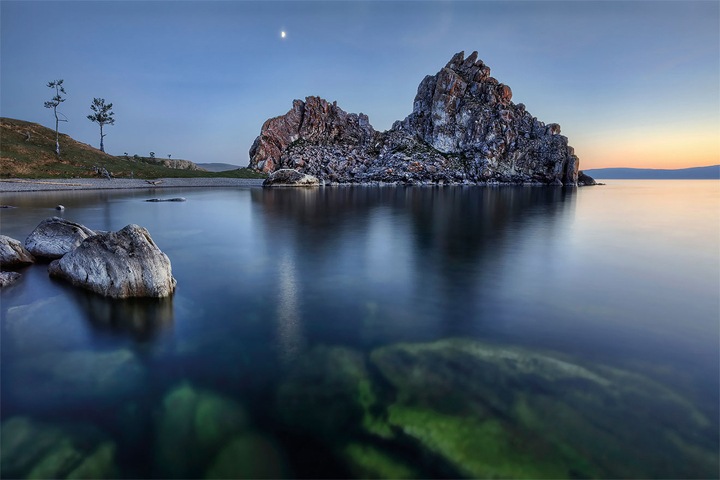
The borders are always debatable
At the end of October, in the Irkutsk village of Bilchir, which is located on the shore of the Bratsk reservoir, the Buryat shamans conducted a rite of worshiping the spirits of water and asked them to prevent Baikal’s shallow. According to the Roshydromet, the lake tributaries for nine months of this year amounted to only 62% of the norm (about 36 cubic meters). So far, this is the worst result in the 21st century. Even in the past, great low water, in 1976-1982, the average influx in Baikal was 45.6 cubic meters. km, and in soft low water 1996-2013 - 54.5 cubic meters. km. And there were no serious problems for water users then.
But what has been observed since 2014 differs from everything that happened before. In 2014-2016, the flow of water in the Bratskoye, Ust-Ilim and Boguchansk reservoirs amounted to 65–67% of the norm, 61% to Irkutsk. The expenses of the Irkutsk hydroelectric power station were reduced to maximum permissible values (1300 cubic meters per second), which is necessary only to maintain the level of the lake and ensure water supply in the Lower Buehf (water intakes of Angarsk and other large cities of the Irkutsk region are forced to work in modes close to emergency). I had to introduce restrictions on the sediment of ships, and from November 2014 to May 2015 - even the emergency mode in the territory of the Irkutsk region and Buryatia.
As noted in the publications of the Institute of Energy Systems named after Melentyeva (ISEM SB RAS), such an extreme situation exposed the contradictions between various participants in the water management complex and exacerbated the risks of the normal functioning of the entire hangar-Yenisei cascade (AEK). The main stumbling block again was the dispute about what the permissible prism of lake regulation should be - one meter or higher. This is not a new dispute, it lasts all decades of the “adjustable” history of Baikal, in which politics, ecology and energy are intertwined in a tight knot.
CAZUS of regulatory
Any hydraulic structure is a complex natural-economic system that needs to be correctly controlled. Actually, for that, dams are being built on the rivers. But to regulate one of the four elements, of course, it does not always turn out: people do not have the power of Poseidon. Few of the townsfolk generally thinks that Baikal, Angara and Yenisei are the largest hydropower complex in Russia. The Angarsk and Yenisei branches of the Cascade of the hydroelectric power station are hydraulically interconnected, belong to the same water basin and work for the entire united energy system (OEC) of Siberia. Five subjects of the Siberian Federal District (Irkutsk region, Krasnoyarsk Territory, the Republic of Khakassia, Tuva and Buryatia) are located on the banks of Baikal (and the Irkutsk reservoir adjacent to it), as well as the fraternal, Ust-Ilim, Boguchansky, Sayano-Shushensky and Krasnoyarsk seas. These reservoirs are used for the needs of not only electric power industry, but also water transport, fish farming, industrial and communal water supply, irrigation, forest industry, tourism, etc. In fact, the vital activity of 20 million Siberians depends on the operating modes of the station of the Angaro-Senisei cascade (AK).
All this huge system has been created for six decades - from the moment of the construction of the Irkutsk hydroelectric station to the commissioning of Boguchanskaya. And the authorities and scientists always had one question: how to regulate the cascade taking into account the interests of all regions and all water users? The uniqueness of Lake Baikal, the main regulatory capacity of the Irkutsk reservoir and at the same time since 1996 - the UNESCO natural regulatory, is also created.
The situation has never been an ideal situation - neither in the years of the USSR, nor in the new Russia. The most always “flew” to the hydropower plants - from the side it seems to many that the owner of the hydroelectric power station steers “damper” in his own interests, no matter what. To remove these accusations, it was the energy sectors back in the 1970-1980s that became customers to develop uniform rules for the use of water resources (PIVR) of the total AEK. The Institute "Hydroproject" (now included in the structure of "RusHydro") has developed such a document. But, as the deputy director of the Institute of Geography writes in one of his books. V.B. Sochava of the Siberian branch (CO) Leonid Korytnaya, the highest leadership of the USSR during the years of perestroika was not up to it. And the maximum that managed to achieve is the statements by order No. 601 of the Minister of Land Reclamation and Water Economy of the RSFSR dated November 30, 1987, the document called “The Basic Rules for the use of Water Resources of the Angarsk Cascade of the HPP (Irkutsk, Bratski and Ust-Ilim)”.
These rules were also bogged down in approvals and were eventually divided into two parts - for the Angarsk and Yenisei cascades, respectively. Subsequently, it was possible to approve only the "Angarsk" rules, the "Yenisei" remained on paper. They have not acted de jure for a long time, but de facto are quite adequate, of course, subject to some actualization. Moreover, since then, firstly, another step appeared in the cascade: the Boguchansky hydroelectric station-Dolgostroy received a second wind in 2006, and in 2014 with the launch of the ninth unit, the completion of the fourth hydroelectric station in the Angarsk st cascade ended. Secondly, which is much more important: the state disappeared, and with it the conditions of administration, to which those rules wrote. Private owners appeared among water users, the conditions in the lower beef of the Irkutsk hydroelectric power station have changed significantly, and energy switched to market rails.
In 1999, Federal Law No. 94 “On the Protection of Lake Baikal” was adopted, in Article 7 “Water Lake Baikal Lake”, it is said that “the regime of filling and working Lake Baikal is determined by the authorized federal executive body in the manner established by the legislation of the Russian Federation.” There is also a “ban on increasing water level in Lake Baikal above maximum values and a decrease in water level in Lake Baikal below the minimum values established by the Government of the Russian Federation.” Thus, the regulation of the lake level was fully assigned to the federal government (as a result of the murals). And on March 25, 2001, the Decree of the Government of the Russian Federation No. 234 was issued, in which a tough range of oscillations of the prism of Baikal was prescribed - between 456 and 457 m in the Pacific Height System (TO).
For all decades of the “adjustable” history of Baikal, no such strict decisions have been made. Moreover, the natural fluctuations in the lake level to the construction of the dam of the Irkutsk hydroelectric power station reached 2.17 m. And when designing the station, a range of 1.96 m was laid. The “meter” limit looked strange, but only the strengthened logic of manual control fed the then strengthened. The desire to prevent the arbitrariness of power engineers was also visible. “Internal contradictions and insufficient legal status of the rules became the cause of the low discipline of their compliance. This, in particular, manifested itself in the “vague” period of 1983-1994, when the level of Lake Baikal was forcefully forced by energy, ”the barnet writes in his book, recalling that the dashing 90s showed even in such an industry section. Be that as it may, but for some time the question with the level fell silent, especially since the average water content was established in Lake Baikal.
Manually
For scientists, it was initially clear that to keep Baikal in a meter prism with any force majeure with an approximation of in a lake-long low water or large water-it would be impossible. As proved in 2014-2016, which on the lake has already been called "extreme low water." But at first it seemed that nature would not be so deaf to the orders of officials. In February 2015, the Prime Minister of the Russian Federation Dmitry Medvedev signed Decree No. 97, to which in the autumn-winter period 2014-2015 “in the conditions of an extremely low-water period in the Lake Baikal Lake basin,” allowed the use of the Irkutsk reservoirs below the resolution No. 234 of the minimum values. But only "in the amount that ensures the economic and other activities of the population and objects of the economy located in the lower beef of the Irkutsk hydroelectric complex." And followed by the restoration of the level of Lake Lake Baikal during the full -course of 2015. Which, however, did not happen.
And then, on June 1, 2016, by Decree No. 626, the Government of the Russian Federation generally temporarily suspended Decree No. 234 and allowed the Irkutsk reservoir to “work” to the mark of 455.54 m of that. There was still no other way out - either temporarily lower the artificially invented level, or reduce the discharge at the first hydroelectric power station in the cascade below the sanitary and in the middle of winter to drain water intakes of the main cities of the Angara region.
This document is valid until the end of this year. From January 1, 2018, if you follow the letter of the law, Decree No. 234 should again come into force. It is obvious that it cannot be fulfilled. According to the Institute of Energy Systems. L.A. Melentyeva (ISEM) SB RAS, with a probability of 90%, the level of the lake by May 1, 2018 will decrease to the marks of 455.65–455.75 m of that. “The relative stability of the cascade was maintained largely due to the preservation of the minimum watercasm of water through the Irkutsk hydroelectric power station (over the past three years, expenses have been maintained on the minimum allowable volumes under the conditions for ensuring the normal working conditions of water intakes in the Lower Bethef - 1300–1250 cubic meters per second) and the resources of the Bratskoye reservoir, which performs the functions of the main regulator of the Angarsk cascade. However, in 2017, due to extremely low lateral supply to the fraternal reservoir, its regulatory capabilities were significantly reduced. In the upcoming autumn-winter season (October 2017-May 2018), it becomes the inevitable work of Lake Baikal and the Bratsk reservoir below the established permissible marks (456 m of TO and 394.73 m BS), ”scientists predict (BS-the Baltic Height System).
What to do?
The Ministry of Natural Resources of the Russian Federation has already answered this question: the regulation.gov.ru website has a draft Decree of the Government of the Russian Federation on maximum and minimum values of water level in Lake Baikal in 2018–2020. It is proposed to suspend the action of Decree No. 234 in it before January 1, 2021, and for the upcoming three years to register the values for medium water (457 and 456 m, respectively), as well as the minimum level for the low water (455.54 m TO) and the maximum - for the multivarious period (457.85 m of TO). That is, in fact, extend the action of Decree No. 626.
The explanatory note directly states that in the low water of 2014-2015, an installed minimum of 456 m, despite the work of the Irkutsk hydroelectric complex, was not designed by minimal discharge expenses. In the past two years, the low -water conditions in the Baikal basin have been preserved: the flow of water in the summer months amounted to 63% of the norm, and for July and August (47% and 50% of the norm) have been the smallest since 1960! By the end of the year, Roshydromet predicts the influx in the range of up to 200 cubic meters. m per second at a rate of 283 cubic meters. m per second.
Rosvodresurses calculated that before the mark of 456 m, Baikal will be worked out by the end of 2017 - on November 7, the water level in the lake has already dropped to 456.23 m (this is 0.14 m less than the level of the same date last year). By the beginning of the flood of 2018, the level is expected in the range of 455.64–455.7 m of the same - that is, the same that predicts the IPEM of the SB RAS: “Given the preservation of low -water conditions, the need for determining the above regulation range for the valid for the period 2018–2020. The adoption of the Decree of the Government of the Russian Federation will not require additional financing from the federal budget, will ensure the conditions of normal life during the period of protracted low water in the Baikal region, as well as the safety of the population and economy facilities located in the lower Bethef of the Irkutsk hydroelectric complex, when passing floods of rare repeatability (0.01%) ”.
Ecologists have already opposed. The louder of all the Greenpeace of Russia, who called for vote against the draft Decree of the Government of the Russian Federation and even posted on his website detailed instructions on how to do it. In their protest, Greenpeisers do not deepen into details. For example, they write that the new decree of the Government of the Russian Federation will give the Irkutsk hydroelectric power station the ability to "arbitrarily change the water level, and this is dangerous for the lake ecosystem." And they forget that the hydroelectric power station itself has nothing to change: the volume of expenses through the dam is placed by the hydropower plants, and since 2014 they are stable - 1300 m per second. With such expenses, the work of the first station in the cascade is not at all subordinated to the tasks of energy generation, it is only responsible for restraining the natural drain of the hangar. And by the way, until 2020 no one is going to change these conditions (in any case, if low water does not suddenly change to a lot of water).
“Irkutsk hydroelectric power station uses as much water from Lake Baikal as it is required to obtain electricity - this causes fluctuations in the water level in the lake. The climate in the region changes and becomes more arid, the lake gets less and less water ... This can lead to the death of fish and a change in the coastal relief. Residents of coastal territories also suffer from fluctuations: when the water level in the lake falls, it also becomes less in the wells. ” All these myths, suitable in the level of professionalism only for discussions on Facebook, “Greenpeace” broadcasts without any embarrassment. Again, resting on the fact that the authorities "regulate the level without proper assessment of the consequences, without scientific justifications." The UNESCO World Heritage Committee, resemble ecologists, repeatedly demanded that Russia “develop an assessment of the potential impact of the existing water use and regulation rules on the environment and do not introduce any further changes to the rules until their impact on the object is completely clear.” But the authorities, of course, are deaf to the requirements of the Savior Baikal, because they relate to the UNESCO World Heritage Object "as an economic reservoir."
Not so scary
Unlike ecologists who live in the “chef, everything is lost”, representatives of hydropower science believe that the influence of baikal level fluctuations on the lake ecosystem is not so obvious. And all the conversations that, for example, it is necessary to bring the regime of its controlled vibrations to the natural, sound beautiful, but they have a weak relationship to reality. For example, in the book of Vladimir Savelyev “Modern Problems and the Future of Siberia Hydroine sufferers”, released by the SB RAS Publishing House in 2000, contains the following conclusion: the intensity of fluctuations in a long -term context and after the construction of the Irkutsk hydroelectric power station, and under natural conditions depended mainly on fluctuations in water supply. And that "artificial regulation has practically not reflected in the intensity of fluctuations." Moreover, Savelyev is sure that "since the Baikal ecosystem was formed and functioned for millions of years with a variable level regime, the creation of artificial, favorable for it only in the situation can turn out to be disaster."
Valery Sinyukovich, senior researcher at the Laboratory of Hydrology and Hydrophysics of the Limnological Institute of the SB RAS, recalls that in the low water of 1976-1979, the perennial reserves of the Irkutsk and Bratsk reservoirs had to work almost completely, since the spring of 1980 they worked only in seasonal regulation. And by the spring of 1982, the level of the reservoir of the Irkutsk hydroelectric power station fell even below the level of dead volume, to 455.27 m that! “And, turning back, today we can say that this has not brought any noticeable environmental problems,” says the scientist.
“According to the established practice, the impact of regulated regimes on the ecosystem of water bodies is evaluated, based on how much they diverge from the natural regime. There is an axiom: life in a pond has adapted to natural conditions and therefore exists in it, and going beyond the limits of the prevailing vibrations can lead to negative consequences for it. This is evidenced by international experience and an established practice, but in Russia it is still poorly guided by this. Nevertheless, on the Lower Volga, for example, a decrease in the level of fluctuations in the level in the lower bieff of the hydroelectric power plants is recognized as negative. We recall that the natural range for Lake Baikal is about 2 m, and it was reduced twice. Most likely there is no great benefit in this. In particular, from some hydrologists we can hear that a wider range of vibrations improves water exchange in individual bays, stagnant zones and in the reservoir as a whole. If the water exchange slows down, then the processes, similar eutrifications, the growth of Canadian Elodea, are accelerated, and Sinukovych adds.
«В условиях изменяющегося климата более эффективным является управление режимами работы ГЭС по критерию обеспечения гарантированной зимней мощности всего АЕК в целом, предусматривающего возможность компенсации в случае дефицита или избытка воды в отдельных водохранилищах каскада», – отмечается в одной из публикаций ИСЭМ СО РАН. По мнению Синюковича, «каждый раз, когда обсуждается ситуация с уровнем, мы призываем, чтобы диапазон колебаний был как можно ближе к естественному, то есть около 2 м. Один метр – это мало». ПИВР от 1987 года определяли уровни (нормальный, форсированный и мертвого объема) Иркутского водохранилища в соответствии с первоначальным проектом станции: нормальный подпорный уровень – 457 м ТО, форсированный – 458,2 м, а УМО (минимальный уровень, допустимый при нормальной эксплуатации. – «НГ») – 455,54 м соответственно. «Это лучше, чем метровый диапазон. Если не злоупотреблять форсировками, возможность которых ПИВР также предусматривали, эти уровни кажутся наиболее оптимальными», – говорит Синюкович. За что тогда бьются экологи, требуя не отменять постановление № 234?
Хватит это терпеть
«Если маловодье будет продолжаться, то, естественно, такие временные решения будут приниматься и дальше», – прогнозирует Синюкович. «Постановление правительства № 234 – это один из, к сожалению, нередких примеров серьезной чиновничьей ошибки. Никто не решается ее признать. Постановление должно быть отменено. Не продолжено, не изменено, а прямо отменено, – говорит Леонид Корытный. – Естественно, не надо при этом никого наказывать и искать виноватого. Просто в связи с изменением общей климатической обстановки отменить постановление и принять новое, а затем уже доработать и утвердить ПИВР. Закрывать глаза на существующую проблему и через каждые год-два к ней возвращаться – ничего более неумного придумать нельзя», – уверен ученый.
С этой позицией в принципе согласны все: и ученые, и экологи, и энергетики. Задача – разработать наконец современные и четкие ПИВР. Тем более что новых станций в АЕК строить никто не собирается, значит, такой документ прослужит не одно десятилетие. Попытки это сделать уже предпринимались: еще в 2002 году опять же по инициативе энергетиков было подготовлено Техническое задание на разработку новых правил, причем для всего каскада, а Минприроды РФ даже выражало готовность принять функции генерального заказчика «по координации выполнения и финансирования проектных работ». Но дело тогда не пошло. В мае 2010 года Минприроды РФ дало всем бассейновым управлениям в стране от двух до четырех лет на разработку новых правил взамен устаревших. Работа ожидалась адская: всего требовалось разработать и утвердить ни много ни мало 343 документа с полным научным и экономическим обоснованием. Неудивительно, что эта объемная задача до сих пор не реализована.
На этом фоне продление действия постановления № 626 – пока что единственное и наиболее адекватное решение. Спорить с природой – донкихотство, совершенно бессмысленное. Другое дело, что разработкой ПИВР тоже нужно будет заниматься – и в принципе это та «поляна», на которой можно будет помирить все заинтересованные стороны – от экологов до энергетиков. «Это не получится сделать быстро, но посмотрите – в США и Канаде над правилами для Великих озер работали 12 лет и еще 13 лет этот документ отрабатывали. Мы не можем не учитывать того, что происходит в одной части системы, если это накладывает ограничения на всю систему. Если сегодня понижается уровень Байкала, то у нас страдают не только Ангарск и Усолье – у нас обмелело и Братское водохранилище. С водозаборами, допустим, еще можно что-то решить: есть, например, предложение проложить пластиковые трубы из верхнего бьефа (кстати, вода по качеству даже будет лучше, чем сейчас). Но проблему маловодья это не решает. Тем более не решает проблему повышенной приточности, которая когда-то все равно наступит. Иркутская ГЭС рассчитана на пропуск 7 тыс. куб. м в секунду, а уже при 5600 начнутся проблемы с подтоплением застроенной поймы. Вот об этом нужно написать в новых ПИВР», – говорит Игорь Бычков, академик РАН, научный руководитель Иркутского научного центра СО РАН. По его словам, «ПИВР ведь для того и пишутся, чтобы Енисейское бассейновое водное управление, сидя в Красноярске, управляло пропуском и имело набор рекомендаций на все, в том числе и экстремальные, случаи. А то сегодня они вышли на эту «полку» 1300 куб. m per second through the sheet of the Irkutsk hydroelectric power station - and that’s it, a dead end. Правила нужно разрабатывать с учетом всех обстоятельств, в том числе и маловодья на Селенге, и вероятности строительства монгольских ГЭС и т.д.».