
Translated material
The police must be returned to the people
“They will kill - come” - sometimes the work of the Russian police is arranged just like that. In order for the police to make friends with the people, it needs to be taken from the Ministry of the Interior
The police should become local
There are many complaints to the Russian police . She applies torture , does not know how to release the innocent , sabotes the investigation of some crimes and fabricates others, and all this for good reporting . In general, she spends a lot of time on a different nonsense , and what people need, does badly or does not do at all; For example, it is not much engaged in the prevention of crimes.
It is not surprising that in many cases - they took the phone, pulled out a wallet, robbed a car or apartment - half of the victims simply does not go to the police. And in general, people do not matter to the police.
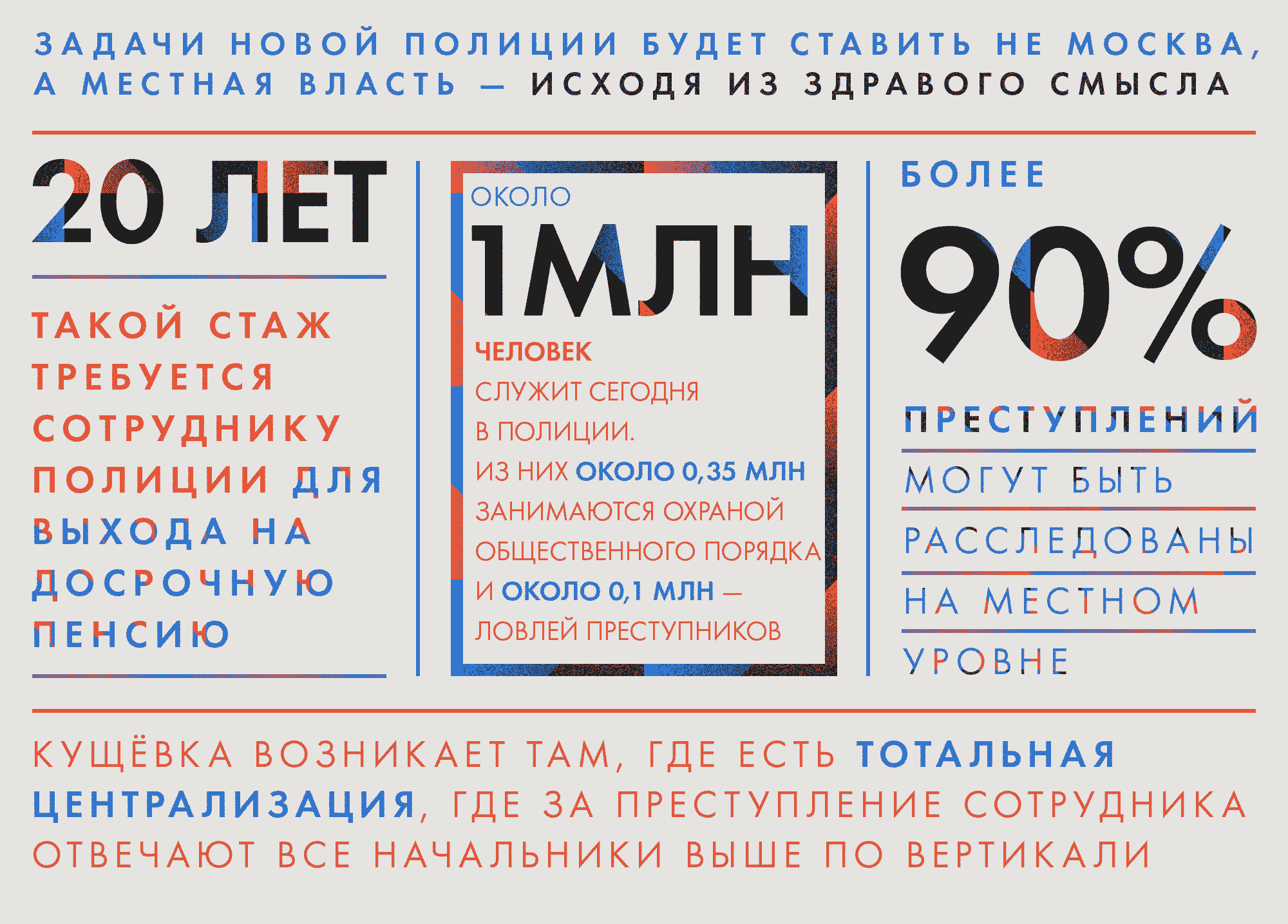
The root of most of these problems is in excessive centralization. The entire Russian police - and this is about a million employees - is managed from a single center. The Russian Minister of the Interior is subordinate to about a hundred regional departments (including transport management). Even just remember the main superiors of everyone is an unrealistic task. There can be no question of any individual approach. Instead, there is a grandiose reporting system, which is the same for everyone - from Kaliningrad to Vladivostok. And the police work for these formal indicators, which she calls “sticks” .
In Russia, there is only one structure of a comparable scale and a comparable degree of centralization - this is an army. But the army exists to destroy the enemy, and the police - to help living people. This for them, for people, she catches criminals, ensures order on the streets, etc.
And the needs of people are different. Here is the factory village where the main street is littered with drunk. Here is the area where the entrances are dotted with syringes. But the city where the main trouble is theft in stores, so even in the afternoon they trade through the grill during the day.
If the police obeyed the local authorities, the main forces would be thrown in each case on their own - to patrol streets, to search for drug dealers, to catch thieves. But today this is impossible - then the police will not collect the right number of universal all -Russian “sticks”.
Therefore, the main thing to do is to select the police from the Minister of the Interior. Regional and/or local authorities must manage the police.
The struggle against crime will definitely not hurt
If in such a huge country as Russia to melt the police in small -town apartments, criminals will immediately use this - this is the most common argument against decentralization.
First of all, let's recall that it would not be a good part of the police at all. About 350 thousand employees are patrol, precinct, etc. They protect public order. The federal leadership is not necessary in principle. Her leadership should be at the local, municipal level.
Crime is also not so simple. If you look at the structure of crime, then in more than 90% of cases there is no federal coordination there either. The maximum is regional, and then rarely. We have mainly marginal, domestic crime. It can usually be controlled at the district level.
Of course, no one is going to liquidate the federal police - it just should become very compact and intervene where it is really necessary. That is, to investigate the remaining less than 10% of crimes - the most serious and complex, as well as those where criminals act on the interregional level.
 The excellent police of the future will be able to spend much more time on meaningful work : Roman Pimenov/Interpress/PhotoxPress
There is still a common objection: as soon as we give the police to the governor or mayor, we immediately get Kushchevka. They will all conspire there, corrupt each other and will rule together. But Kushchevka arises just where there is total centralization, where all the bosses are responsible for the crime of the employee above vertically. And it is not profitable for anyone to take out the CRU from the hut. And the division of the police into levels creates competition. The victim of the municipalities - from the district police officer, which helps his wife to open the store - can always complain to the regionals or federals, and thereby there is no point in covering competitors.
Reform is needed a year and a half
Decentralization can be carried out quickly enough - about a year to prepare - a change in legislation, drawing up a plan, etc., and six months to the reform itself.
Preparation must be started with the budget. Regional and local authorities must receive money for the maintenance of the police. Now it is fully funded from the federal budget. That is, it is necessary to change the budget code.
It is unrealistic to combine such a reform with a large -scale personnel cleaning in our conditions: we are not Georgia, which could afford to live in virtually without police in general. Therefore, it will be necessary to transmit units entirely.
One fine day, the deputy chief of the public order, who leads the patrol, district police officers and inspectors for minors, leaves the subordination of the police chief and becomes his own boss who reports to the municipal authorities - for example, to the mayor.
Then the gradual restructuring of the work begins. Just as it was when the Investigative Committee was withdrawn from the prosecutor's office. At first, almost nothing changed, the investigation of especially serious crimes was led by the de facto prosecutor, and all the investigators went to him, and not to their new boss-the recent deputy prosecutor. As a rule, the prosecutor and his former deputy preserved a wonderful relationship. But gradually the head of the investigation transformed his formal independence into real - and now we already see the wars of the Investigative Committee and the Prosecutor General.
With our reform will be the same. After three to five years, we will receive a fundamentally new police.
New beautiful police
The new police will have more time to do their own business - the protection of public order.
They will not put pressure on the district police officer on top, forcing to fill out a crazy number of papers, which often have no relation to his work at all. For example, district police officers make up anti -terrorism passports of objects. This is a gigantic load, these are several working days of the year and it is absolutely pointless, because the passports later lie in a dead cargo in the main department of the Ministry of Internal Affairs in the region.
The district police officers will not put stronger operational services on the side. Here is a fresh example. We have a scanty share of relapse among conditionally convicted and among those released at UDO. And how the term ends-this share increases sharply: a person immediately either steals something, or beats his wife. What is the matter? And just this indicator is reporting for operational services. And they do not allow the district police officer to investigate such things so as not to spoil their reports.
The tasks of the new police will set the local authorities - based on common sense. Accordingly, the police in one place will be involved primarily drunk, in the other - drugs, in the third - with scorching roads, etc.
This will bring us closer to the American model of a universal policeman, which, depending on the situation, can go to the patrol, can do work with the population, or can investigate a simple crime.
The police work will also be evaluated, based on common sense - whether there were fewer drunk on the street, there are fewer syringes in the entrances, whether teenagers stopped shaking on the street for money. No special knowledge is required here.
If it is better not, the head of the police is time to change. Who does this and how - the mayor, the local representative of the representative power, they are together - will be spelled out in regional legislation. Moreover, in different regions, the procedure can be different.
Idiocy will no longer become
Local authorities, of course, will plant local traditions with the help of the police. The federal legislation will not allow the police to monitor the length of the skirts and depth of the neckline. But some dead articles of the Code of Administrative Offenses may well earn. For example, somewhere they can decide that in public places it really cannot be drunk. And somewhere-that you really can’t smoke. It will not be possible to go with beer and cigarette from the supermarket to the house anymore. Well, it's okay.
But people will be better protected from today's idiocy of federal campaigns. When throughout the country they suddenly begin to catch teenagers for being on the street at a later time (in St. Petersburg, such a campaign recently coincided with the walk of school graduates - it is good that the local authorities had the mind to close their eyes). Or check the operation of the electronic system of alcoholic products of the EGAIS in deaf villages, where there is not even mobile Internet.
It will be easier for the victims from such campaigns to appeal to the police if she obeys the mayor, and not the Minister of the Interior.
Who will do all this
It is clear that the Ministry of Internal Affairs will not reform itself. The point is not only that rarely someone will voluntarily cut off money and powers. The fact is that, with rare exceptions, no executive body in Russia today has resources for conducting any reforms at all.
Our ministries are not engaged in the development of politics, but direct management. The Ministry of Education and Science manages educational institutions, the Ministry of Health - medical institutions, etc.
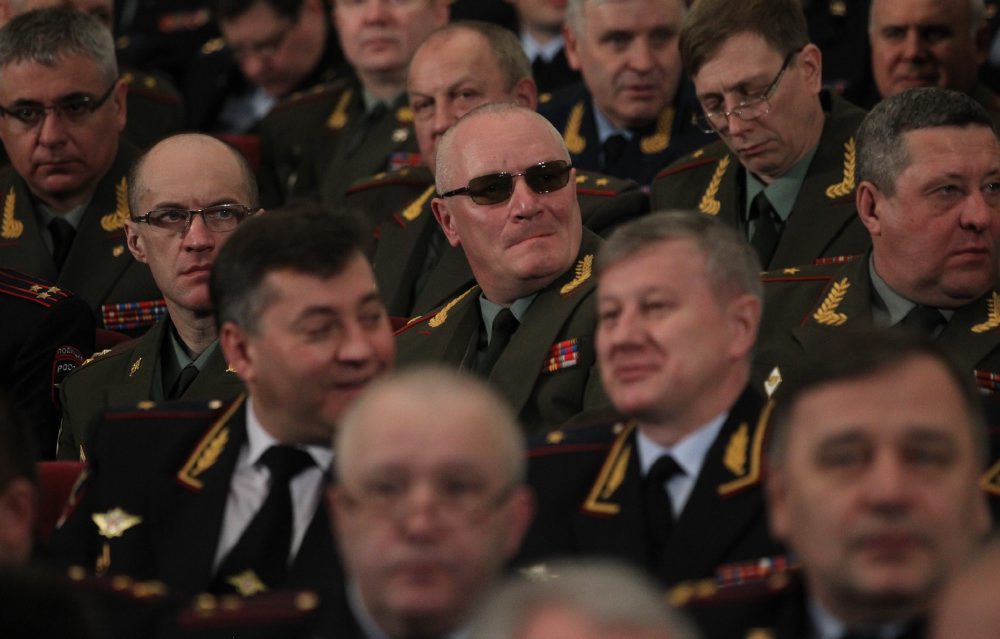 The Ministry of the Interior needs to care for (in the photo - the expanded college of the Ministry of Internal Affairs) Photo: Photoxpress
The presidential administration, by and large, is engaged in routine personnel decisions. We will calculate how many people the president appoints us - only enormous efforts are needed to maintain this process in a living state.
The participation of the state in all areas of life of the country is so great that no one has time left or effort to reform.
For the reform of the Ministry of Internal Affairs, you need a separate project office. The temporary body, which will be created by the joint administrative act of the President and the Government.
This office should be equipped with brave people, because, as far as I know, no one has yet done such a reform. In Europe, the police were originally formed as decentralized. There was a vertical in the USSR, but it existed along with the horizontal: the police were subordinate to the local authorities (the Executive Committee of the Council of People's Deputies) and the local party bodies (Raikkom, the List of the CPSU). A similar system is now in China.
The only analogue of today's Ministry of Internal Affairs that comes to mind is the unification of police forces under the auspices of the RSHA - the Main Directorate of Imperial Security in Hitler Germany. But even there, the allies carried out the reform in 1945.
The author is a sociologist, a leading researcher at the Institute of Law Problems at the European University in St. Petersburg
Other articles of the heading "Such Russia"
Do you want us to send the best texts of “such cases” to you by e -mail? Subscribe to our weekly newsletter!