
Translated material
Three myths about Jonathan Swift
Not an Irishman, not a misanthrope, not a madman
This year marks the 350th anniversary of Jonathan Swift. In the mass consciousness in the name of the creator of “Gulliver” there are many labels, often having little to do with reality. Let's try to deal with the most famous of the myths surrounding the figure of Swift."Irish writer"
Undoubtedly, if Swift was alive, he would have angry with the modern tradition to classify him with the Irish: on the Internet, dozens of sites certify him as an “Irish writer”. Although Swift was really born in Ireland and lived there for a long time, he was a purebred ethnic Englishman from the family who settled in Ireland recently: both of his grandfathers were born and raised in England. In addition, Swift was a priest of the Church of the Anglican Church (the so -called Irish Church was Anglican, although it was officially listed as a department of the State Church of England only from 1801 to 1871). There is no need to add to this that he wrote exclusively in English.
He acquired the reputation of the Patriot of Ireland during his lifetime-not because of Gulliver's travels, but because of his journalism in defense of the rights of the indigenous Irish. The English colonization of Ireland was accompanied by unprecedented economic pressure, which led to the impoverishment of the population - up to hunger. Outraged by the English policy towards Ireland, Swift wrote a number of pamphlets, the most famous of which is the series of “Cloth letters” and the independent text “A modest proposal, which is not to allow the children of the poor in Ireland to be a burden to their parents or their homeland, and, on the contrary, make them useful for society.” In the latter, it was sarcastically invited by the British to let Irish children into meat.
Swift pamphlets caused a large public resonance and sometimes influenced the policy of the British authorities: so, after the “letters of the cloth”, a patent issued to a private person was withdrawn to minting a copper coin in Ireland, although Isaac Newton himself gave an expert conclusion that the patent does not threaten devaluation. These events made Swift an icon for the Irish. He was met with posters, and on November 30, 1727, they arranged a solemn celebration on the occasion of his birthday. But soon the unexpected glory began to weigh the writer, and later he will respond to the Irish with irritation. Become someone's national symbol-in his eyes it was the height of vulgarity.
"Misanthropus and Pessimist"
No less firmly stuck to the Swift, the label of the “Misanthropus” and “Pessimist” stuck. Such an image of the writer is read from the last part of “Gulliver’s travels”, with its famous contrast of talking higangnms, whose society is based on the mind and order, and disgusting human-like Yehu, exclusively moved by animal instincts. The fact that Gulliver, even expelled by the guigangms, continues to be ashamed of his human nature and prefers horses to people is perceived almost as a direct manifestation of the author’s views.
The famous translator A. S. Livergant in the preface to the collection of Swift's letters calls them the author “a convinced person”, quoting Swift’s letter to the poet Alexander POUP on September 29, 1725: “The greatest hatred and disgust I nourish to the essence of“ man ”. That's just the quote is slyly torn from context.
In fact, Swift, how everyone who reads further can be convinced, is written here: “I have always been alive with all the nations, professions and communities, which did not prevent me from loving individual people <in the original:“ All my love is addressed to individuals ” - M.E.>. For example, I can’t stand the tribe of lawyers to the spirit, but I love such and such a lawyer, a judge of such and such; The same - with doctors (I will keep silent about my profession), military, English, Scots, French and all the others. Most of all, I am hated by a variety called “man”, but I have the warmest feelings for John, Peter, Thomas, etc. <...> on this strong foundation of the misanthropy (having nothing to do with Timon’s misanthropy) and the whole building of my “travels” is built, and I will calm down only when all honest people agree with me ”(Per. A. Livergante).
As we can see, the image of Swift-Home-to-Hoether imposed on a popular culture was influenced by a professional philologist and translator, who also retired the text of the letter in the sense that, they say, Swift hated humanity, but for individual people, so be an exception. But Swift is not talking about that. His idea is transparent: you need to love not national or class communities (“imaginary communities” in the terminology of our time), but a specific person. "Man in general" is all the more abstraction. Only John, Peter, Thomas are real. The mention of the protagonist of the Shakespearean play “Timon Athenian” is not accidental. In Shakespeare, virtuous Timon selflessly helps friends and acquaintances who shamelessly use his generosity and bring him to ruin. Having lost wealth, Timon is disappointed in people and curses them. The treasure found later, he spends on revenge to the city. Pretty unsympathetic motives of behavior, in general. Emphasizing that he is not Timon, Swift thereby indicates that his “misanthropy” is not based on personal grievances.
And is it possible to accept literally a declaration of “misanthropy” by the person who at this time wrote “letters of the cloth”, risking to be arrested? However, Swift’s human rights activities are now also fashionable to debunk: they say that his ordinary Irish did not worry, he stood up for the English Genti. But what about the piercing “modest proposal” written during the famine in Ireland, which clearly says about the poor and laborers?
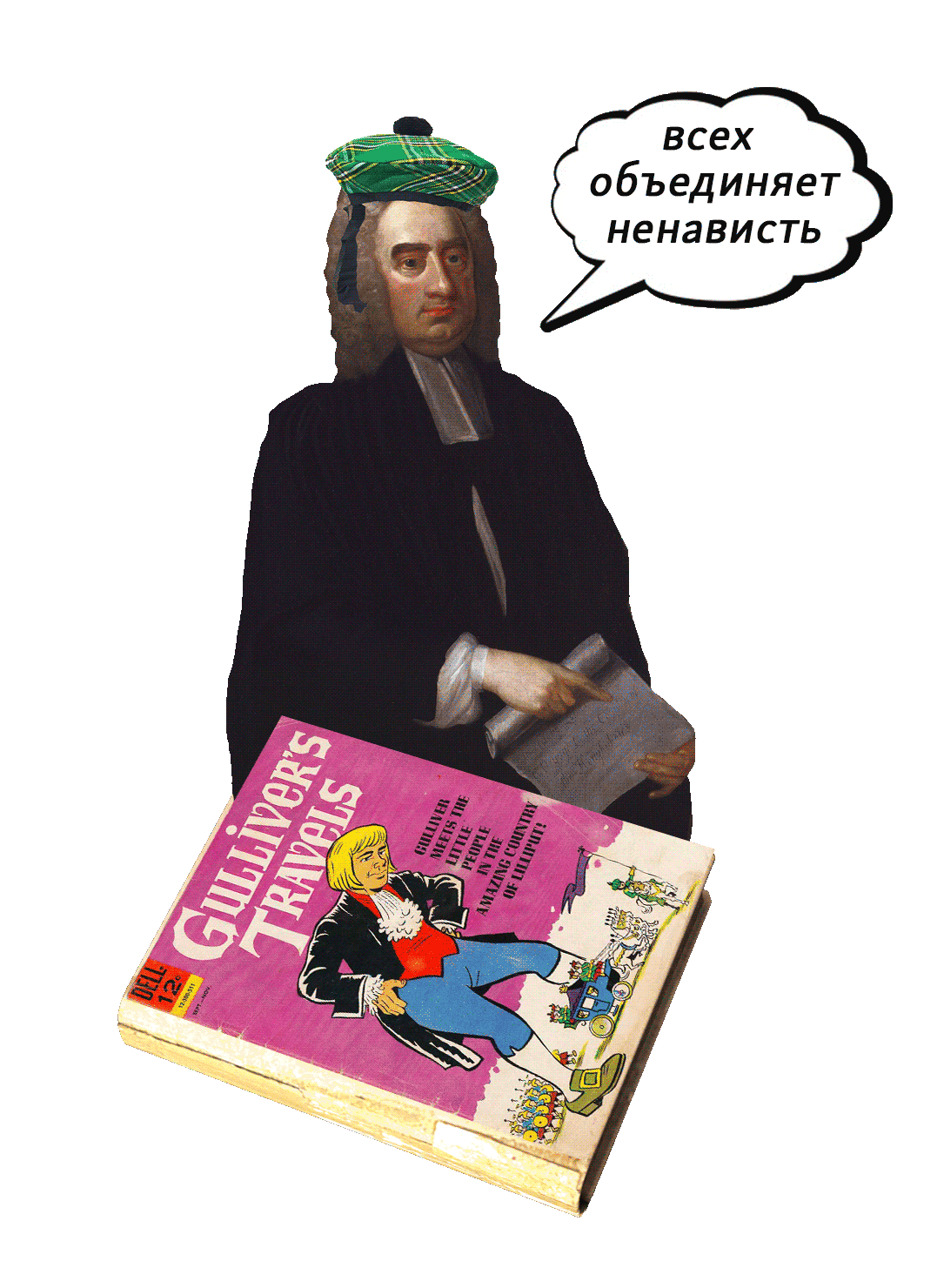
It seems that readers and even critics seriously confuse the author of “Gulliver’s travels” with his hero, and really hated humanity at the end of the 4th book. But Gulliver is a fictional character. His name reminds of the words Gull, Gullible “Obrafil” (in one of the plays of the Shakespearean era, a simpleton named Gullio appears). The episode, where he tries to praise English society without a shadow of irony and unintentionally turns Panegyry into anti -advertising, makes him doubt very much in the fact that Gulliver expresses the author’s position.
During the cross -reading of the “modest proposal” and the last part of the “Gulliver”, strange rapprochement arises. The rational guigangings are calmly discussing the plan for the complete destruction of Yehu - just as a spotlight, on behalf of which is written a “modest proposal”, rationally discusses the advantages of cannibalism as a method of combating poverty. Of course, herbivore horses do not eat yehu, but belts from their skin are made. And in a “modest proposal” the idea is made to make gloves from the leather of Irish children. Nowadays, Swift is made, frankly, from the prophecy of Swift.
No, it does not look like Swift to consider the ideal to be deprived of the emotions of talking horses. In the end, he was a Christian priest. Forty -year -old is far from the age of youthful idealism - Swift in the essay “Reasoning about various objects” wrote: “Our religion takes exactly to force us to hate, but not to make us love each other.”
Twenty years after these words, Gulliver will be released. What does his finale mean? That Swift for old age changed his attitude towards a person? Or maybe Gulliver has failed an exam for a Christian? After all, the basis of Christian teachings is that a person is not loved by rationality, beauty and a healthy lifestyle: a sinful creature (from late medieval preachers of human nature, it got worse than from guigangns). But, as they say, we do not have other people for you. "Gulliver" turned into a book about the impossibility of love, but do not project the hero on the author. This is a sign of an infantile approach to literature.
Note that it is not generally necessary for English literature about love for humanity and other good feelings, except in specially allotted places - holy stories. This bashfulness is inherent even to Stern, which the sensitivity is densely seasoned with irony and a carnival grotesque. Swift “just the most vivid founder of this language of bashfulness and denial of pathos, which created a unique English way to speak on sore topics.
"Madman"
There is a sustainable idea that Swift graduated from his days to mentally ill. In fact, there are no documentary evidence of this. It is only known that in the last years of his life, Swift was seriously ill and needed guardians who stopped letting fans to him, referring to the unsteady mind of his mind and memory. What is not surprising: the writer was far over seventy, and a stroke at this age was a common thing today.
The myth of the insanity of Swift is mainly a literature product of the XX century. Back in 1911, the British Encyclopedia confidently spoke of a stroke and senile dementia. The spread of the myth, presumably, owes the “history of civilization” by Will Durant, an American historian and philosopher, who colorfully described the violent swift - he was supposedly held by five orderlies. Subsequently, his own novel was used as the “evidence” of the writer's insanity - obviously inadequate, from an ordinary point of view, Gulliver’s behavior in the finale, where he is hiding from people and prefers to communicate with horses. What to do, during the time of Durant, a biographical approach to literature was in fashion. Since then, Nabokov laughed at biographism many times, and only the lazy did not joke on the topic “Was Leo Tolstoy Horse” (here is the unexpected echo of the topic of the Guagngnms!). But what left the “serious” literary criticism, went down to mass culture and still affects reading the swift.