
Translated material
Oxygen.life: "Baikal under a microscope"
The results of the “Baikal expedition” in 2017: in the waters of the lake, an excess of the marginal concentration of biogenes and toxic metals was found. Along with the euttrification, this situation is no less dangerous for Lake Baikal. Scientists - for creating a distributed monitoring system of the largest freshwater lake of the planet, in which the active role is assigned to public organizations.
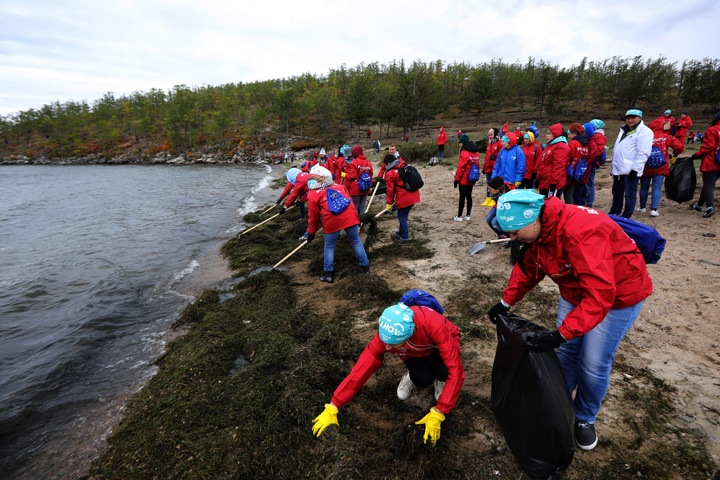
For two days, on November 27 and 28, activists of the Baikal Expedition’s socio -scientific initiative worked in Irkutsk - they summed up 412 mass actions and scientific work conducted throughout the year with the support of two companies, Siberian Health and En+ Group. The project that began in 2012, which took on the work of examining the coast in 2012 and bring over the location of algae on the map, in 2017, the Baikal Expedition has already covered a record 3 thousand people involved in experiments with spirogyra and four hundred other projects.
The “Baikal expedition” as the EN+ Group project, the ICF “Renaissance of the Siberian Land” and the World around you Foundation Siberian Health Corporation, now supports more than 20 organizations from Irkutsk, Moscow, Novosibirsk, Ulan-Ude, Baikal settlements (North Baikalsk, Ust-Barguzin, Turkish, Khuzhir, Baikalsk, Baikalsk, Baikalsk, Baikalsk, Baikalsk, Baikalsk, Baikalsk, Baikalska, Baikalsk Mica, large Golousy). All this suggests that the “Baikal expedition” solves its main problem: to involve local residents in the study of the lake and assess its condition. The experience of Western Europe suggests that even children can be taught to take samples for the content of chemicals and even more so - for the content of microplasty (that is, decomposed plastic bottles, networks, bags, and so on).
“The Baikal Expedition project has become a significant part of the EN+ complex program to protect Lake Baikal. The main value of the project is that people living directly on the shores of the lake learn how to behave, how to be useful to the lake and how to use everything around, in the economy and even business. A new type of thinking and a person’s relationship to nature is formed: not a consumer, but an active participant in what is happening, ”says Elena Vishnyakova, director of public relationships about ideology. “For us, the Baikal Expedition project is an opportunity to attract partners of our company in 25 countries of the world to the problem of preserving the purity of Baikal waters. The ability to combine the efforts of the scientific community and the socially active public. The ability to use the obtained scientific results to realize the situation in Lake Baikal. People have been using the lake for hundreds of years, the time has come to repay the debt, ”adds Larisa Buyantuev, the head of charity projects of the World around you fund, Siberian Health Corporation.
The main achievement of the “Baikal expedition” is launched several long -term and accessible projects for each resident. The main problem identified during the session in Irkutsk is that the number of people who want to take part in these projects is much more than the project coordinators can cover with their attention and support. Already in the near future, the expedition will or turn into the headquarters receiving anxiety from all over the lake. Or start the publication of its own media, which will take on the functions of a "collective organizer and propagandist." “The situation in Baikal requires an integrated approach to both study and comprehension. Today, a lot of attention is paid to the problems of the lake, but all this looks like a “broken mirror” - separate fragments. Our goal is to get a holistic picture. It is impossible to do it right now by the forces of one organization and one project, therefore we advocate uniting efforts - ecologists, local residents, scientific institutions, schools and interested citizens, ”said Elena Vyrodova, President of the MBF“ Renaissance of the Siberian Land ”.
"Copper and zinc are better to overstate than to underestimate"
A serious part of the “Baikal expedition” is scientific research: this year they were conducted by a group of employees of the Department of Hydobiology of the Faculty of Biological Faculty of Moscow State University named after M.V. Lomonosov, specialists of the Main Control Center for Drinking Water of Moscow and the Moscow Physics and Technical Institute. In June-July of this year, scientists passed along the Listvyanka-Tanjo-Babushkin-Turguzin-Olkhon route route, and the coastal zone from the quadrocopter was carried out along the entire movement route, which showed places of expulsion of algae. Scientists took water samples, which later in laboratory conditions checked for silicates, phosphates, mercury, lead, pH (acidity), alpha and beta-active. Separate water samples were collected for expanded analysis for toxic substances. For the first time in Baikal, a study for microplastics was organized. “We made 300 measurements with plankton networks with a cell size of 300 by 300 microns. We had three networks, made three repetitions at each measurement. There were samples from the surface of the water (depth 15 cm) and a control sample from a depth of 60 meters. On the shore they took soil samples for microplastics - 200 field measurements at 33 stations along the coast, ”said Mikhail Kolobov, an employee of the Department of Hydrochemistry of the Hydrochemistry of the Faculty of Hydrochemistry, on November 28.
The study conducted in 2016 was superficial (“not an expedition of scientists, but a journey of naturalists”), but it also showed that the biggest problems with the growth of algae are observed in the area of Severobaikalsk. And they are directly related to human activities. The results of hydrochemical tests made by the participants of the Baikal Expedition in 2017 allowed to see that the concentration of biogenes, toxic metals, for example, copper, zinc and lead, was increased in the lake water. In some places, it is two to three or more times higher than the maximum permissible concentrations (MPCs) established for water-economic water and economic purposes. Along with the problem of lake eutrophication, this situation is no less dangerous for the Baikal ecosystem.
Participants in the scientific expedition discovered dozens of abandoned networks 200-300 meters long in some areas. The fishermen themselves admitted that the Chinese network costs only 700 rubles, and in such an abandoned network, fish and seals can die, algae grow on it and in general the networks become almost the main garbage on the lake. Microplastics was collected and studied by the simplest filter-data is not enough for any generalizations, because plastic is collected where the wind blows and the currents are carried. And the results vary from zero to 5-6 particles per liter. This can be compared with the data of Lake Michigan (which is considered anthropogenic-loaded). The study of plastic for the construction of living organisms confirmed all expectations: plastic became a home for organisms that usually lived at the bottom, that is, these organisms became traveling, mastered a new ecological niche. As a result, Lake biomass begins to grow. Plastic is included in the food chain - and this is a serious reason to study it and try to evaluate the consequences.
Silicates samples (MPC hereinafter for fisheries of 1 mg/l, for Baikal norm 2.6 mg/l) gave a slight excess of norms - in the embassy 3.4 mg/l, in the selengy delta - 5.8 mg/l, in Turk - 0.86 mg/l. According to Mikhail Kolobov, this indicates some works going on the banks of rivers and accompanied by erosion of the soil. Of particular importance for biologists is analysis for copper content: this metal blocks breathing in zooplankton, while it does not have the lower concentration limit - that is, it affects any content in water. Formal MPC is taken 0.0001 mg/l, for Baikal the average value is set at 0.00002 mg/l. The 2017 expedition discovered a dozens and hundreds of times: Listvyanka - 0.004, Slyudyanka - 0.004, Huzhir - 0.003. According to Mikhail Kolobov, such a content of copper cannot be explained by an anthropogenic factor-for this, the inhabitants of the hujir, for example, would have to pour some solutions of hundreds of liters. So, we are talking about so far about the unrelated natural monster.
The situation with zinc content (MPC 0.01 mg/l) is not so complicated: two excesses were found near the village. Tanha and in the Elenga delta - 0.017 mg/l. With special attention, scientists checked samples for iron: in small concentrations, it contributes to the growth of algae, with high ones it becomes a toxicant and leads to their death. For iron, MPC is 0.1 mg/l, the norm for Lake Baikal is 0.03 mg/l, the real situation indicates the excess of all norms ten times, for example, in the area of the village. Turk - 0.38 mg/l. “Probably, the source of zinc, iron and lead are places for the development of polymetallic ores, but in 2017 there was no excess of lead at all,” said Mikhail Kolobov. - Another thing is research on ammonium. This is the product of the decomposition of proteins, its presence in the water says that somewhere something recently died and decomposes, and the ecosystem manages to process this product. A striking example identified in 2017 is the Ust-Barguzin district. The maximum permissible concentrations are not exceeded simply because in Baikal it simply should not be, there are no bacteria in the lake that can digest it and that is why ammonium is for scientists a marker indicating some kind of anomaly. ”
Scientists measured alpha and beta-active (measured in Beckerels, BC/L), which was used as a marker of transfer of substances washed off from land into water. On average, the level of activity is 0.1 BK/L, which is ten times lower than the norm, but even its insignificant increase in water samples, according to Mikhail Kolobov, indicate the Selenga River, as the main source of the intake of pollution in the lake. It is not surprising that the amount of algae in recent years has been growing in Lake Baikal, because this process is generated by eutrification - that is, by saturation of water with those substances that are nutritious for algae. “Spirogira like sparrows, cockroaches and a person quickly reacts to changing conditions, she lives and propagates violently in those places where others are uncomfortable. We took algae samples, a geneticist worked with us, who is now studying these tests. The process is not fast, I will return to Moscow, and we will continue this work, but so far we plan to do genetics after the New Year, before the New Year - the analysis of satellite pictures, ”explained Mikhail Kolobov.
Preliminary results voiced by Kolobov and his colleagues do not allow you to give any interpretations and recommendations. In the future, scientists will develop a system of distributed Baikal monitoring, which will be used to promptly assess its condition, including to monitor the spread of overgrown algae - spirogira and Elodea. The “Baikal expedition” proposes to use for this monitoring a combination of a wide variety of methods, including work at several levels: field studies of water, soil and aquatic organisms, shooting and analysis of images from drones, analysis of multi -instrumentation of ultra -high resolution. Previously, such studies in Lake Baikal were simply not conducted.
Synergy of the methods will allow more quickly and accurately evaluate the current state of the lake ecosystem, to identify in which places there is pollution and determine the possible causes of “flowering” of water caused by both natural and anthropogenic factors. At the same time, not only scientists, but also local residents of coastal territories will be involved in monitoring, who will help to photograph and control the state of the coast with the established frequency. Schoolchildren have already joined the research - in the village. Ust - Barguzin, under the guidance of scientists, the eighth grader began the first stage of the study on the topic "Factors affecting the spread of spirogira in the Barguin Gulf."
Not only science
In addition to scientific research, together with the Union of Crowerity and the Baikal Interactive Ecological Center, a new educational technology has been developed-the children's multi-theater “Tales of ARYUNA”, the result of which was the children's tale “The right word” created by children. Together with the workshops around Lake Baikal, the factory-laboratory of creating new design materials earned, the idea of which is to make garbage with a resource for designer products, for example, to use glass bottles a second time, sending them to a battlefield and receiving glass pellets for aquariums, mosaics, phytodesign and aquarium-unique and affordable material for the design local Baikal hotels and camp sites.
In the village of Turk, the Baikal district of the Republic of Buryatia, an experiment was conducted to grow potatoes using algae - including spirogira, which was added to each hole during landing. After it became known that the algae are non -toxic, in two sections - an experimental and control - an area of 18 square meters. Each meters, potatoes were planted. There were practically no favorable factors for growth: earlier these lands were not used under agriculture, sandy, poor and not saturated with organicism, grass was almost not growing, watering was not produced, the summer of 2017 turned out to be arid. 11 kg of potatoes were assembled from the plot with the spirogira, 7 kg from the control. Algae helped retain moisture in the soil. According to local residents, manure and humus for this territory are an expensive resource, and spirogirs on the shore are sufficient, moreover, it is free. The plans include experiments on the cultivation of other crops, as well as monitoring the dynamics of the influence of spirogira on the enrichment of soil organic substances - for next year the spirogira will turn into a biohumus.
Every year, different people come to the expedition - researchers, artists, local residents, who unite one - an indifferent attitude towards Baikal. “Our expedition differs in that it unites all people around the concern for Lake Baikal. Baikal’s life is our life. Here we live, our children, grandchildren. We do not divide people into those who know more about Lake Baikal, and who are smaller, who is an expert and who are not. The idea of our expedition is that together we can take care of the lake, unite our resources. In the Baikal Expedition project, we are constantly looking into the future. If we do not solve environmental issues today, then we send them a “package” to the future of our children. I do not want to accumulate these "packages". Also, thanks to the involvement of children in the project that most acutely feel what is happening with the outside world, we look at what is happening with a new look and more accurately realize the situation. The main thing in the expedition is partnerships, and the children are also our partners, ”says Marina Rikhova, the head of the Baikal Expedition, the head of the public science project.
In our plans for 2018, says Maria Gracheva, head of the EN+ Group, sustainable development project, building an effective interaction between the expedition participants with other company projects: a “new generation school”, “School of Ecological Entrepreneurship”, and the All -Russian Ecomapone “360 minutes”. “We expect that such a synergistic effect will make new discoveries and seriously advanced in studying and helping your beloved lake.”