
Translated material
Russia will be able to challenge in court the decision of the IOC to prevent the Winter Olympics - 2018
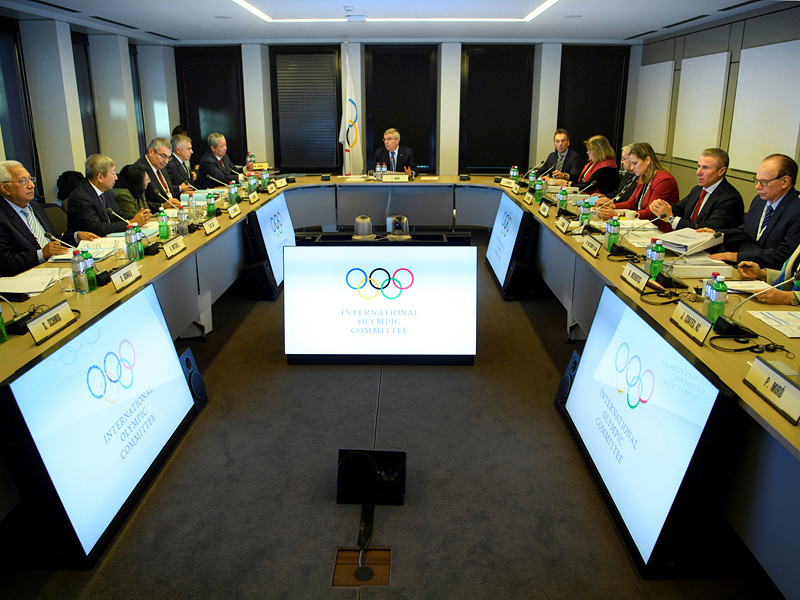
On Tuesday, December 5, in the Swiss Lausanne, the Executive Committee of the International Olympic Committee (IOC) delivered that the Russian team would not go to the Olympic Games in February 2018 in South Korean Pyeongchang. A meeting of the executive committee, which includes 14 people (President Thomas Bach, four vice presidents and nine members of the IOC), decided that Russian athletes would be able to compete at the 2018 Games only under a neutral flag.
Now Russia can challenge the IOC verdict in the sports arbitration court (CAS) in Lausanne.
The IOC requirement, that Russian athletes speak in Pyeongchang under a neutral flag, Russia may be considered unacceptable and generally refuse to participate in the Olympics, announcing it a boycott . In addition, in case of athletes to the games under a neutral flag, the issue of the participation of Russians in team competitions will arise. It is not known who, in this case, will be represented by hockey players, Kerling teams, bobsleists, skaters in a team tournament, skiers, biathletes, short-refreshors and other athletes in relay races. Probably, in these sports and disciplines, Russian athletes simply will not take part. And this contradicts the desire of the IOC to use the principle of collective responsibility and to deprive the "pure" athletes of the opportunity to speak at games.
The meeting of the executive committee was held closed. It was heard by expert reports, a report of the World Anti -Doping Agency, statements by representatives of the Russian delegation. Journalists were not even allowed into the staff of the IOC headquarters.
The IOC Commission under the leadership of Samuel Schmida the day before completed an investigation in the case of state support for doping in Russian sports. And on December 4, her final report was transferred to the IOC. In addition to the investigation on the existence of a doping system in the Russian Federation, the Schmida commission also engaged in the establishment of specific persons, institutions and organizations involved in this system.
Another commission - under the leadership of the Swiss lawyer, a member of the Executive Committee of the IOC Denis Oswald - double -check the doping tests of Russian athletes from the 2014 Olympic Games in Sochi. The results of her work were the recognition of more than two dozen Olympians of the Russian Federation guilty of violating the anti -doping rules at the home Olympiad and the deprivation of Russia in the team in the competition.
Based on the conclusions of these two commissions, the IOC today decided on Russia.
The fact that the verdict of the Olympic Committee would be negative for Russia, on the eve of the ejes, the publication of Inside the Games reported, noting that if the Russian team is allowed to play at the games, then only in a truncated composition and under a neutral flag. It was assumed that Russia would be proposed by a model already used by the International Association of Athletics Federations (IAAF) for the admission of Russian athletes for the 2017 World Cup in London. Then athletes submitted individual applications in which they should have proved that they personally did not violate the anti -doping rules. In addition, international federations will decide which athletes to allow before the competition.
As for the performance of Russian athletes under a neutral flag, the IOC even turned to the company Nike in advance with a request to create a special “neutral” form for athletes from the Russian Federation. In Russia, it has repeatedly stated that the performance under a neutral flag is categorically unacceptable. Now the IOC verdict will discuss on December 12 Olympic Assembly of the Russian Olympic Committee, TASS reports.
Until the decision of the IOC, the Kremlin stubbornly remained silent and refused to discuss the verdict options. “Some kind of endoent reasoning is probably now the destiny of political scientists, the destiny of different analysts. We prefer to keep silence now before the IOC announces a decision, and most importantly, before we receive some written information, official information from the IOC in this regard,” explained Dmitry Peskov, spokesman for Russian President Dmitry. “We intend to protect the interests of our athletes, protect the interests of the Russian Federation, maintain commitment to the ideals of Olympism and maintain all the contacts with the IOC and to resolve all the problems that arise through these contacts,” the Kremlin spokesman added.
Deputy Chairman of the State Duma for Physical Culture, Sports, Tourism and Youth Affairs Valery Gazzaev is convinced that Russian athletes "should not submit statements and prove that they are clean, this is the obligation of specialized ministries to protect our athletes." "As for the neutral flag, this is humiliation for our large country to act as if we are without a clan and a tribe. Russia, sorry, is not a banana republic, it is a powerful sports power that gave the world a lot of talents and records. We must prove its innocence in the legal field, sue all instances. The principle of the Olympic movement, the Olympic Charter, that any form of discrimination is neither. National, even more political - should not be applied in any case, ”Gazzaev told RT channel.
The President of the Russian Bobsleya Federation, the Olympic champion, the banner of the Russian team at the Games in Sochi, Alexander Zubkov, said that he simply could not understand "how to go under a neutral flag if my country has a flag and a anthem." “As an athlete, I would only go exclusively under my flag,” he said.
Denis Tikhomirov, the Russian national team coach, believes that "there will still be a fair decision." But, in his opinion, the boycott of the Olympics is not a way out. "We still need to find an opportunity for the guys to give a chance. From the perspective of deputies, of course, it is easy to speak, but first of all we need to talk with those who gave this a lot of time, sweat, blood, it is at this four-year, this is nervous training. They already need to erect a monument for the fact that they trained, without any rumors, they continued to prepare, not omitted, no matter what kind of flag, they are still our Russian Russian Athletes, ”Tikhomirov said in an interview with Business FM .
The Soviet hockey player, two -time Olympic champion Evgeny Zimin believes that the national team should have a flag. "As for hockey, it is impossible to even compare it with something, this is insanity. How can the national team be known, with an unknown flag, anthem? Won - and the team in unknown sports form on the podium, first place. In my opinion, the sport should be outside the policy," the hockey player said.
The 2016 Olympic champion in modern pentathlon Alexander Lesun noted that he would not agree to perform at the Olympic Games under a neutral flag. However, he added that he could understand athletes who will be forced to go for it. “Personally, I would not go to the Olympics under a neutral flag, ” R -Sport quotes his words. “I want to represent my country, see my flag and hear my anthem. But I had world champion titles. And I perfectly understand people who have only one chance to go to the Olympic Games. This is the choice of each athlete.”
The Deputy Prime Minister of Russia, the former Minister of Sports Vitaly Mutko, said that "all decisions were made by the Denis Oswald commission as a copy and they only fix the abstracts of Richard McLaren on the state support for doping in Russia and manipulations with samples." “The state is judged, and this, of course, is a unique situation. Although the UNESCO Committee admitted that we all corresponded to the organization’s convention, and the manipulations took place in the areas for which the IOC and the World Anti -Doping Agency are responsible,” the Deputy Prime Minister added.
In his opinion, the performance of Russian athletes under a neutral flag is unacceptable. “There should be our flag at the games, these are complex competitions, there are subtleties. But still, in the case of an individual invitation, each athlete will have to decide for himself. And this will be a difficult choice. The athletes later went to the Olympics,” Mutko said.