
Translated material
Built a redut
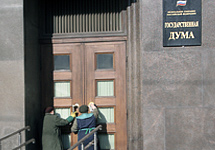
State Duma deputies voted for a ban on visiting the building of the lower house by journalists of the American media included in the list of "foreign agents". This is reported by Interfax.
"Protecting democratic values, deputies of the State Duma of the Federal Assembly of the Russian Federation reserve the right to take symmetrical measures in connection with the decision to deprive a number of Russian accreditation journalists under the US Congress," the Duma resolution says.
The ban affected Radio Liberty and the Voices of America. These media have accreditation in the Russian Foreign Ministry, and potentially their journalists had the right to go to the State Duma. The rest of the media, declared by "agents", does not have accreditation in the Foreign Ministry.
The day before, the Federation Council made a similar decision.
On Tuesday, the Ministry of Justice recognized the functions of a “foreign agent” the first nine media . "Foreign media that perform the functions of a foreign agent are recognized:" Voice of America ", Radio Free Europe/Radio Liberty (RSA/RS), TV channel" present time ", Tatar-Bashkir Radio Liberty Service (Azatliqradiosi), Siberia. Realii, Idel.reali, Factographer, Caucasus.realii, Caucasus, Caucasus.reali “Crimea. Realities,” the department said.
On November 15, amendments to the law on the media, which allows to equate foreign media with “foreign agents”, were adopted by the State Duma as the answer to the United States to measures regarding Russia Today and Sputnik - Russian propaganda media operating in this country. The document was adopted urgently - the day after entering the lower ward. On November 22, the law was approved by the Federation Council , and on November 25, Vladimir Putin signed .
On November 16, the Ministry of Justice was notified by the Voice of America, Radio Liberty and his projects about the possible inclusion of “foreign agents” in the list of the media.
On November 29, the representative of the US State Department Hiser Neurt said that the new Russian law poses another threat to free media in Russia . “The freedom of expression of opinions, including freedom of speech and the media, even those that can be inconvenient to the government, is one of the fundamental human rights that Russia has pledged to observe,” Neoert emphasized.