
Translated material
We will only understand the voice
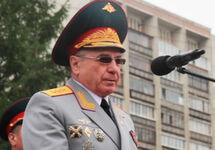
One of the key defendants in the case of the MH-17 flight of Malaysian Airlines in the east of Ukraine is the chief inspector of the Central Military District of Russia, retired colonel general Nikolai Tkachev. This is stated in the joint publication of The Insider and the Bellingcat investigative group.
The authors of the investigation drew attention to the negotiations of two alleged participants in the destruction of the aircraft published by the joint investigative group (JIT) in 2016. One of the interlocutors has a call sign "Dolphin" and seems to Nikolai Fedorovich, the other - "Orion", he is also called Andrei Ivanovich. According to the content of the negotiations, journalists came to the conclusion that "dolphin" is a senior military man who was not in the war zone at the time of the conversation.
The Crimean blogger Boris Rozhin claims that the Dolphin was a “vacationer -curator” from Russia in a general rank, ”who“ was engaged in the operational leadership of the militia detachments from Krasnodon (Luhansk region. - Ed.) ”. Former “DPR Defense Minister Igor Girkin also confirmed that he had met with Dolphin, a retired Russian general, at the headquarters in Krasnodon at the end of July 2014. According to Girkin, in Krasnodon "there were several retired generals and colonels," but "the commander did not receive any instructions, no specific help from them. JIT does not specify what kind of role "Dolphin" played in the confusion of the Malaysian Boeing.
Of the living Russian generals, information about which is in the public domain, only Tkachev has the same initials as the Dolphin.
The Insider journalists, under the pretext of an interview with the Suvorov School, recorded a fragment of Tkachev’s speech and then asked experts from the University of Colorado in Denver, the USA, and the Lithuanian Center for forensic examination to monitor the voice on this record and negotiations, published by JIT. The results of both examinations say that the voices on records with a fairly high probability belong to the same person.
According to information from open sources, on May 9, 2014, Tkachev was in Yekaterinburg at the parade, and on August 23, 2014 - in Chebarkul of the Chelyabinsk region, he met with the chieftain of the Orenburg Cossack army. The military leader himself claims that after 2012, "he has nowhere to go from Yekaterinburg" and was not in Ukraine in 2014.
Tkachev, a participant in both Chechen wars, served in different military districts. Before dismissal from military service, he was the commander of the military unit 20650 in Krasnodar. The general was fired from the army by Decree of the President of December 10, 2010. Its former part was disbanded on September 8, 2014, two months after the crash of the MH-17. From February 2011 to August 2012, Tkachev was the main Russian military adviser in Syria.
Boeing, flying from Amsterdam to Kuala Lumpur, was shot down on July 17, 2014. All 298 people who were on board were killed: 283 passengers, most of the Netherlands, and 15 crew members.
In September last year, the International Investigative Group submitted a second report on the crash of the liner . It was established, it was said in the document that the missile shot down the plane was released from the Buk anti-aircraft missile system, which was 6 kilometers from the city of Snezhnoye. "Buk" was delivered to Ukraine from Russia, and after the Boeing disaster was returned back.
The chief prosecutor of the Netherlands Fred Westerbeke pointed out that more than 100 persons can be involved in the death of Boeing-777. At the same time, he noted that it had not yet been established on whose order the crew of Buk acted.
In early June 2017, group B Ellingcat published the final evidence that Buk was assigned to the Russian 53rd anti-aircraft missile brigade deployed near Kursk (military unit No. 32406). The air defense system was delivered to the Ukrainian border on June 23-25, 2014. The Russian lieutenant, the sergeant and two ordinary people, was said in the report, crossed the border of Ukraine along with Bucus. Bellingcat also determined the circle of senior officers who could give the order and the commanders responsible for the operation.