
Translated material
Rutheniya from Mars
At the press conferences, the results of verification of the Mayak association was announced in Moscow on December 8, which at the end of November was conducted by an interdepartmental commission in connection with the autumn in Russia and many European countries in the atmosphere of the radioactive isotope of Ruthenenia. Representatives of the commission said that there were no traces of leakage of ruthenium-106 at the enterprise. As the main version of the emission source, the commission called the drop in the satellite, the fuel element of which used this radioactive isotope. Independent experts do not believe the conclusions of the commission and continue to insist that the leakage of ruthenia occurred at the Rosatom enterprise.
The increased content of ruthenium-106 in the atmosphere was recorded in Germany at the end of September. After the Magate became interested in German data, it turned out that the rate of ruthenium content in the air was exceeded over other European data. The Institute of Nuclear and Radiation Safety of France (IRSN) on the basis of a mathematical model suggested that the release of Ruthenenia-106 occurred in the territory of Russia, between the Volga and the Urals. Here is the “Mayak” - the enterprise of the nuclear industry, in particular, engaged in the processing of the worked out nuclear fuel (OIS). Representatives of the Rosatom State Corporation hastened to say that there were no radioactive emissions at the concern enterprises, and the radioactive background is normal. But in mid-October, Roshydromet published a report confirming the presence of the decay products of the ruthenes isotope in samples taken in the Southern Urals, in Tatarstan, Volgograd, Rostov-on-Don, and the highest level of pollution was recorded by Roshydromet in villages near the Mayak plant.
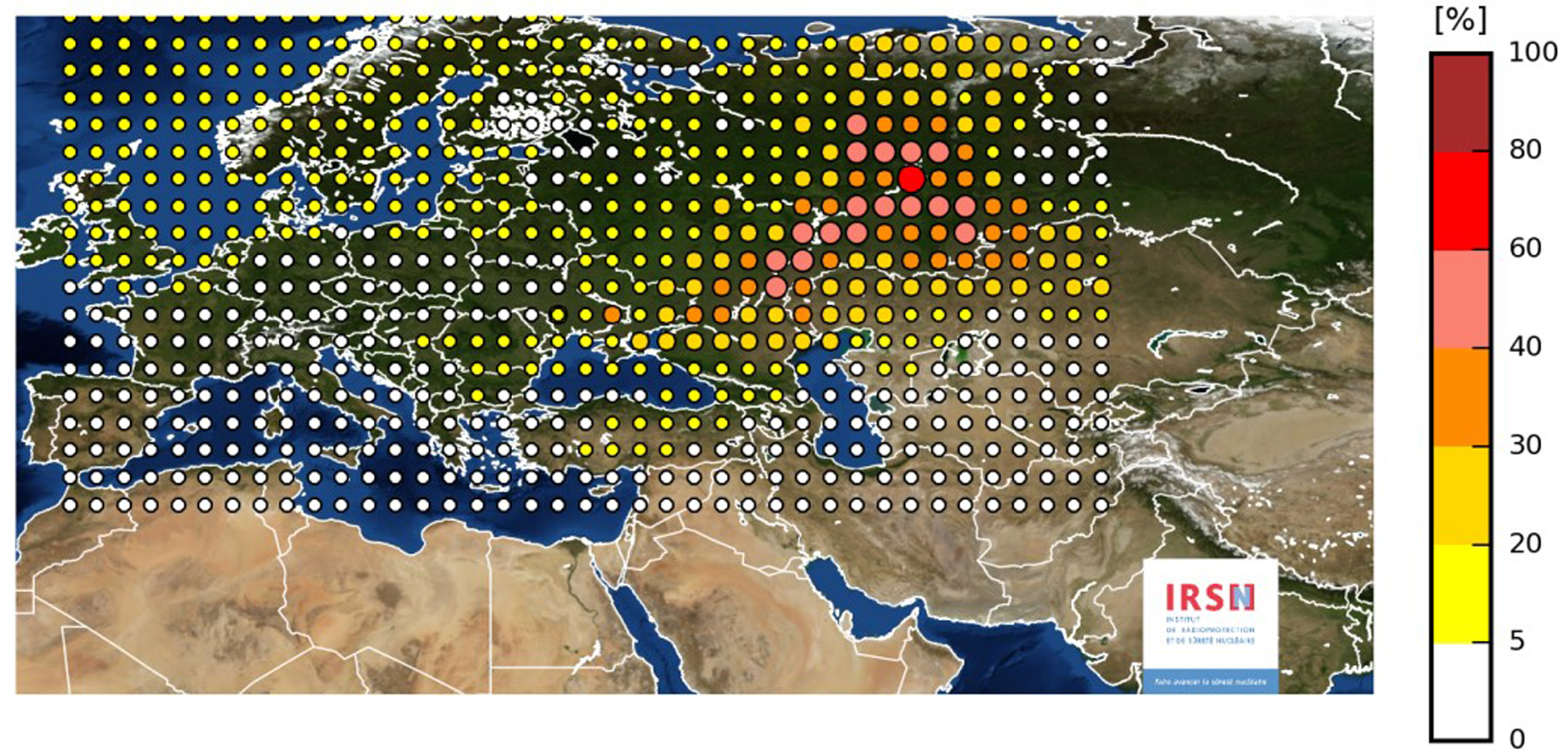
The level of ruthenium content in the air was not and does not pose a danger to health either in the short -term or in the long run - the representatives of Rosatom and independent specialists agreed from the very beginning. But the source source caused disputes, taking into account the exotic type of pollution - only one isotope, which has spread to a very long distance. Three hypotheses were nominated: a leak on the processing of OHS, an incident in an enterprise that produces ruthenes for medical needs, or combustion in an atmosphere of a satellite, which had ruthenes in fuel elements.
At the first version, he insisted, for example, the head of the laboratory of the radioisotope complex of the Institute of Nuclear Research of the Russian Academy of Sciences, Boris Zhuikov , who suggested that Ruthenius-106 could disappear with the evaporation of water solutions of radioactive waste in the air: filters could not completely absorb this radionuclide. This could happen both on the “lighthouse” and at another plant engaged in waste processing.
The commission, which included representatives of Rosatom, the Federal Medical and Biological Agency, the Institute for the Safe Development of Atomic Energy of the Russian Academy of Sciences, assures that the Mayak was not a source of pollution. There are two key arguments: firstly, there were no traces of ruting at the enterprise and around it. “The substance was in the air - this is a fact, but if the source was on the“ lighthouse ”, then around, including on the basis, we would see concentrations of hundreds of thousands of times more than determined by the discovery,” Rafael Arutyunyan assured journalists of the Institute of Safe Development of Nuclear Energy of the Russian Academy of Sciences. Secondly, experts appeal to the readings of sensors that did not record the release. “The first version: the filters could not work, and the pollution went through the pipe out, but in this case we would have seen changes in the testimony, and they were not,” said Vyacheslav Usoltsev, chief specialist of the department of radiation, industrial safety and environmental environmental services. The commission also rejected the hypothesis with a leakage of medical ruthenium-106, since its volumes are obviously too small compared to the emission recorded in the atmosphere. As a result, the main version of the working group called “combustion in the atmosphere of an artificial satellite (or its fragment), on board the source of Ruthenenia-106 with high total activity.”
Specialists interviewed Radio Liberty consider the conclusions of the commission unconvincing. Academician of the Russian Academy of Cosmonautics named after Tsiolkovsky , Alexander Zheleznyakov, noted that he unknown spacecraft, the fuel elements of which would use ruthenia isotopes. In addition, there are always ground services for the fall (combustion of the atmosphere) of satellites, and especially containing radioactive elements, and in the corresponding period there were no falls.
Boris Zhuykov said that the arguments of the interdepartmental commission did not refute his version:
Therefore, the “Mayak” remains the main suspect to exclude it, it is necessary to act in a completely different way. And there must be an independent commission
-The materials of the press conference once again convince that there is no other version, except for the proposed by me, so far. First. Ruthenia oxide Ruo4 is a gaseous product, and gaseous products rise up, and do not immediately settle. He will settle only when he is on some large particles. If there was no emission, no dust around, the gas will fly quite high. Sooner or later, of course, ruthenes will settle, but it will be very far away. I was engaged in the chemistry of ruting with radionuclides and well imagine its behavior, especially since this problem is not new, they came across it back in 1986 after the accident at the Chernobyl nuclear power plant. Now about the sensors. Spectrometers do not put on pipes, put only radioactivity sensors. And when the spent nuclear fuel is heated, there, in addition to ruthenium, the crypton-85 inert gas is also released. And there is more than ruthenium there, and against his background to notice ruthenes is very difficult. In addition, the sensors are oriented to an emergency, a quick and unexpected emission, an explosion. If there is slow heating and gradual secretion of activity, then the sensors will also not register any throw of radioactivity. They will show something, but they show something always, especially when crypton-85 stands out. So my hypothesis is not at all refuted. The advanced arguments are insignificant. In fact, at this press conference it was necessary to answer a very simple question-was heated by the Otya or the products of its processing during this period or did not heat in the air? But no one posed this question.
- The version that Rutheniya got into the atmosphere from the satellite seems fantastic to you?
- This is a purely Martian version. Because no one has ever seen such satellites - once. No one knows why it is the ruthenes of the 106th that should be used there. This is far from the most suitable isotope. Finally, no companions fell. These are continuous fantasies, from the series-the Martians flew in, threw the ruthenes of the 106th and flew away, leaving no traces.
- Are you sure that the case is the emission on the “lighthouse”?
- I do not claim that it was in the "lighthouse", Otya is also processed in other places, for example, in Zheleznogorsk, in the Krasnoyarsk Territory. But "Mayak" is the most famous place of processing, it is heard. In addition, it is in the zone, which turned out to be according to the calculations of the French Institute. There was also a version that the source of pollution was in Romania, but if you look at the hydrometeorological plants for the entire period of September 25 to October 2, the wind blew exclusively from the Urals towards Romania, no way. Therefore, the “Mayak” remains the main suspect to exclude it, it is necessary to act in a completely different way. And there must be an independent commission. Because Comrade Harutyunyan, with whom I know, although he works in the Russian Academy of Sciences, is not at all independent of Rosatom, ”said Boris Zhuykov.
Greenpeace Russia demanded a further investigation of the incident, “so that in the future this does not lead to even more serious consequences and concealing significant information.” Environmentalists propose to contact the Prosecutor General of the Russian Federation Yuri Chaika with a request to conduct an audit involving the public.