
Translated material
Alexander Sokurov and Russian death
In Berlin, a prize of the European Film Academy was awarded. Reporting Anton Dolina
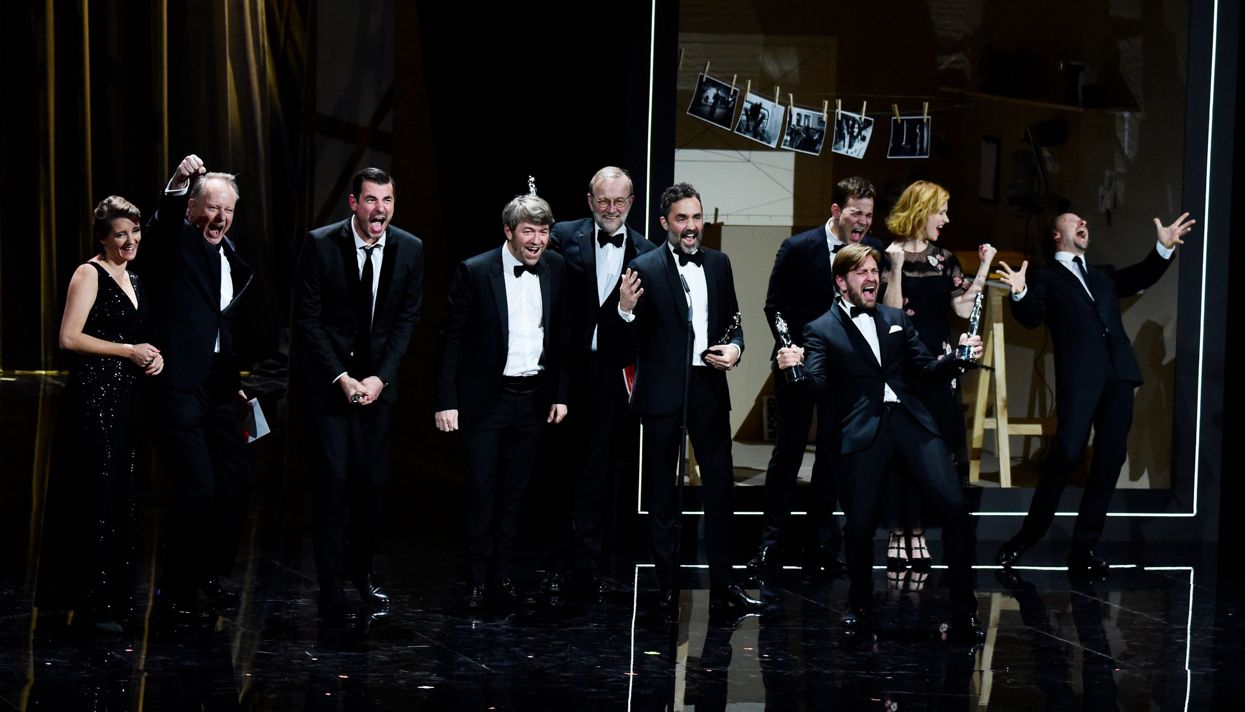
On December 9, the annual award ceremony was held in Berlin in the European Film Academy. Its triumph was the satirical comedy of Swede Ruben Estlund “Square”, which has already received the main prize of the Cannes festival, and its through leitmotif is the relationship of the united Europe and strange Russia: all the more, director Alexander Sokurov received the premium. The film critic of Medusa, Anton Dolin, who visited the ceremony, says that it was remarkable on it - and why do you need such awards at all.
“We are repeating a little here,” the Swedish actor Stellan Skarsgard muttered under his nose before declaring the winner: the caustic satire of Ruben Estlund “Square” was recognized as the best European film of 2017. Prior to this, at the same ceremony, Square defeated competitors in the “Best Comedy”, “Best Direct” and “Best Scenario”. Also, the artist of the film Josephin Osberg and the main role of the Bang class played there. It all started a little more than six months ago from the most prestigious festival trophy in the world - the Cannes of the Golden Palm branch.
In May, this decision of the jury seemed a bold, almost non-non-conformist one: a young director, a provocative talented film, the first comedy-laureate in a few decades ... Today, on the contrary, the European film academy diligently repeated the verdict made by senior brothers, not telling anyone new. Moreover, it was predictable from the very beginning. Many applicants for the main prize did not even come to Berlin; In particular, there was no aka Kaurisma and Andrei Zvyagintsev in the hall.
And the Swedish dominant was obvious. The ceremony began with a comic sketch-a detailed quote from the Seventh Press Ingmara Bergman, the first president of the Academy, which this year celebrated the 30th anniversary (everything was picked up). Toward the end, there was another sketch - from the “pigeon sitting on a branch, reflecting on the being” of another Swedish classic, Roy Andersson. In the final, the producer of Andersson Calle Buman, he - one of the teachers of Ruben Estlund, went on stage for applause. When Scarsgard approached the microphone with an envelope, even an idiot would have guessed whose name he will call now. Even the usual Estlund reprise - the requirement for the hall “shouting louder, so that the guts are out,” caused a feeling of deja vu.
This happened before. The Cannes triumph received an additional confirmation of the no coincidence of his victory from the European Film Academy: “Dancing in the Dark”, “4 months, 3 weeks and 2 days”, “The White Tape” ... But it happened otherwise when the masterpiece missed by festivals received his compensation from colleagues here: “Great Beauty”, “Amelie”, “Tony Erdmann”. This year, the authors of the “dislike”, the favorite of the same Cannes, were unfairly circumvented. As a result, the picture received only two technical prizes - for music (Eugene and Sasha Halperina) and operator work (Mikhail Kricman). It is deeply symbolic that the laureates on the protocol did not even have the right to thanksgiving.
You can explain the collective choice in favor of the “square” as you like. For example, for so many years they were given deserved that in which the eyelids I wanted to borough of someone younger. Or: Tired of dramas and tragedies, the time of laughter has come - even if laughter is both bitter and angry. But one can see in this a cautious attitude towards Russia, which never finally became its own in the European "family of peoples." It is not without reason that the Russian character of the “square”, the actor-activist Oleg Rogozhin, is shown as a rude cruel primacy, breaking a solemn party in the Museum of Modern Art.
From the stage, Moscow, Washington and Tehran are called a comma as conductors of totalitarian ideology. When the jokes of artists on stage suddenly (in a comic interludia) switch to Russian speech, the hall is frightening in fright: not a single laugh. Death in a parody of the Seventh Print, sitting down at a chessboard with a knight, states: "I will win, all Russians are good in chess." That is, their death is Russian. The leitmotif of the ceremony is the hashtag #freeoleg, the name of the director-confused Oleg Sentsov sounds constantly: in particular, Ah Weiwei, who wrote an open letter, was invited to the presentation. The only Russian who acts with a ten -minute speech and was adopted by a friendly ovation is Alexander Sokurov, who received a prize for his career (Agnieshk Holland presented him as “Author of Anti -Soviet films” - partly ironically, but still). He is the only consistent defender of Sentsov among the art elite of Russia.
However, the enthusiastic reception of Sokurov and his speech, in which he spoke of his hatred of prisons and other forms of lack of freedom, was by no means connected not only with civilian pathos. Sokurov is actually the largest director of modern European cinema, which belongs not only to Russia (and in recent years especially: as you know, Sokurovskaya Francophony, the unconditional hit of the festival art production, was made without a penny of Russian money). Today he is the righteous whose presence and word removes the stigma of the totalitarian state from the whole country.
The European film academy and its prizes in the world are different. They laugh at the doomed attempts to copy Oscar, shrug their shoulders about political pathos, and criticized ceremonies criticize. However, this utopian project, as well as the art installation of Ruben Estlund “Square” (here is another reason to reward his film), carries a trace of sincere faith in united Europe. He, unlike the purely American -, although not as an example of a more powerful - Oscars, really stands on the foundation of the idealistic values of several, very different nations and cultures at once. “Only we British are so stupid that we are going to leave Europe,” Stephen Frirs complained from the stage.
Perhaps that is why even on the most boring award there are several unforgettable moments, for which it is worth flying to Berlin. For example, awarding a prize for the best female role of Alexandra Borbeli, a young Hungarian actress from the film "On the Body and Soul" (in the rest of the prizes). Borbeli, who made a new hairstyle to the ceremony and putting on a magnificent festive dress, was not at all like an autistic lonely heroine of the film, but, despite the ceremonial look, could not cope with excessive emotions. She began to cry even before the postcard with her name was taken out of the envelope, and on the stage she looked so bewildered and touching that the whole hall was wiped literally.
The plot is a different kind, although it also did not do without tears, was associated with the prize for the Frenchwoman Julie Delpi. An outstanding actress (“Three colors: White” Kshishtoph Keslevsky, Richard Linklater's trilogy) and a novice director received a prize for the European contribution to world cinema. She went to the microphone and confusedly, then awkwardly giggling, then sobbing, talked about how she lost a subsidy of 600 thousand euros for her new film a couple of weeks before the start of filming. The solemn moment turned into a story about a tragic failure. Directly from the scene, Delpi announced a lottery in which she offered to play breakfast with her, and literally begged the audience to help somehow get her money for a picture, which she in advance declared the best of her everything made. The situation was furious, playing like a joke, but it was quite obvious that the despair of the delpi was not played.
This episode has become a speaker. No matter how good European cinema is, the issue of survival for him is relevant today, more than ever before. Therefore, such shares of solidarity and support of each other at least symbolic awards and are priceless, no matter how much the snobs-synephils were curved from the list of excessively predictable winners.
Anton Dolin , Berlin