
Translated material
Complete decommunization
Lithuanian deputies propose to rename the streets and dismantle monuments "symbolizing Soviet ideology"
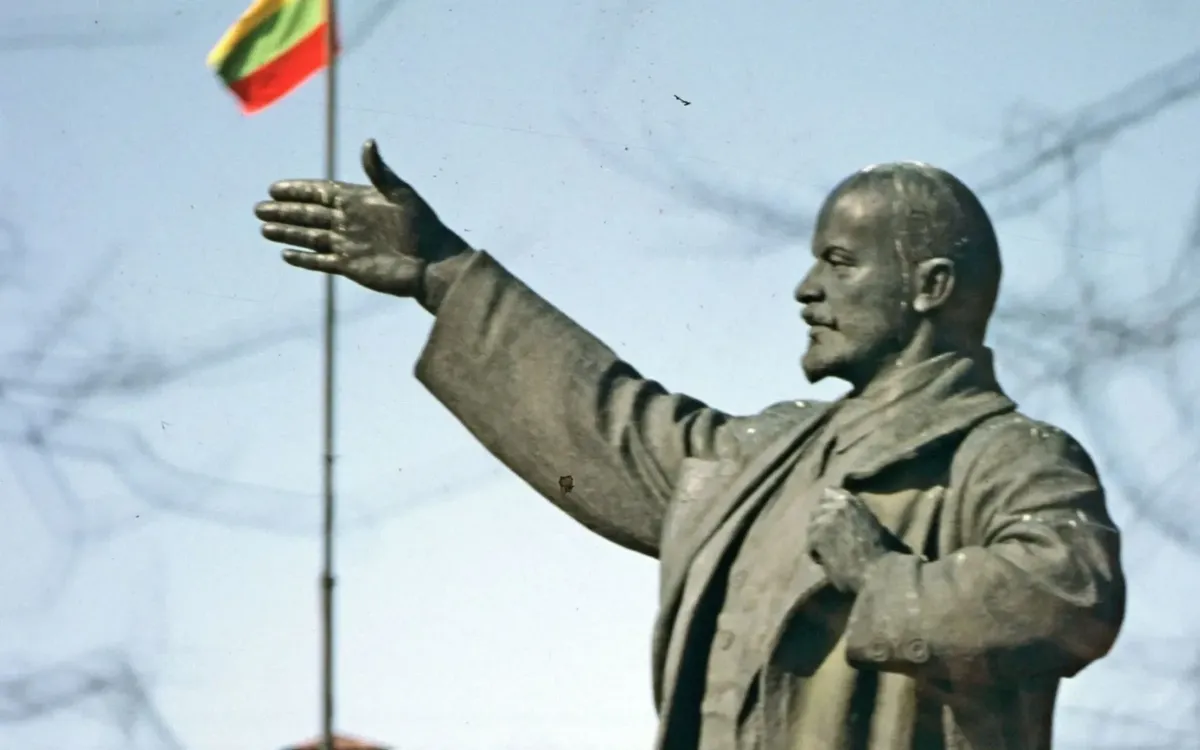
The other day, the deputies of the Sejm from the Union of the Fatherland party - Christian democrats introduced a bill on the "prohibition of the propaganda of communism and other totalitarian ideologies in the public space." The law with the same name in Lithuania is already valid: it, in particular, prohibits the use of Soviet or Nazi symbols, public execution of the anthem of the USSR, public support for the “occupation regime”. Conservatives Audrronyus District and Laurinas Kashnas propose to expand the law on the “objects of public space” - streets, squares and monuments - somehow promoting communism, obliging the municipal authorities to rename or dismantle them.
The deputies of the Sejm were inspired by the initiative of the Vilnius administration, where in recent weeks there are discussions about the fate of several monuments to public figures, who, according to the city authorities, were too closely connected with the Soviet regime. According to the member of the city council Paul Kuzmitskene, the head of the special commission on memory culture, the discussion began with the appeal of a group of students of the Vilnius gymnasium, which proposed to remove the monument to the writer Pyatrats Zvirke from the square in the city center.
Members of the commission do not undertake to decide for themselves who to consider Pyatrats Zvirk - a writer and a poet worthy of the monument, or an active accomplice of the Soviet regime, a member of the plenipotentiary delegation from the deputies of the Lithuanian Sejm, who in 1940 petitioned for the reception of Lithuania in the USSR. Therefore, they turned to historians - to the center of the genocide and resistance of the inhabitants of Lithuania, a special archive and the History Department of Vilnius University. “We want to get an expert opinion,” says Kuzmitskene. “Now we are waiting for the information, and as soon as we get it, we will offer the decision of the Vilnius City Hall and the City Council.”
In addition to Zvirki, members of the commission asked historians to evaluate the activities of several more Lithuanian writers of the Soviet period - Salome Neris, Antanas Ventslov, Ludas Gira. If experts consider them accomplices of the communist regime, the City Council will decide the issue of renaming any objects named in memory of them.
The deputies of the Sejm Odzhubalis and Kashchunas decided to support the initiative of the Vilnius City Council with their bill, and at the same time give the process a centralized character. Now the majority of monuments - unless they wear the status of cultural heritage objects - in the maintenance of municipal authorities, they also solve issues of renaming streets or houses.
“We know that historical memory is a lot of emotions. Regularly one or the other monument raises questions, ”says deputy Kashmunas. He is sure: since such “controversial” objects are a headache for any municipality, there are plenty of information on each of them. Deputies offer municipalities to share this information with professional historians who will make a certificate for each object: when and in honor of whom a monument was erected or a street was named, who is this or that historical personality, what are its connections with the Soviet government. In general, they will conduct a kind of inventory and provide information on each object to the government.
“The main criterion is whether this or that object symbolizes Soviet ideology,” says Kashnas. “It is over that there should be no monuments or busts to people who represent this ideology.”
In the center of genocide, the initiative of the deputies, in general, is welcomed, but they say that first we need to discuss all the nuances.
“I think that the step itself is correct,” said Teresa Birut Burauskay, the director of the center. - We need to put all points once over I. We are faced with this all the time: there is some kind of monument, some bring flowers, others worry about this-both of them turn to us. There is no underground war in society - but there is no necessary calm. ”
At the same time, Burauskite emphasizes: historians are ready to prepare all the information about every historical personality and for each monument, but are not ready to decide what to consider the propaganda of communism.
“What can the historian say about Salome Neris? She is a tragic figure. And it hurts me to listen to how she is dragged with Ludas Gira, Zvirka and others. It's just unethical, ”Burauskite believes. - How did it affect the fate of the Lithuanian occupation that she went to Moscow then? And if I had not gone, would we remain independent? There is her poem about Stalin, the poem “On the Bolshevik”-once we all taught them by heart, of course, bad. But she is a pure lyrics. I just want to cry when they put it on a par with others. ” But Pyatraza Zvirku Burauskete herself considers "an ideological communist, rather a politician than a writer."
A separate question is what to do with monuments that are included in the register of cultural heritage objects, as well as with memorials installed on the site of mass graves to the soldiers who died during the Second World War. According to Kashnas, no one calls to demolish such memorials or especially valuable from a cultural point of view.
“Somewhere it is quite possible to put clarifying signs next to the monument,” the deputy believes.
By the way, the format of such signs in the near future should also be approved. Recently, the Vice-mayor of the Birzhasky Territory, the small northeastern region of Lithuania, where the memorial “heroes who fell in battles for the freedom and independence of our homeland” was installed, placed a sign next to him, which reads: “The notes of the Soviet time do not correspond to historical truth.” True, the mayor of the Exchange Territory immediately condemned her - but rather for arbitrariness and inconsistency of actions than for the message itself. And some self -government immediately became interested in such a relatively painless solution to the issue of “controversial” monuments.
Deputies of the Sejm hope that their bill will pass the first reading until the end of the year - then there is a chance to accept it before the summer holidays of the parliament.