
Translated material
The failure of the Operation "Sochi"
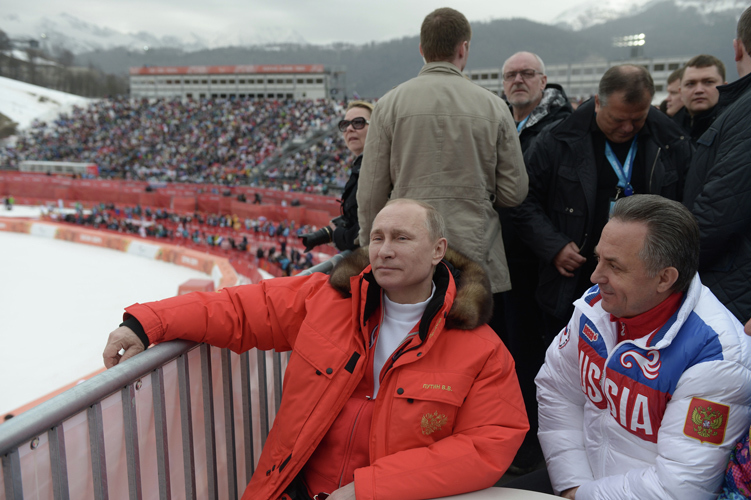
The deprivation of Russian athletes of the Olympic medals of Sochi and the ban on the participation of the national team in the Olympics in Pyeongchang have become the largest fiasco of Russian foreign policy of recent years. It was foreign policy - the victory in Sochi was one of the main foreign policy achievements, the personal triumph of Vladimir Putin, a symbolic prize that remained even after Russia broke with a modern world order and turned into a revenge power.
Now there is neither medals, nor victory in the general team. This is even logical in its own way: Sochi medals were the last heritage of that old, Resetskoye, Russia, which proudly showed the world its history and masterpieces of the Russian avant-garde at the impressive opening ceremony, won the snow areas, and not in the backs of hybrid wars, was part of the global world. From now on, everything fell into place, the last connection with the past era was torn. It turned out that the Olympics was a doping fake, a special operation of the FSB, part of a hybrid war with the West.
Doping as a metaphor
The most banal and dead-end answer would blame the West in everything, which is now engaged in state propaganda, taking out a full set of philistine stamps from the sleeves about an anti-Russian conspiracy: “They eat everything, but they catch Russians”, “This is the answer for the Crimea” (or even for 1945, as recently suggested in the State Duma), “without doping the sport of higher achievements is impossible,” “Norwegers are all Norwegers, everything Take drugs for asthma ”, etc. You can be comforted by myths about the anti -Russian conspiracy in Mok and Wada and send the curses to the “traitor” Rodchenkov, but all this does not cancel the main uncomfortable question: whether there were all those facts that became known from the McLaren report, ARD films and Rodchenkov’s diaries. The response to it is eloquent silence and conciliatory statements by our usually such warlike authorities that de facto mean recognition of the facts. Moreover, the evidence is so convincing that the Kremlin prefers to come to terms with the Moka's relatively soft verdict, so as not to endanger the World Cup.
There is nothing new in the fact of using doping. Doping in Russia is a systemic phenomenon, lubrication in the resource machine of Soviet and Russian sports, where medal plans and standards go down from top to bottom, and medals and results are delivered from below. Each Sports School coach is responsible for the uninterrupted cultivation of candidates and masters of sports, each federation by sport - for the preparation of the Olympic champions, and the Olympic committee for winning the medal standings. The top of this pyramid is the distribution of the Olympic champions and winners of the Mercedes and Audi on the Vasilyevsky descent at the Kremlin, to which apartments and multimillion -dollar handouts from governors and oligarchs are added. In this administrative-bureaucratic machine, sharpened only on a demonstration of the superiority of domestic sports, the bodies of athletes turn into a biological resource, and doping into a necessary condition for solving state strategic problems. This machine worked for decades, from children's sports to Olympic, in the context of Darwin selection, rejecting hundreds of thousands of people who have not passed selection - so that a person who had fulfilled the MS standard and did not get to the Olympic reserve, as a rule, was thrown to the side of the road with torn health and sustainable disgust for sports.
And everything would work in this machine with regular interspersed of individual doping scandals, but then the Olympics in Sochi took place as the main image campaign of the decade and the personal project of Vladimir Putin - after the disastrous performance of the Russian team in the previous Winter Olympiad in Vancouver, only victory was needed in the home territory. And here, it seems, the FSB connected to the sports and medical machine, which turned the Olympiad into a special operation with techniques, as if written off from spy novels: a hole in the wall of an anti-doping laboratory, disguised as a wardrobe, FSB officers under the mask of plumbers, opening and replacing samples and the like spy passions. As it now becomes clear, everything was done clumsy, with the branded Russian gouging: what are there in the diaries of Rodchenkov only experiences and curses about confused test tubes and trials - you can’t imagine such a deliberately!
In a special operation mode
As a result of the mediocre and failed operation, the scandal around Russian doping became a political fiasco comparable to the negative media background (but, of course, not by the scale of human tragedy) with the Boeing's downed Malaysian Boeing. And this means the limits of the “hybrid war” and special operations, which in the Putin era began to replace diplomacy, sports, mass media, administrative procedures and regulations in Russia. In other words, the problem is much wider than doping - it is in the political system where the authorities have usurped by the special services, who plunged the state and society into a state of permanent threat and hybrid war: not only domestic policy (UKOUKAEVA, elections of the president and the rotation of governors, repressions against the opposition), but the external were transferred to the regime of specialize, in which special Normal political and bureaucratic procedures for coordination, examination and decision -making, mechanisms of transparency, publicity and audit are canceled. The security forces, in essence, replaced all the complex mechanisms of public policy, and indeed politicians as such, the regime of special operations.
The special operation, in essence, was the whole Olympiad, from lobbying for Sochi’s candidacy in the MOK to the construction of Olympic facilities, for which entire territories were transferred to a state of emergency with the restriction of the constitutional rights of citizens, such as ownership and freedom of movement. The special operation was the long -prepared annexation of Crimea with a multilayer cover and lies; The special operation was the war in Ukraine; The campaign in Syria also unfolded according to the laws of a special operation with misinformation regarding the scale and goals of military presence and the silence of Russian victims. The most scandalous special operation was the Russian intervention in the elections and the domestic political discussion in the West countries through the creation of an extensive system of state propaganda, fake news and trolling in social networks, the culmination of which was an attempt to influence the elections in the United States in 2016.
With the special operations that replaced the policy of us, there are three problems. First of all, they are ineffective. Sochi doping thriller not only deprived Russia of Olympic medals and command participation in Pyeongchang, but also undermined its positions in world sports for many years to come. The annexation of Crimea left Russia with a toxic asset in the hands for which it is subject to sanctions, but it cannot use it really - to the well -known problems with banks and energy supply (scandal with Siemens turbines), the failure of the tourism industries and the criminalization of all levels of power on the peninsula. In the same way, the result of a hybrid war in the east of Ukraine was the final separation from Russia the most important part of the former empire, exactly along the covenants of the deceased Brzezinsky, while Russia remained with another toxic asset-the pirate republics of Donetsk and Lugansk, living exclusively at the expense of Russian infusions and economics of violence.
And, finally, all Russian special operations to support anti -systems in Western countries - from law -Popopulistic and protopharsist parties such as the National Front in France and the “alternatives for Germany” in Germany to the Kremlin’s former hope of Donald Trump - ultimately failed: the system parties were more stable, and the Trump became the headache of all. humanity, including Russia. By and large, the Kremlin turned out to be a large number of toxic assets on his hands: doping medals, Crimea, Donbass, the cannibal -eater Assad regime in Syria, levoradicals, separatists and proto -fascists in Europe, and now Trump in the White House - all these are the fruits of special operations and hybrid wars, in which Russia eventually developed itself.
Toxic Russia
And here is the second problem of the policy of special operations: they are highly toxic. Even where Russia’s intervention was insignificant and symbolic, its politics and its representatives now “phones”: the West is looking for a trace of Polonia where it may not be. A good example is Russia's intervention in the American elections: apparently, it was not so large -scale as to have a decisive effect ( about 50 thousand dollars were spent on the promotion of fake accounts on Facebook , which in the election campaign is a orientation cost of $ 2.5 billion - actual trifles), but the fact of the intervention of a third -party power in the holy holy of American politics - the election - so bad The American establishment that the witch hunt was opened there in the spirit of McCartism, and the heads of Internet giants from Google to Twitter are lined with hearings in Congress in order to testify their loyalty and present traces of Russian agents. As for the propaganda Rupors Russia Today and the Sputnik, frankly, their influence in America is not so significant as to limit their activities in the United States and thereby put the Western media in Russia, but the channel deservedly reapes the storm, which itself stubbornly sowed. The toxicity of Russian influence is so great that the slightest presence is cleaned, any mention of even innocent contacts with the Russians leads to a scandal, and the “Russian infection” can ultimately destroy the already weakened and embittered, making a mistake for the mistake of Donald Trump.
The same effect of toxicity is now felt by Russian athletes, even those who are not named in the report of McLaren and are incomprehensible to the Sochi doping and scam: any Russian athlete now a priori is suspicious, a presumption of doping arose in relation to Russian athletes, who shifted the burden of evidence of their own purity. This is unfair and disappointing, but this is the same radioactivity of special operations, the Chekist polonium that polluted the clothes of all. Russian contributions, capital, investments, businessmen, real estate - everything is now under suspicion, as can be seen from the arrest of Suleiman Kerimov and the preparation of the new sanctions list of Washington, which will appear in February 2018. Paranoia reigns in the world about Russian hackers, “cheaters”, trolls, Russians are looking for under the bed, and this stigma, this radioactive radioactive The background we will carry on ourselves for many more years, even when Putin is no longer in power.
What is characteristic, the failures of special operations coincide in time: in the same months, Rashagate unfold in Washington, a Russian doping scandal in Wada and Moka, and there is still a court in the Boeing case, in which new evidence of Russia's involvement-journalists-colonel Nikolai Tkachev have just called The call sign "Dolphin", presumably involved in the disaster of the Malaysian aircraft . It is possible that the removal of Russia from the Olympics is only the first call and we are waiting for the collapse of the entire system of Russian hybrid conquests: from Crimea to Trump, from Donbass to Assad.
Transparent world
And here the third fundamental weakness of special operations is manifested: they are inadequate to the modern world. Yes, it is complicated, interdependent and vulnerable, it is a “risk society” (according to Ulrich Bek), which is easy to bring to the hybrid “fog of war”. But these are also a society of radical transparency, “panoptia” (according to Michel Foucault), the world of networks, DVRs and anonymous activists from Wiki L Eks to Bellingcat , where every step, telephone and bank transfer is tracking, where you will not conceal any offshore, nor a tube in the safe, nor “Buka” on the trailler and where The special services are just as vulnerable, transparent and old -fashioned as the states that they serve. Our knights of the cloak and dagger act according to the old fashioned way: planning, operational development, recruitment, intimidation, disinformation -but in the society of networks and civil control they are instantly calculated in the footsteps of Polonia, Doping urine and Olginsky IP -adorses, for interception of communication sessions and selfies of VKontakte soldiers, and global institutions, no matter how much They are not imperfect, impose sanctions, how our athletes and businessmen are now convinced.
Exactly in the same way-due to the intervention of special services-half a century ago, in the late 1960s, the Soviet Union lost its place in the nascent information revolution. It was then, under Brezhnev, that a fatal decision was made to transfer from scientists to security officials the Soviet computer industry, which at that time was on equal terms with the United States or even a little ahead: we had advanced programming languages (Algol) and competitive machines (BESM-1). And the security forces, trying to minimize the risks in the strategic industry, transferred it to the special operation mode: the theft of technology in the West, the reverse engineering of American samples (primarily IBM ) and their reproduction at Soviet enterprises. But what used to be done with missile technologies and nuclear weapons, partially borrowed in the West, did not work with computers that were an order of magnitude more complicated and required not closed design bureaus, but open code, their own developments, cooperation of science and industry, testing in production and in the market. The well -known sociologist and part -time historian of the Soviet computer industry Manuel Castels gives anecdotal examples: since in the USA the size of transistors and the width of the lines on the microcircuit were measured in the imperial system of measures (stake of inch), and in the USSR in the metric, American sizes decided to round to a certain sign, and as a result, smuggled chips did not Suitable under the Soviet connectors. As a result of this long -term special operation, Castels admits, by the time of the collapse of the USSR, the Soviet computer industry lagged behind the United States by about twenty years.
Today, the “hybrid wars” special operations again discard us for decades ago in relations with the outside world-either in the early 1980s, or in the early 1950s: Russia is again afraid and isolate, but this fear is no longer possible to capitalize, and its consequences are increasingly hit by us themselves-as they now hit Russian athletes and fans. The lesson from everything that happened is simple and banal: the athletes should prepare the coaches, and not representatives of the special services, relations with neighboring countries should build diplomats and businessmen, and not “polite people” and “vacationers”, dressed from Voentorg, “soft power” of Russia should carry artists, artists and athletes, and not hackers, trolls and propagandists, and representatives Special services should do their direct business - to catch terrorists, and not replace with special operations all existing institutions and procedures.
However, in the country, which is preparing to celebrate the centenary of the Cheka and for the fourth time to elect the president of the Chekist, only you can only dream of this.