
Translated material
Stalin, where is the diary?
In the late 1930s, Veniamin Kaverin came to Yuri Tynyanov, and Garya carried from the street. The owner of the house, one of the fathers of Russian formalism, pointed to the open window: "People burn memory and do it for a long time, every night ... I lose my mind, thinking that thousands of people throw their diaries into the fire every night." Due to the shortage of paper, their life was recorded on the pages of school notebooks of the old and new intelligentsia-engineers of human souls before and after the revolution-and workers with the peasant past; In the 1920s, all of them had only to become real Soviet people.
A significant part of the personal archives became available to researchers in perestroika years. The German researcher Johen Hellbeck managed to visit the People’s Archive in Moscow, the GA of the Russian Federation, RGALI, the manuscript department in Lenin, the Solzhenitsyn Foundation. The scientist complains only on the closeness of the central and regional archives of the NKVD. He received part of the information at a meeting with those authors who survived the Soviet Union and agreed to talk to the researcher. As Hellbeck notes, many of them did not agree with his interpretations of their diaries, but believed in the historical significance of their biographies.
Professor of the Faculty of History of the University of Ratger Johen Hellbek in his work analyzes three groups of diaries that the inhabitants of the USSR in the 1930s were conducted. The first included the diaries of “Class of Alien Elements” (intelligentsia). In their records, these people said goodbye to the old, pre -revolutionary, world - a way of life, values, ideals. One of the authors - the teacher Vera Pavlova could not afford an alliance with the representative of the old intelligentsia, such an alliance prevented her from included in the Soviet modernity. The second group was made up of the diaries of self -education and formation, their immigrants from the lower layers of society were led by them: fugitive peasants, poor workers climbing the communist ladder. They all needed to urgently understand and accept the device of the new world. The evolution of the personality is recorded in the works of the former fist of the subduing: biological desires are replaced by the awareness of historical time and their place in it. The revolutionary, semi -Aarchist question of Chernyshevsky "What to do?" Turned into the pressing of every writing 1930s "Who am I?" Although Bukharin described the socialist person as the opposite of the American dream, the criteria of this personality were not obvious to ordinary proletarians. In the third group of diaries, Hellbeck includes entries of the Communists. Hellbek extensively analyzes the notes through them - the fate of the Soviet playwright Afinogenov, the author of the plays “Fear” (1931) and “Lies” (1933) popular until 1937; The censor of the latter was Stalin, the production was banned shortly after the premiere. For the disgraced author, the diary became a Soviet purge, a witness to the writer's transformation during cleaning.
 © New Literary Review, 2017
The creation of a biography, one of the main functions of the diary, was perceived by the authors as a way of their inclusion in the great history and revolutionary time. The scientist and former White Guard Nikolai Ustryalov in the mid -thirties, after returning from China, shares his craving for Soviet identity with his diary. Fearing alienation, he writes: "I want to completely, to the end, become my own in the ranks of Soviet people, Soviet patriots, and burdenedly endure your harsh isolation." In 1937, Ustryalov replenished the ranks of the executed. The alienation was extended not only to the victim of ideological persecution: its environment was excluded from Soviet society. Social rejection sometimes became almost physiological in nature, like a stigma in medieval Europe. The wife of the enemy of the people of Julia Pyatnitskaya “had to watch how former acquaintances turn away from her, and her sons lose friends. She came to the conclusion that “the grief has some kind of smell, it smells equally from me and Igor, although I take a bath every day”. ”
However, in his study, Hellbeck gives examples of positive biographies. The peasants and representatives of the city intelligentsia, working as rural teachers, engineers and writers built their socialist “I” every day. The teacher Vera Pavlova, following the political course, divided her life into a five -year plan, applying production standards (five -year plan) to the field of private life. Anatoly Ulyanov made a plan “for the period from January 1 to March 1, 1933. To study at least the 6th volume of Lenin, think into it, divide your opinions with you [diary] and all obscure issues arising from reading.” In the 1930s, the diaries used the diaries as historical chronicles-the dating of important events in personal life was increasingly counting on the communist calendar: “Professor Vasily Pedani, who started the diary in 1930 in connection with the birth of a grandson of Glory, noted that on April 12, 1931, when Glory was not yet a year old, the family taught the boy to respond to the pioneering greeting“ Be ready! ” “I raised my hand:“ Always ready! ””; "Having indicated that this fun took place on Easter's traditional holiday, the pedances thereby emphasized the communist orientation of the education of the grandson." With the help of such records, residents of the USSR compared their lives with the ideal of a "new person." The idea of a communist future, pure world worked as a mirror in the present tense for many Soviet people. Each resident of the USSR was responsible for the transparency of its surface.
Julia Pyatnitskaya criticizes the convicted person after Bukharin - without leaving the party the right to make a mistake, the author of the diary saves his new subjectivity due to a close, but ideologically alienated person. In the 1930s, the Soviet system goes into a hermetic dimension, to where falsification is just a way of doing business.
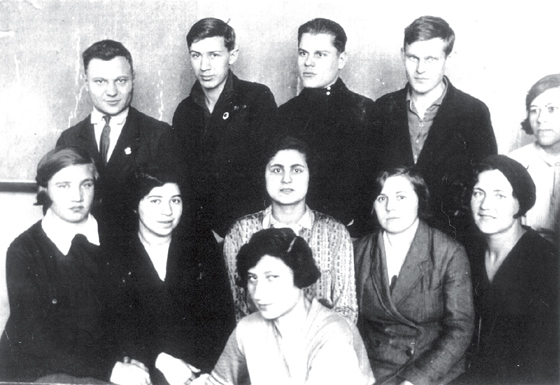 © Chemical Archive of Marina Gavrilova, Moscow Stepan Podlubnaya (left, in a tie) with a group of students of secondary school "Pravda". 1934
If we recognize the interests of the revolutionary society, then, according to Hellbeck, “exposure and denunciations can be understood as acts of constructing their own identity at the expense of exposed subjects.” The authors of the diaries were afraid of their non-establishment history: Ivan Poddubny, successfully hiding the peasant origin, by irony of fate, turned out to be an informant of the GPU-NKVD literally a few days before the amnesty of the fists and for many years was afraid of opening his bourgeois roots. In the 1930s, communication with the pre-revolutionary world, even at the level of intention, seemed criminal.
All personal life in diaries was most often perceived as a continuation of the public, spiritual complaints were marked as weakness in front of the mirror of the revolutionary present: “In the morning, having made extracts from newspapers, I wanted to write about myself, but a strange feeling arose: it was embarrassed to write all kinds of personal nonsense after the chronicle of state affairs.”
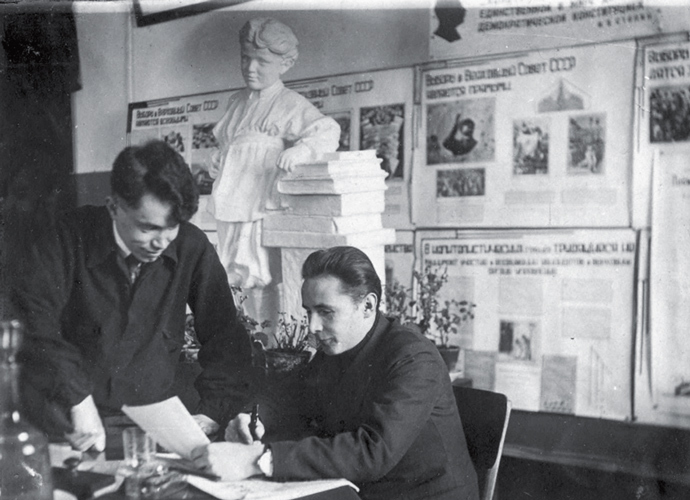
While forming proletarians with the help of diaries were engaged in self -education and attempt to communist values, the diary of Mikhail Bulgakov confiscates the GPU; After the return of the notebooks, the writer destroys the records. Against this background, a monstrous and absurd is a zealous maintenance of records in the proletarian environment. A programmatic example of the openness of the Communists in front of their society was semi -public diaries. Leonid Potemkin, in the future deputy minister of geology of the USSR, “having written one of the first letters to Zhirkova, read it to his friend Nikolai Aleinikov (which is also captured in the photograph). Nikolai asked Leonid to rewrite this letter for him, "having discovered something interesting in him." Hellbeck analyzes this picture in which Potemkin keeps a diary at the table in Leninka’s halls. The young communist mattratly watches the bust of Ilyich.
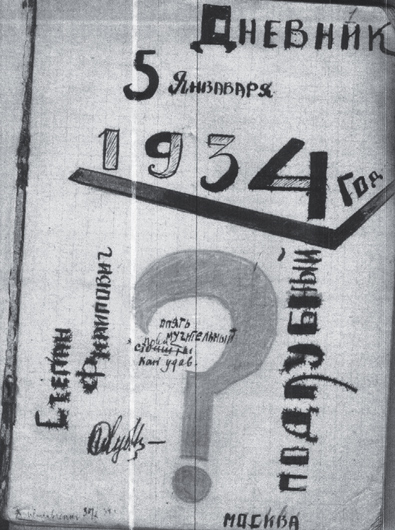 © Chemical Archive of Marina Gavrilova, Moscow title sheet of the diary of Stepan Podlubny for 1934
Often Soviet people were “dialogues” with their diaries, and the topic of conversation almost always turned out to be doubt about his author, historical and psychological adequacy: “What if it is all wrong that I wrote. short -sighted. Suddenly yes, this is only the external side of the phenomena, visibility, absolutely necessary, so to speak, legalized by history, and behind this appearance is a bright and rainbow essence?! And I looked at this essence, for I am an insignificant, short -sighted creature, capable of only licking the truth, but not to open it? .. Or maybe in fact a decrepit, yellow feature, class enemy, as they write in the newspapers ?? ” State propaganda worked on the formation of a complex of guilt among Soviet citizens, personal responsibility for a “discrepancy” with a communist project.
In the diaries of the 1930s in questioned Hellbeck, criticism of the regime was also found, but often in indirect form. The ethnographer Biryukov invented the figure of the “layman” and put all the anti -Soviet views in his mouth, the author’s voice was in these works in conventional, prosperous positions. In the 1930s, Soviet ideology suppressed any alternative scenarios of the future; There was only one turn in history.
Finishing the analysis of the contents of the diaries, Hellbeck asks the question as a fundamental question for the historian: why and at what time did some records were destroyed, others were stored, and the others were inaccessible? You can start the answer to this question, comparing the political climate of every Soviet decade. Most of the diaries have not yet been studied, they are hidden not only in state courses, but also in apartments throughout the former USSR. However, do not forget about the records taken beyond the indicated limits.
Perhaps, in the Soviet furniture wall, your neighbor on the stairwell is stored one of many times rewritten stories of the country, in which "everyone will feel pain, will feel infringement if his interests in any way conflict with the interests of the team."
Johen Hellbeck. The first -person revolution: diaries of the Stalin era. - M.: New Literary Review, 2017