
Translated material
Aggressive block
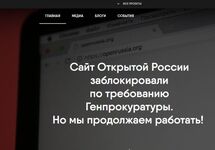
Roskomnadzor blocked access to the Open Russia movement sites, reports in OP. Access to Openrussia.org resources, or.team, the site "Open University" (Openuni.io), as well as the site of the founder of the movement of Mikhail Khodorkovsky (khaodorkovsky.ru).
Sites are included in the register of prohibited resources with by decision of the Prosecutor General of December 11 on the basis of Article 15.3 of the Law "On Information", the register says. Site administrators did not receive any notifications of blocking. "There (in article 15.3.3. - Ed.) It is written that the Prosecutor General’s Office may demand to block sites calling for extremism or mass riots without trial. From November 25 of this year, a item about the site of" undesirable organizations "was added there. Since the prosecutor’s office is not used to contradicting himself and confusing us with the" undesirable "London, it may be, of course, no one explained anything to us", no one. - They note in Open Russia.
In April, the Prosecutor General’s Office recognized the “undesirable” in Russia by Otkrytaya Rossia, Open Russia Civic Movement, Open Russia (public network movement Open Russia), as well as Institute of Modern Russia from the United States. The Russian movement emphasizes that all these non -governmental organizations have nothing to do with it.
"However, law enforcement agencies repeatedly come to the measures of Open Russia, justifying their actions by the fact that" the police received a message about the conduct of an inconsistent event with the participation of members of the organization, whose activities were recognized as undesirable in Russia . "In addition, the participants in the movement were being brought up for participation in an" unwanted organization, "the movement said.
Later, on Tuesday, Roskomnadzor reported that sites of 11 "undesirable" organizations were included in the register of prohibited resources. "The Roskomnadzor from the General Prosecutor's Office received requirements to restrict access in the Russian Federation to Internet resources that distribute information materials of organizations recognized as undesirable in Russia. The General Prosecutor's Office also demands to limit access to the data of Internet resources," the agency said .
The administration of the social network "Odnoklassniki" blocked the Open Russia group. The reason for the blocking by the social network calls a certain "violation of the regulations". Other explanations in the press service of "Odnoklassniki" "Open Russia" were not given.
The law on the extra -court blocking of sites, named by the name of his initiator of the deputy Andrei Lugovoi, was adopted in 2013. Initially, its action extended to resources with information containing calls to riots, the implementation of extremist activities, participation in mass (public) measures conducted in violation of the established order. "
On November 25, the State Duma adopted in the third, final reading of the amendment to expand the law on the sites of "undesirable" organizations. In addition, at the last moment, provisions were made to block the media sites recognized by "foreign agents" . On November 25, the document was signed by Vladimir Putin and the law entered into force.
In September, amendments to the Law "On Information" were introduced to the State Duma, Unenos Yuri Shvytkin, Socialist -Revolutionary Oleg Nikolaev and communist Alexander Yushchenko. Currently, the activities of 11 foreign and international NPOs are recognized in Russia "undesirable".
In 2014, on the eve of the annexation of Crimea, according to the Lugovoi Law, the sites of our publication, as well as the "Daily Journal" and Kasparov.ru were blocked. The reasons for the blocking of "the faces were reported only in court. It was argued that access to the resource was limited, since the" set of content "of the site allegedly encourages the reader to participate in" promotions conducted in violation of public order. "Subsequently, Roskomnadzor repeatedly blocked resources under the Lugovoi Law.
Before for Russian users, an “non-closed” mirror was created https://grani-ru-org.ppspot.com/ , RKN introduced more than 700 mirrors of our site to the register of prohibited information.
On September 15, the ECHR communicated the complaint of the "faces" to block the site , uniting it with complaints of representatives of other resources. All applicants complain of violation of Article 10 of the European Convention on the Protection of Human Rights (freedom of expression). Until January 15, 2018, the Russian authorities must answer the court questions. In particular, Moscow should explain whether the laws are quite accurate, on the basis of which locks are made; whether they allow the site to block the whole if there is some prohibited content on it; Is there a danger of the arbitrary application of these laws, whether Roskomnadzor, the prosecutor’s office and courts are obliged to take into account the interests of different sides and side effects in the form of blocking legal content.