
Translated material
China, which has its own lunar program, is interested in the revived lunar program of the United States, but is afraid of its militarization
The official representative of the Chinese Foreign Ministry Kang, commenting on the words of US President Donald Trump about the possibility of using the moon and space in the military sector, said that the PRC is opposed to the militarization of space.
US President Donald Trump signed an order to resume the lunar program , curled by his predecessor Barack Obama. By signing the document, Trump noted that "space has many applications, including in the military sphere," but did not go into details.
"China welcomes the achievement of scientific progress in a peaceful study of space space by all countries. We proceed from the fact that these successes will ultimately benefit all humanity. The Chinese side is also ready to expand cooperation with other countries in this area. As for the issue of militarization, I still need to clarify what President Trump said. However, the position of China's militarization of cosmic space is a clear and clear and clear and clear and clear and clear and clear and clear and clear space Consistent, ”said Lu Kan.
He emphasized that the Chinese side hopes that all members of the international community will be able to come to the consensus and will begin to discuss the agreement on the prevention of the space space, RIA Novosti will begin as soon as possible.
- Three stages of the Chinese Luna Study Program
Recall, China is interested in its own lunar program, which is implemented, in particular, together with Roscosmos. China only in 2003 senta man into space on his own rocket, becoming the third country after the USSR and the USA. And until 2036, the PRC intends to send astronauts to the moon . And this will be a manned lunar program of exploration.
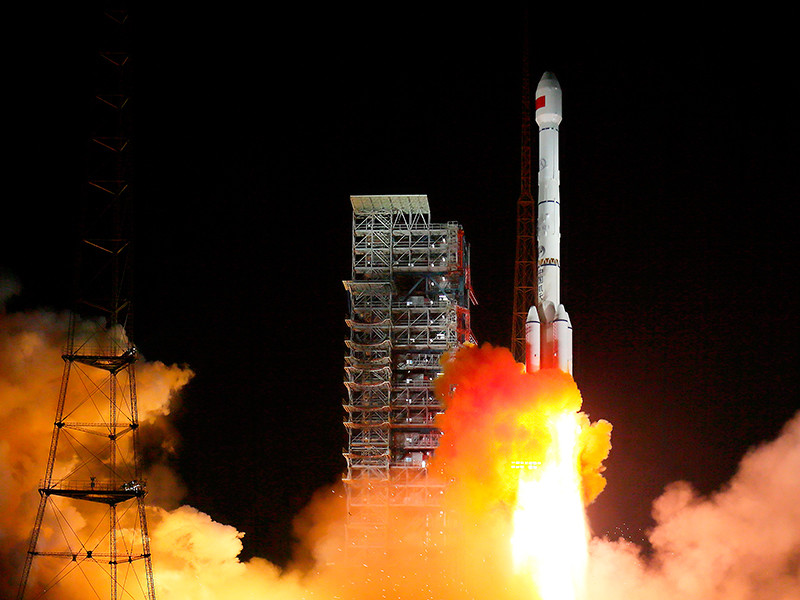
But for this lunar mission of the PRC, you need a fairly powerful missile for lifting at least 100 tons into near-earth orbit, and the last launch of the Changzhen-5 heavy missile was unsuccessful . The missile was supposed to deliver to the moon a device for a fence of soil samples, which was collected by the Chinese Lunum "Jade Hare" , which studied the Earth's satellite since December 2013.
In 2018, the country plans to land the first probe on the dark side of the moon. The mission of the Chan-4 apparatus involves first of all the world's first soft planting of a research probe on the back of the moon, which will be a real breakthrough in its study. The second important task will be to establish a connection between the Earth and the reverse side of the moon through the relay at the L2 L2 L2 point. "Chane-4" will also deliver a lunar rover, which will be used for geological research.
In 2020, China was preparing to launch a probe, which in 2021 will reach Mars. And in 2040, Beijing has already outlined a manned flight to Mars.
The space program is one of the priorities of China under the chairman of Xi Jinping, who wished to make the country a space power. According to official figures, China spends about $ 2 billion a year on the space program (1/10 from US expenses to space).
Recall that the US Congress prohibited the NASA space agency to cooperate with the Chinese for security reasons, but under President Trump, everything can change, since the advantages from such cooperation outweigh his alleged dangers.
Earlier, Russia announced joint plans with China to master the moon, Mars and the entire solar system.
Three stages of the Chinese Luna Study Program
The Chinese program for studying the moon is conditionally divided into three parts.
During the first in 2007, the Chan-1 apparatus was successfully launched. He worked in the orbit of the moon for 16 months. As a result, a three -dimensional map of its surface with high resolution was compiled.
In 2010, the second research apparatus was sent to the moon for photographing the Chan-3 landing areas.
The second stage of the Chinese program of the study of the natural Earth satellite provided for the delivery of the self -propelled vehicle to its surface. Within the framework of the third phase, which is being implemented now, samples of lunar breeds should be delivered to Earth. China plans to send its astronauts to the moon until 2036 .
Until the end of 2017, the Chan-5 apparatus should be launched, which will take samples of lunar breeds selected by the lunar transmission, take off from the surface of the moon, make an automatic docking in its orbit, and then return to the ground. The lunar apparatus weighs 8.2 tons and consists of four parts: the orbital module, the returned part, the module for take -off and the landing module.