
Translated material
The crafty numbers of Putin
The head of the expert economic group Evsey Gurvich - about the differences between the real economy and the one that Putin is seen
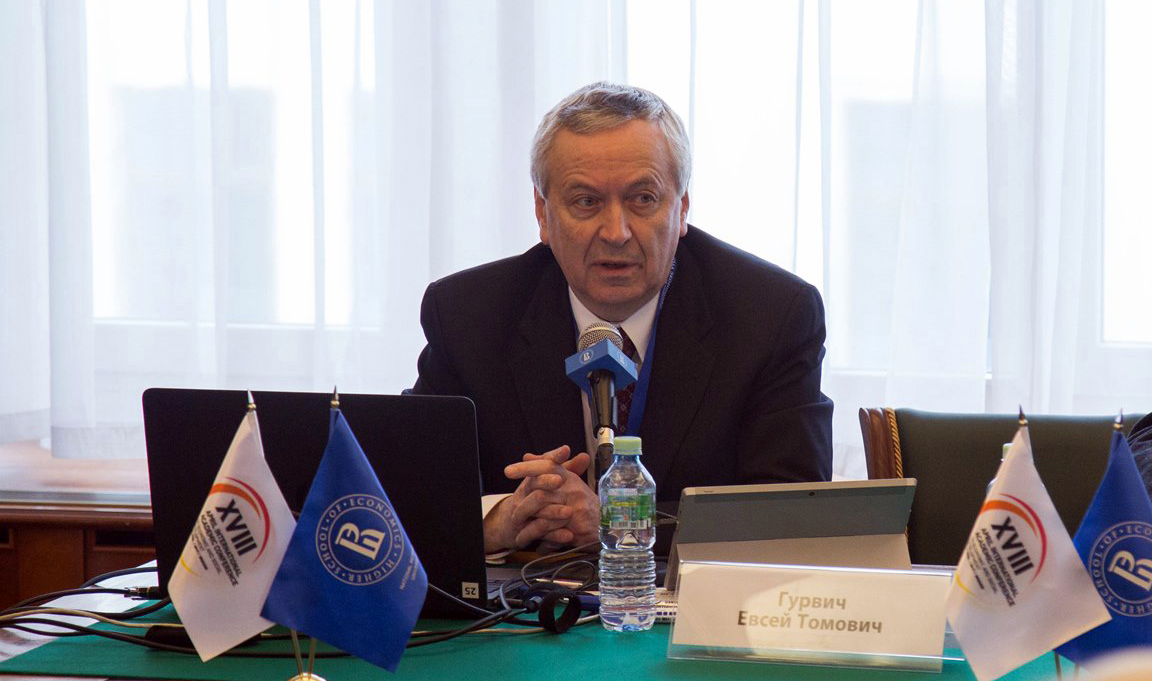
Photo: hse.ru
## Problems of growth
NT: *The President said that GDP has grown by 75% since 2000. Is this really an achievement? *
Evsey Gurvich: In fact, over 17 years (2000–2016) growth is even more - 88%. But this is still not so much. This is 3.8% per year, that is, it approximately corresponds to the average ICROUTIES. And the countries of our category, those called the forming markets, are growing on average even more. An important conclusion is that if we “clean” the results of the influence of fluctuations in oil prices, then the growth of the economy is slowing down in our country. For example, when we take indicators over the past 12 years (in 2005 the prices were the same as in 2016), we get the average growth rate of GDP of 2.5%. And this is already noticeably lower and the average -Ingoric indicators, and even more so the countries of our category.
In the future, a further slowdown in the growth of the Russian economy is expected. According to IMF forecasts, in the next 5 years, our growth will be only 1.5% per year. The negative trend is obvious. The president himself recently set the task of bringing the rate of economic growth to 2020 to the Sreder -Issue. This is a very difficult task, if at all, fulfilling. In any case, this goal can only be achieved due to supermargic reforms carried out on a wide front.
NT: *Do we, as the president says, has significant growth in many industries - in particular, in agriculture? *
Our agriculture is really quite a successful industry. But still, growth is not amazing: in 2015-2016, it was 3-3.5%. In addition, this industry decides little, since the share of agriculture in our economy is only 4%.
Industry growth is also observed, but it is also small. Last year - only 1.3%.
“The president himself recently set the task of bringing the rate of economic growth to 2020 to the mid -Issue. This is very difficult, if at all, feasible. This can only be achieved due to super -energy reforms "
NT: *Did foreign directive directs really occur? Is there a high -quality shift here? *
In 2016, they really raised, amounting to $ 32 billion, of which $ 11 billion was given to the privatization of Rosneft (that is, a one -time event). This is significantly larger than in 2015, but still much less than it was before the introduction of financial sanctions against Russia. From 2011 to 2013, the influx of direct foreign investment was on average more than $ 50 billion per year.
Numbers and "gingerbread"
NT: *President allowed raising the retirement age. He even mentioned the numbers - 63 and 65 years old. How do you look at this problem? *
Both I and other experts have long said that it was necessary and inevitably happen. This is a generally accepted practice, among the post -Soviet countries, only two have not yet increased the retirement age - Russia and Uzbekistan. It is important for us to do this, since life expectancy is growing, and the duration of a healthy, active life. A country where life expectancy rises, and the retirement age does not grow, sooner or later it will go bankrupt. The fact that the president first made such a measure is great progress, which opens the way to make a decision. At the same time, all over the world, raising the retirement age is a politically difficult topic. Usually, before the elections, everyone carefully avoids her. After the elections, I think we will inevitably have to do it.
NT: *How can this reform help the Russian economy? *
It will help both the budget, and the pensioners and business. If you do nothing, then either we will increase the gap between the pension and the salary, or all the budget money will be retired. It is realistic to assume that expenses from other budget items will move on retirement and the gap between the income of pensioners and workers will grow. You may also have to increase taxes in order to make ends meet. All this is bad and undesirable. We can avoid all these problems. Therefore, reform is extremely important for the stability of the economy.
“All over the world, raising the retirement age is a politically difficult topic. Usually, before the elections, everyone carefully avoids her. After the election, I think we will inevitably have to do it "
NT: *Putin said that about 42 million people from tax debts need to be released. It is, according to him, about 41 billion rubles. Will it be a competent step? *
In principle, this is not good, as it undermines tax discipline. People begin to hope that the next time they will be forgiven for debts, and therefore incentives for paying taxes are weakening. It is clear that the debtors will be satisfied. At the same time, this amount is noticeable for the budget, but not fatal (especially since a significant part of the debt will most likely never be paid). In general, this move is obviously politically motivated - this is a clear “pre -election gingerbread”.
The pace is not impressive
NT: *Discussing the Russian economy, Putin used the expressions “sustainable growth”, “sustainable financial and economic situation” and praised the government. Do you agree with such an assessment? *
The macroeconomic situation is really stable for us, although the drop in oil prices has created very serious problems. In real terms, budget revenues fell by a quarter, that is, a very serious “hole” formed in the federal budget. But the government firmly carried out budget consolidation.
On the other hand, there were a significant surge in inflation and destabilization in the foreign exchange market. And again, the government and the Central Bank took control of the situation. Now we have restored macroeconomic stability, the trust of investors has really increased, the influx of investors on the public debt market has begun. That's just the growth rate of the economy is not impressive. If the growth rates of the IMF predicts for a long time, in 1.5%, then we will not only not reduce the lag from developed countries, but also allow us to catch up with those whom we are still ahead. This, of course, is not at all what you can dream of.
NT: *The president defended the position of the head of the Central Bank and its strict policy. What do you think of this approach? *
The policy pursued by the Central Bank is generally true. Business wants cheap money, but partly it was corrupted by relatively inexpensive money available in recent years. Apparently, Vladimir Putin trusts the management of the Central Bank and does not interfere in their policy, does not “press” them. This is a sign of a healthy situation characteristic of developed countries. Many people criticize the Central Bank, claiming that there is a state system of the banking system. The entry of the Central Bank into the capital of several large banks is mentioned - “discoveries”, Binbank. But this is a forced measure. If the Central Bank can be reproached with something, so only because he did not prevent the problems of these structures that have arisen.