
Translated material
Living classic
110 years ago, the great architect Oscar Nimeyer was born

Cathedral in Brazilia (1960) Photo: Copa2014.gov.br

The Brazilian Oscar Nimeyer, who is sometimes called the last architect of the 20th century, was born on December 15, 1907 in Rio de Janeiro. From 1930 to 1934 he studied architecture at the National School of Fine Arts (now the National Architectural Institute). In 1936, under the leadership of Luchio Costa and Le Corbusier, Nimeyer, together with a group of young architects, designed the building of the Ministry of Education and Health in Rio de Janeiro. The construction was completed in 1943 and attracted universal attention not only as a public structure created using the latest architectural means, but also as the first example of using a solid solsema-dining screen on one of the facades.

(1942–1943) Photo provided by Moire
Outside of Brazil, Nimayer built a Brazilian pavilion at the World Exhibition in New York in 1939. In 1974, he acted as the main consultant during the construction of the UN headquarters building in New York. In 1955-1956, Nimeyer developed a project of the Museum of Contemporary Art for the capital of Venezuela Karakas, and for a permanent residential block in Berlin in 1957 in Berlin in Berlin. In 1966, he completed the design of the headquarters of the French Communist Party in Paris and the vast residential complex in the city of Grass near Nice.
In 1957, Nimeyer was appointed chief architect of Brazilia, the new capital of the country. Her master plan was fulfilled by Nimaier together with Lucia Costa. Nimeyer designed all large public buildings, including the Presidential Palace (Dawn Palace), the Ministry of Foreign Affairs (palace of arches), the building of Congress, the Supreme Court, as well as the Cathedral.
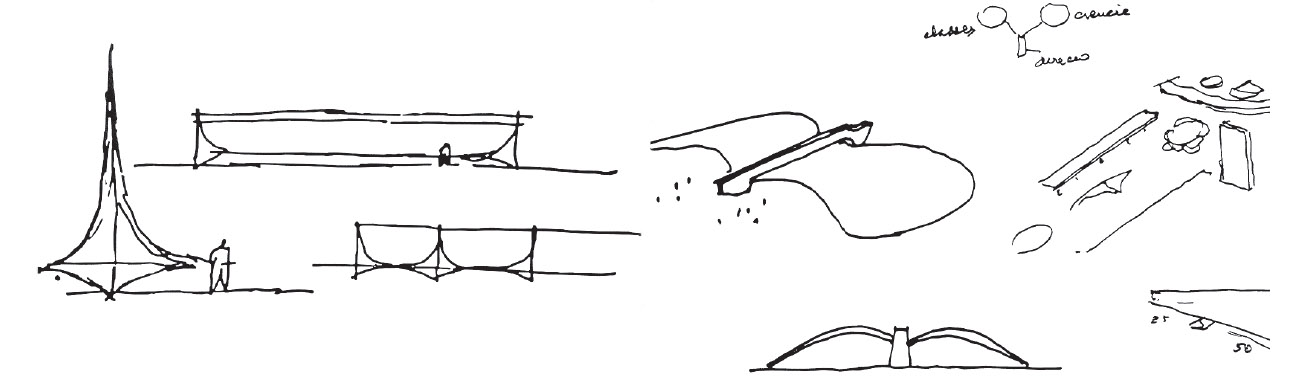
Sketches of O. Nimeyer

Museum of Contemporary Art in Niteria (Brazil, 1996) Photo provided by Muar
First published in NT January 14, 2008