
Translated material
How I ate a planet
The text continues the project on the Ecology "Variable" .
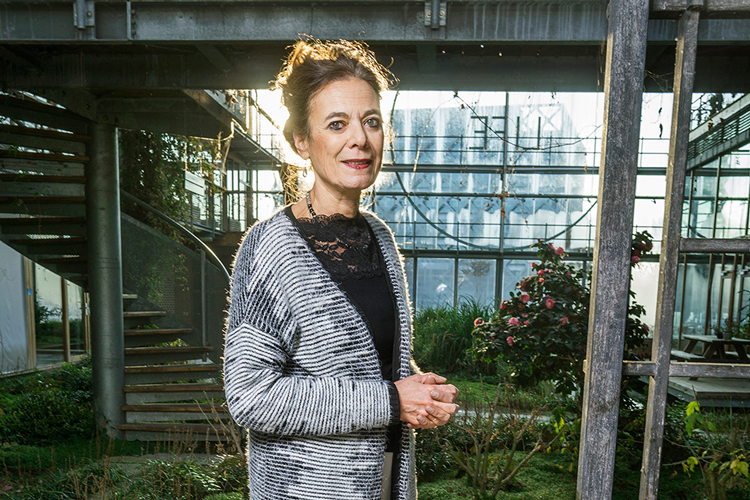
“The number of starving people in the world is reduced,” Louise Fresco, professor of Dutch Waglingen University and an expert in the field of agriculture began his performance. Fresco came to Russia as part of the Dutch Science Talks project, which is conducted by Nuffic Neso Russia and the Netherlands Embassy.
Strictly speaking, she was a little mistaken. Indeed, 25 years ago in the world there were more than 1 billion starving, gradually the figure decreased to 795 million in 2014, and a year later - to 777 million people. But in 2016,an increase occurred again : 815 million inhabitants of the planet chronically did not mean.
30 years ago, Fresco received a doctoral degree in the field of tropical agriculture to save the world from hunger. “On TV, newspapers and magazines were pictures of people starving in Africa. I realized that I would do this. I did not grow up on the farm, my father is a professor of philosophy. And yes, everyone was surprised by my decision. When I chose a specialization in agriculture at the university, this was also amazing, especially for a woman, ”says Fresco.
Three dozen years ago, a fifth of the population was starving on earth, in 2015 - 11%. However, then “we considered calories that will save people from hunger,” says the researcher, and now the task is “much more complicated”. To feed 8 billion people now and 10 billion people who will live on Earth in 2050 is one of the 17 goals of the UN sustainable development. But the achievement of one goal in itself does not mean anything: calories really will not save the world, well -fed people will not be able to live happily if the environment is not preserved.
“Now the tasks of the development of agriculture include the preservation of the climate, the care of the environment, the preservation of biodiversity, reduce the loss of crop and minimization of resources for the production of products,” Fresco explains.
Down with pesticides
According to the statistics of the food and agricultural organization of the UN ( FAO ), the total area of arable land in the world is 1.6 billion hectares, and in 2050 this figure will approach 1.7 billion hectares. Productivity after 33 years will grow to 4.2 tons per hectare against the current 3.2 tons. This is a significant leap in comparison with what humanity has already done: in developed countries, grain crops due to the improvement of agricultural technologies over a quarter century have increased from 1 ton to a hectare to 2.5 tons.
But the growth of space and productivity required deforestation, additional water resources, energy, as well as stimulating the productivity of the soil. This is active, or exhausting, land use, which inevitably poses the question before us: will future generations be able to feed themselves if their ancestors exhaust all resources?
“For a long time, ecology and agriculture have been in opposition. In the Netherlands, we succeeded in removing this contrast. If we produce products, then we do this with the help of the most gentle technologies for the environment, ”says Ms. Fresco and asks a controversial question:“ Who in the hall believes that organic agriculture will be able to save the world? ”
Two raised hands somewhat surprised the lecturer.
“When I ask this question in Europe, I see the forest of hands,” said Fresco. “To feed the world with the help of organic agriculture, six planets of the Earth will be required, this is impossible.”
A quarter of a century ago, there were more than 1 billion starving in the world, by 2015 their number was reduced to 777 million people. But in 2016, growth occurred again: chronically did not have 815 million inhabitants of the planet.
The easiest way to explain what organic agriculture is, as follows: it is agriculture that does not use artificial chemicals to combat pests or for plant growth. As a result, cucumbers, tomatoes, potatoes and other products in organics do not contain the number of chemicals that are in industrial agricultural products. In addition, the organic method of growing spares the environment: pesticides do not pollute the soil and groundwater.
“As far as I know, in Russia there is no standard for organic agriculture,” Professor Fresco, which has not yet ended, ends the that has not yet begun. In the November article to the APEC summit, Russian President Vladimir Putin wrote that the country expects to become a leading supplier of “environmentally friendly food” for neighbors in the region, but in the legislation there is no such thing as there is no state standard recognized by the international community on the production of environmental food products.
The owner of one of a dozen organic farms in Russia Ilya Kaletkin boils: “What is she saying what she says? Young people will think that organics is to knit bast shoes and walk with a seeder-wound, but this is not so. ”
According to Kaletkin, such generalizations are harmful to the development of organic agriculture in Russia: organics works on other principles, but this is definitely not a return to subseral and aggregate agriculture, as in textbooks on the history of the fifth grade. In the organic economy, selection is developed, and tons of “chemistry” do not pour tons of “chemistry” to combat pests, but use natural-nastic enemies, he says. “You can’t guess with chemistry - the pests only were won, and the plant became weak and did not cope with the disease. I'm not talking about many modern technology, which replaces manual labor and allows you to use chemistry. For example, there are special cars for weeding, ”Kaletkin said. In his opinion, in Holland, where there are few lands, organic agriculture is probably not a way out, but "in Russia, where there is enough space, such statements cannot be made, only organics should be on open ground."
“Agriculture should combine the best practices. In the Netherlands, for example, now they use 10% of the number of pesticides that were used 30-40 years ago, ”the Dutch expert is trying to convey the idea that traditional agriculture is moving to the minimum doses of“ chemistry ”.
Unhappy cows
The rural and forestry is responsible for the fifth of all global emissions of greenhouse gases. This is more than emissions from industry, and 1% less than from the sector of electricity and heat. According to FAO , greenhouse gas emissions from rural, forest, and fish farming have doubled over the past 50 years, and by 2050 they will grow by another 30%. The more humanity produces food, the faster the emissions grow - this accelerates the change in the climate, and it, in turn, adversely affects productivity (a vicious circle is planned). According to FAO , after 2030, the negative consequences of climate change for the production of crop production, livestock, fish and forestry will become more and more difficult in all regions.
At the same time, livestock and cattle are champions on methane emissions. In the last report of the UN climate experts ( IPCC ), data are given that the greenhouse activity of methane per 100 years is 28 times stronger than that of carbon dioxide, and in the 20-year perspective-84 times.
The climatic horrors of livestock do not end there. Only 10% of the energy that cattle receives in the processing of feed is transmitted to a person: the percentage of the efficiency of cows is half as lower than the efficiency of the old steam engine. In addition, cattle occupies a bunch of place. According to the FAO report , the area of pastures is twice the area of arable land, and pastures give only 10% of world agricultural products.
It seems that in order to save the climate, humanity has only one way out - to abandon livestock.
- Similar technologies are already existing now, but they are roads. But the windmills were roads 20 years ago, and now this is one of the cheapest types of energy.
“As soon as the income level in society grows, people begin to eat more meat. Plus, in some areas, such as Argentina or individual regions of Canada or the United States, you can not engage in crop production, but only cattle breeding. I do not urge you to eat 400 grams of meat a day, as some Argentines or Americans do, but it will not work to refuse meat. Meat is the most reliable and simple source of protein for children and women, so it cannot be abandoned in developing countries, ”says Professor Fresco.
She believes that both cows and climate can be saved. The main thing is to find a reasonable balance. According to Fresco, a protein of animal origin is necessary for a person. You can calculate how much it needs to be daily, by the formula: 0.6 grams per kilogram of body weight. It turns out that if you weigh 100 kilograms, a day you need 60 grams of protein, which are contained in 200 grams of meat. However, it is not necessary to get protein only from meat, it can be replaced with proteins from legumes or fish, Fresco believes.
In addition to reducing meat consumption, the researcher proposes to build livestock complexes of a closed cycle. The professor notes that such a task is more difficult than growing potatoes or cereals, since animals require more care and more ethical conditions of detention. But closed farms will allow you to control emissions of the same methane using filters. “Yes, cows and chickens will not graze in the meadows, but if they have enough space in the premises, then why is it bad? A reasonable approach is needed everywhere, ”she said.
Another way to reduce methane emissions is to change the diet of cows. In general, animals are not to blame for emissions, but food. American and Swiss scientists today are already offering new diets for cows, in which they will stop breaking methane.
The Dutch professor is confident that closed agricultural systems are the future of the agrarian complex. In her opinion, a quarter of a century will not pass, as farms will appear in cities in the cellars of buildings or in basement floors. They will be as automated as possible, provided with artificial lighting, and full control over the process will avoid unnecessary waste of water and energy. Another plus - instead of chemicals in a closed territory, it is easy to use “useful” insects to combat pests, and diseases will not be terrible at all (what diseases are in sterile conditions?).
“Similar technologies are already existing now, but they are roads. But the windmills were roads 20 years ago, and now this is one of the cheapest types of energy, ”adds Fresco.
Do not leave the crumbs
Theoretically, humanity is already growing enough food to feed everyone, but a third of the food is lost in the supply chain from the field to the counter. And another 30% of the remaining volumes are thrown out of the refrigerators without being eaten. Lost food is in vain labor costs and emissions of greenhouse gases, which could be avoided.
You can fight losses through agricultural mechanization. “I really like an example with a small robot that collects tomatoes. Compared to a person, he is more effective - he notices all the fruits and breaks them carefully. Losses at the stage of harvesting are reduced to zero, ”Fresco notes. But the miracles of technology do not end there. What are the seedlings, when even small farms come to the rescue of small farms in weeding, watering and monitoring plants. Farms in the city will also be useful, which will avoid losses when delivering products.
At the moment when the entire hall froze from the anticipation of the future beautiful green agriculture, an installation appeared on the screen, similar to the apparatus for the distribution of ice cream.
“This car can be called a 3D printer for food. Fall in the ingredients, and it turns out something that taste like meat. I can’t say that I am delighted with this idea, but you can load the remains of food or parts that we do not use into this device. And this will also reduce food losses, ”Professor Fresco wrote out another recipe for rational use of resources.
Lecturers of lectures continued to discuss what they had not yet eaten. "Professor, please specify now, now there are developments that allow you to eat insects that are also a source of protein?" - the young man asked a question. Fresco confirmed that there are such ideas, but noted that the process of growing insects (especially in the necessary quantities) is also energetically costly. The hall, which was quiet from an insect -earned prospect, was rustled, apparently realizing that mosquitoes and grasshoppers would soon enter the diet of a Russian.