
Translated material
Autumn Matriarch
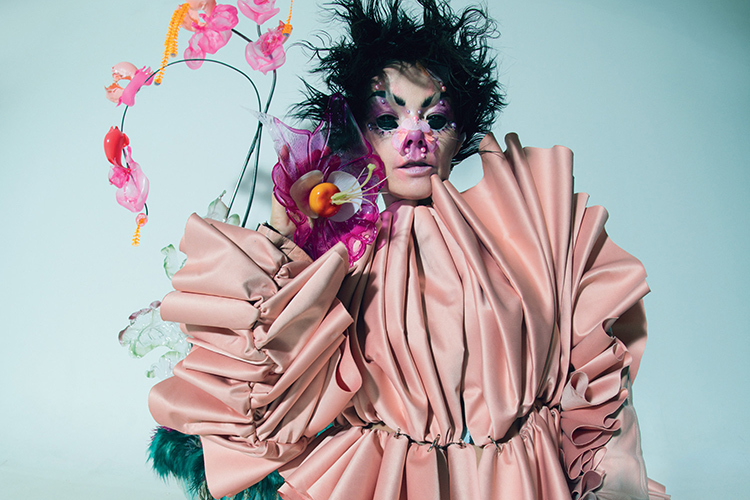
The Icelandic Diva Bjork, who became famous in his homeland at the age of 11, had long excluded herself from the category of ordinary pop musicians. She sees herself with a media artist who is sensitively responding to the challenges of modernity, reflecting on the future and working with modern technologies. De facto she, in whose project “ BJ ö Rk Digital ” , made in virtual reality, you can immerse yourself in the VII Moscow Biennale , and they are-the latest works by Bjork are difficult to imagine in the charts, but in Tate Modern or the Tretyakov Gallery on the Crimean Val - please. Spectacular, catchy, technological and enigmatically; than not exemplary specimens of the Council.
The new, 10th in a row, the album of Bjork is called “ Utopia ” , which is well mounted under the topic of any Biennale-modern artists like to speak out on the topic of utopias or anti-utopias; At least this follows from the accompanying exhibition of curatorial texts. If the previous album “ Vulnicura ” was served as a portion of reflexion over the gap with her daughter’s father, Matthew Barney’s media artist, as a natural piece of raw pain, then, according to the artist, she translates the focus from personal to general and addresses her audience - no less - with “new manifestation”. On the cover, Bjork appears in the image of an alien nymph with a flute, which has grown on the forehead, uh, orchid. The album completes the composition “Future Forever” , where, under joyful synthesizer drops, Bjork sings that we need to forget about the past and twist new nests, build “matriarchal temples” (no matter what it means) and build “musical forests”. The general tone of UTOPIA is optimistic, sometimes even radiant - especially against the background of the ink hmari Vulnicura . The harp rings, sings a flute, murmures of Bjork, tropical birds chirped, whose field recordings of which adorn this album, like flowers - the bride's wedding outfit. This gave a reason to many reviewers with relief to state that the singer recovered after breaking up with Matthew Barney and invites the listener to an audio travel in a bright tomorrow, to the flowering paradise of the garden.
As if not. “ Utopia ” is only disguised as dreams of the future, in fact it is a continuation of “ Vulnicura ” . A return to the past: Bjork is again trying to drag the listener into a funnel of his own pain and disappointment, and not everyone will seem pleasant and interesting. The matriarchal manifesto of Bjork comes down to the original idea that “all men are bastards” who inherit behaviors from their fathers, and they say, let's save our children from their mistakes. Illustrating the social ideas of Bjork in the sound, its permanent collaborator-the ARCA Venezuelan London, overdo it with its futuristic sound design, turning the difficult sound constructions of Bjorka who has abandoned pop semantics in a real test for ears. As, for example, in the puffing hatred and despair of " sue Me ” - a straightforward response to Matthew Barney, through a court to seek equal guardian rights over his daughter. On the best songs " Utopia " - " Blissing Me " and " Features Creatures ” -Bjork does not try to appear in an unearthly elf, Vizioner-Submarich or artist creating conceptual media projects, and remains a wounded woman who sings, charmingly pronouncing the old-fashioned word “ MP 3 ” in anticipation of new love. It is joyful to hear that Bjork is also a person.