
Translated material
Another large bank is leaving the Central Bank. Why is it important
A day after Vladimir Putin expressed the support of the Central Bank at a large press conference (having said, however, that he was “entered” by the materials for the regulator), it became known about the sanitation of another commercial bank by the state- Promsvyazbank . Under the control of the Central Bank, almost all the banks of the “Moscow Ring” (they are the “shot” list of the Alfa-Capital analyst).
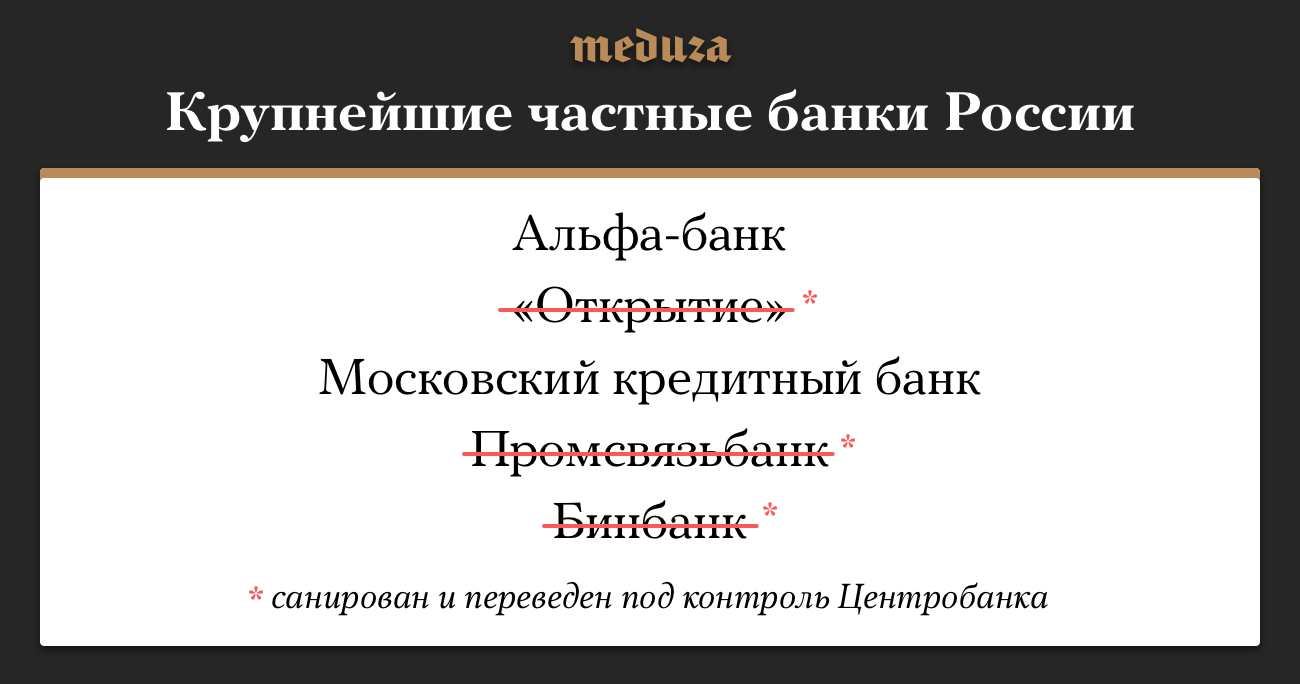
The Moscow Ring almost entirely passed under the control of the Central Bank. So informally called a group of banks: “Opening”, Moscow Credit Bank, Promsvyazbank and Binbank. The term gained fame not because of partial cross-owning by banks by assets of each other (hence the ring), but in connection with the letter of the Alfa-Capital management company. In August 2017, the director of the company for working with wealthy clients, Sergei Gavrilov, announced that the fate of all four banks "could be finally decided this fall." The letter in the Alfa Capital was withdrawn , but the forecast came true: all organizations except the Moscow Credit Bank have passed under the control of the Central Bank (he “escaped” thanks to the help of Rosneft). In the five largest private banks in the country, only the MKB and Alfa-Bank itself remained independent.
Now the Central Bank de facto fourth commercial bank of the country (according to the amount of assets of sanitized banks). Under the control of the state - including the assets of Sberbank, VTB and Rosselkhozbank - are already more than 70% of the assets of the banking sector. How the Central Bank will simultaneously manage the entire sector and several commercial banks, bypassing conflicts, is incomprehensible. President Vladimir Putin does not see a problem in this. “I hear this criticism in relation to the Central Bank: that by its actions the Central Bank, the banking system. This is not so, ”he said at a large press conference on the eve of the sanitation of Promsvyazbank, recalling that a total of more than 500 banks in the country.
How long does the Central Bank plan to do the rehabilitation of the largest banks is unknown. The head of the regulator Elvira Nabiullina said that the “discovery” and Binbank would be taken to the exchange after rehabilitation. But the head of VTB (the second bank of the country after Sberbank) Andrei Kostin does not believe that the Central Bank will be able to sell these banks - because in the current investment climate there are simply no buyers. Another option is to buy a state -owned bank (the same VTB has increased significantly in the last decade at the expense of mergers), but this will not solve the problem of the estimation of the banking sector.
Nothing changes for customers. So far it does not change. The sanitation under the wing of the Central Bank affects primarily the owners (who will lose assets) and creditors (who lined up in line to get their own). In the daily work of banks, nothing changes. The Rocketbank service, which was part of the “discovery”, even rejoiced at “nationalization”. But we must not forget that it was competition that allowed private banks to develop technologies, improve the service and reduce prices. Whether they will fight for customers with a single owner is a big question.
Mikhail Zelensky