
Translated material
“Well, mother, you give. You are a masochist "
Who are Orthodox psychologists and how they help believers
In 2016, more than one hundred thousand people with depression were registered in Russia - this is about 0.07% of all Russians . In fact, their number can be much larger: often people do not seek psychological or psychiatric help, believing that "they will cope themselves." Believers are accustomed at such moments to seek comfort in the church, although it seems to be far from science and operate with the concepts of “soul”, “atonement”, “sin”. In fact, faith and psychotherapy do not always contradict each other. Especially for Medusa, Julia Dudkin found out who Christian psychologists are, where to look for psychological help to a believer - and how psychotherapists help priests themselves.
In the spring of 2017, Eugene decided to go to a psychologist. A few months before, she broke up with her husband, she had three children in her arms. At first, she could not do anything at all and realized that she could not cope with the situation, it was time to somehow pull herself out. The woman to whom she turned to immediately started a conversation about sex and advised Eugene to find a man in order to “satisfy the needs”.
Eugene - Orthodox, goes to church and communes. Talking about “satisfaction of needs” seemed to her disrespect for her faith and life principles. “Then I decided to find a psychologist who adheres to the same moral position as me,” she says. Friends told her about a specialist who called herself an Orthodox psychologist.
At the consultation, the “psychologist” almost did not ask questions: she listened to the story of Eugene, and then said: “I will have a divest prayer, and you write it down and read it before going to bed.” Evgenia has historical education, and she is well versed in folklore. From the very first lines, she realized that she was not dictated by a prayer, but a conspiracy. “The conspiracy is always associated with the ritual - committed or pronounced,” explains Eugene. “It is as if you are guaranteed what you want for the implementation of this ritual.” Prayers never happen like that. I refused to record. "
Then the woman began to offer to guess on the cards or call her ex -husband - to convince him to increase the alimony payments. She did not contact specialists anymore.
Methods approved by the Church
In Russia, the market for psychotherapeutic services began to form in the 1990s - and there is still no single procedure for certification of specialists, nor mandatory requirements for their level, nor the state registry. Choosing a qualified psychologist or psychotherapist from a huge number of sentences is not easy. Many are afraid to seek psychological help precisely because there is a risk of stumbling on a non -professional.
To religious people to seek psychological help can be even more difficult. On the one hand, professional psychologists and psychotherapists work with patients regardless of their views and religion. On the other hand, there are scientific schools and methods that the church does not approve. This, for example, hypnotherapy (since the therapist allegedly receives power over the will and consciousness of a person) or classical psychoanalysis, that is, Freudianism, where psychological conflicts are explained by sexual drives (though classical psychoanalysis is almost not practiced in scientific circles). Therefore, religious people sometimes specifically seek a psychologist or psychotherapist who adheres to the same religion. As the psychologist Natalia Skuratovskaya explains, such people have specific problems, and they are easier to understand the one who thinks in the same coordinate system. Skuratovskaya itself is Orthodox, and patients who lead an active church life often turn to it.
“It happens that a person has been churching for many years, and he is getting worse. Sins cannot be overcome, but love for neighbors does not appear, ”says Skuratovskaya. She explains this by the fact that churching does not always mean spiritual life, but maybe its imitation. According to the psychologist, in such cases, a person accepts external requirements and invents an image, a “frame” - what should be a bona fide Christian; Trying to fit into this role. However, the gap between life circumstances and the idea of himself as an “ideal Orthodox” leads to complex internal conflicts. “Because of this, it does not go honestly to look at yourself and others, start working on yourself and get closer to God. This is such a magical perception of oneself - if you deny some qualities in yourself, then they seem to be not, ”explains Skuratovskaya.
The psychologist gives a simple example. The church gravitates to the patriarchal structure of the family, but in modern society this model is no longer always appropriate - social and economic circumstances have changed; An affiliate model of relations is becoming more and more relevant. Skuratovskaya says that if we impose “correct” behavior to himself and his family, this can lead to neurotization of all its members - both adults and children. For example, in such families it is forbidden to discuss sex - even thinking about it can be considered ashamed. According to the statistics of a psychologist, 80% of adolescents brought up in such a family abandon church life as soon as they receive independence. The rest often enter into early marriages with the same children from religious families.
Another problem is magical thinking. Some parishioners go to church for fulfilling desires and are waiting for rewards for prayers and set candles. “At a certain stage of development, we all think so,” says Skuratovskaya. - At the age of about two to five years, it usually seems that there is a kind of omnipotent creature, and you will get everything you want from him if you behave well. Some grow up without getting rid of this type of thinking, and with it come to church. ”
The Russian Orthodox Church considers mental illness "as one of the manifestations of the general sinful damage to human nature." But the Russian Orthodox Church admits that it is incorrect to reduce all mental illnesses to manifestations of obsession, and the use of clinical methods is permissible in their treatment. This is stated in the "Fundamentals of the social concept of the Russian Orthodox Church" - a document reflecting the official position of the Moscow Patriarchate in the field of relations with the state and secular society. According to the Russian Orthodox Church, for psychotherapeutic assistance to “mentally ill”, it is most effective to combine pastoral and medical care - in the distinction between the spheres of the competence of the doctor and the priest.
“Psychological education helped me in my work, but there was not enough psychotherapeutic training,” admits the rector of one of the temples in Vladivostok, the practicing psychotherapist Rostislav Frost. In the 1990s, he received a psychological education, in 1998 he became a priest, and then-a psychotherapist. True, he was not immediately able to choose the right direction of psychotherapy: most of the common methods for him, as a priest, did not fit.
In the zero in Russia, cognitive-bichevioral therapy began to gain momentum, which helps to adjust the attitude to the problem and human behavior in a difficult situation. Frost claims that this is a very effective method that does not contradict the Christian idea of a person-although it is admitted that other cognitive-bichiral therapists sometimes surprise when their methods are used in the church. Now the frost is included in the Moscow and St. Petersburg associations of cognitive-Bichenoral therapists.
According to him, many people with mental problems come to the temple, mainly with neurosis: “They are looking for help and comfort. Spirituals are good, but with their help you can not heal, often you need help from a professional. ” It is very important to consider the state of a person - for example, in the sacrament of repentance. As the frost explains, with severe neurosis there is always excessive self -digging and “self -eating”. If you demand a thorough study of his own sinfulness from a person, this can serve the bad service: a person is fixed on his own “poorness” and instead of relief of the soul receives an increase in neurosis. The improper use of religious methods can be very harmful to a person.
Fasting and prayer
This is what happened to Valentina (the name was changed at the request of the heroine). Voices became heard by her six years ago. They told Valentine that she needed to do something or go somewhere. “Once the voice said:“ Go to the neighboring house and wait for me there in an hour. ” He sounded as if not in my head, but from the side, ”says Valentina. “I went where he was led.” What happened next, she does not remember; It is only known that the inhabitants of the neighboring house called the police, and then Valentine was in a psychiatric hospital. She was diagnosed with schizophrenia.
“This is difficult to accept. Psychiatrists prescribed pills, but, returning home, I stopped drinking them and soon got into the hospital again, ”recalls Valentina. - Even then I did not reconcile with a diagnosis. Three years ago, from the city where I rented an apartment, I returned to my native village and went to church - to the priest. ”
In confession, Valentina asked the priest of the Council, but he replied that she did not have schizophrenia - this is demons mocking her. He advised to read “Our Father” and “The Virgin Mary, Rejoice”, observe posts, regularly confess and take communion. “I obeyed,” says Valentina. “I was so scared that I was ready to follow any advice.” Just then, after inpatient treatment, she became better. She believed that this helped post and prayer. She did not accept pills. “The priest said that people in the“ vegetable ”condition that I had seen in the hospital before, became such because of the drugs,” says Valentina. “And that my hospital is in the church.”
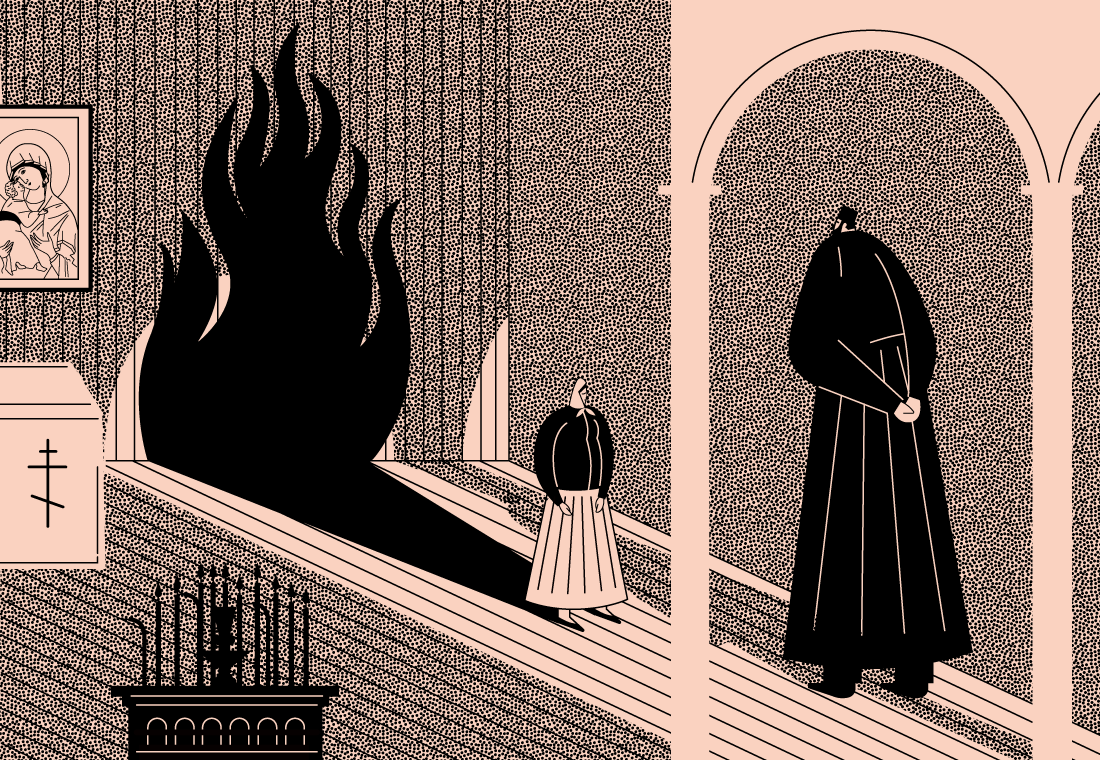
For about a year, Valentina read daily prayers, went to services, communed and confessed. “My daughter was six years old, and I took her to Sunday school. I constantly talked with the mother who taught there, ”says Valentina. - They said that both me and my daughter must fast. For all questions, I called them or the priest. ” In the village where Valentine lives, there is only one church, and there is nothing to compare with it. It seemed to her that this is normal when the head of the arrival and mother told parishioners how to live. “Now it seems to me that it was strange,” Valentine admits. “The priest in this church is very imperious, he ordered all parishioners to throw trousers and even walk in skirts in winter.”
Without the tablets, Valentina again began to hallucinations. When a neighbor, whom she considered a evil and unpleasant man, died, it seemed to her that demons "gathered around his house and escorted him." She did not see them, but "as if she felt." In 2016, shortly before Great Lent (at the end of winter), she still turned to a psychiatrist. “She asked how I live, what I was doing,” says Valentina. “I listened to my stories about demons and said that I am in an unstable state and I should go to the hospital.” Valentina decided to consult with the priest. He proposed to wait for the co -sordation - the church sacrament, which is performed to heal the diseases - and then decide by well -being. Valentina never went to the hospital.
Soon, relations with the priest began to deteriorate. Valentina's daughter wanted to dance instead of a Sunday school, and the head of the parish shouted that this was a sin. Valentina was worried, she got worse. In the end, she again went to the psychiatrist-and, despite the priest’s protest, she still fell into the hospital in the administrative center, for two and a half months.
“On this, my story with the“ church ”treatment ended,” says Valentina. - Now I go to a psychiatrist and constantly control my condition, and I can look at the story that happened to me with a sober look. I am still a believing person, but I don’t want to go to our rural church anymore. ” Valentina's daughter stopped going to Sunday school - she is engaged in pop vocals.
As the religious scholar and teacher of the Center for Studies of Religions of the RSUSU Konstantin Mikhailov, such stories are not uncommon. People in a crisis often fall under the influence of such “mentors”: they do not have enough their own psychological resources to make important decisions. Formally, in the Russian Orthodox Church itself, such abuses do not approve; There is even a special concept of “young nature”. As the teacher of the Sretensky Theological Seminary explains Archpriest Vadim Leonov, Little Management arises from conceit: this is a disease of the growth of a priest who "tries to act as a spiritual mentor, not possessing the corresponding gifts and abilities." Priest Dimitri Dmitriev in the material Pravmir.ru calls youngsters, the main temptation of a young priest: "The word of the priest is especially significant: it seems you just say, but you can destroy life to a person."
However, as Mikhailov says, in practice, such authoritarian mentoring often close their eyes. According to him, for the Orthodox environment, it is quite usually a critical attitude to psychiatry, reinforced by the stories about demons and even their “removals” - that is, exorcism. “The low level of natural-scientific education often leads clergymen to rejection of modern medical and, wider, scientific concepts. - explains Mikhailov. -Let us recall cases of support by clergymen of HIV-dissidential, theory of telegonia or anti-infruction. Therefore, if the priest advises you a psychologist, this is one. And if an “Orthodox psychologist” or a re -registration is completely different. ”
Christian psychology
In the church environment itself, they are increasingly talking about the benefits of psychological education. If the priest knows the basics, then he will be able to determine whether the parishioner needs the help of a psychotherapist or psychiatrist. Since the 1990s, many seminaries have been a course of general psychology. Orthodox media also often raise issues related to the psychology and relevance of psychotherapy for believers: “ Priest and psychologist: confrontation or alliance? "," The confessor and psychologist: What is the difference? "And even" why a monk is a psychologist . "
In the 1990s, some Russian experts and priests started talking about the emergence of the so-called “Christian psychology”-a scientific school, which proceeds from the principles of Orthodox anthropology. She considers man as the creation of God in his image and likeness, and death - as the transition of the soul into a different state.
One of the founders of this direction is the doctor of psychological sciences, professor at the Faculty of Psychology of Moscow State University Boris Bratus. He claims that Christian psychology is not a new phenomenon (Medusa spoke with Boris Bratus, but later he forbade to publish his words; all the quotes of brotherly are given by open sources). “The connection between psychology and spiritual education in Russia has been present from the time, since the time of the Kiev-Mogilyansk Theological Academy,” wrote brother in the article “Christian psychology as a scientific direction: to the history of the issue”. In 2015, this article was published in the National Psychological Journal established by Moscow State University. M.V. Lomonosov.
In his textbook “The Beginning of Christian Psychology”, published by the Publishing House “Science” in 1995, Brother explains that before the revolution, Christian psychology developed simultaneously with scientific psychology. The difference was that one direction was based on philosophical and religious traditions, and the other on natural science, materialistic. With the revolution of Christian psychology as a direction came to an end. This school reappeared only in the 1990s. At the Faculty of Psychology of Moscow State University, a circle appeared, where his brother held seminars on Christian anthropology and psychology. In 2002, at the Orthodox Institute of John the Theologian in Moscow, the Faculty of Psychology was opened under the leadership of the priest Andrei Lorgus. Boris Bratus also became the supervisor of the faculty. In 2016, at the faculty, the Moscow School of Christian Psychology was registered at the faculty.
Since 2009, the Institute of Christian Psychology has been working in Moscow. The institute’s website says that “psychology in general and the domestic school of psychology is especially far from Christian values,” but for modern Christian ministry, psychological knowledge is needed.
As Boris Bratus explains , Christian psychology differs from the usual one in that "is trying to correlate the corps of psychological knowledge, both existing and new, with the Christian concept of man." In practice, according to him, it looks like this: “Here is the situation: a person comes with a problem, something worries him, he is embarrassed, he cannot fulfill the task related to public action. And the psychologist can help him, that is, to teach him how to act in a certain way, but on this his task as a psychologist breaks off. In addition, the question is that, perhaps, the way the psychologist taught something to the patient actually harms him. And the therapist, who professes the direction of Christian psychology, will always remember this and will try not to make mistakes. ”
Не все служители церкви — даже с психологическим образованием — убеждены, что для помощи прихожанам необходимо специальное психологическое направление. Например, Ростислав Мороз к понятиям «православная психология» и «духовно ориентированная психология» относится осторожно. Он считает, что христианская психология пока недостаточно сформировалась, чтобы быть уверенным во всех ее представителях. По его словам, чаще всего практикующими «православными психологами» становятся обычные психологи, принявшие веру и пытающиеся вносить религиозные воззрения в свой труд. Учитывая, что мало кто из них получает хорошее богословское образование, результаты могут быть любыми.
«Попыток вывести понятие православной психологии, область ее деятельности и практического применения предпринималось много, но к единому знаменателю ученые и богословы пока не пришли», — говорит Мороз. По его мнению, стоит отдельно работать с расстройствами психики, и отдельно говорить с человеком о духовных вопросах: «Пусть это будут два разных компетентных специалиста, тем более, что между ними можно наладить взаимодействие».
С ним согласен кандидат биологических наук, директор Центра когнитивной терапии Яков Кочетков. «Людям любой конфессии ничто не мешает проходить психотерапию, — говорит он. — Вопросы веры и расстройств психики — это разные вещи, а некоторые специалисты, называющие себя православными психотерапевтами, иногда идут вразрез с принципами психотерапии». Например, бывает важно помочь клиенту научиться отстаивать свои права, но «православный психолог» с недостаточной психологической подготовкой может решить, что такой подход противоречит христианским ценностям.
Возвращение в реальность
«Прежде чем покончить с собой, я решила привести свои дела в порядок, — рассказывает Анна (имя изменено по просьбе героини). — Я представила, что вот я умру, родственники приедут заниматься похоронами и скажут: „Сдохла, а за квартиру не заплатила, кучу хлама оставила“. Я начала разбирать полки, экономить, чтобы заплатить за жилье на месяц вперед».
Все началось за несколько лет до этого, когда Анна вышла замуж. Брак длился три года, и все это время Анна с мужем постоянно ссорились и дрались. Он приходил домой «под кайфом», Анна выгоняла его из дома, но, когда он уходил на несколько дней, не спала ночами и пыталась до него дозвониться. «Когда я выходила замуж, знала, что он покуривает травку, — говорит женщина. — Но это ведь многие делают, и я не думала, что наркотики скоро окажутся для него на первом месте. Мне хотелось сделать ремонт, может, завести детей. Но в нашей жизни был сплошной хаос».
Однажды у них произошла серьезная драка — муж, по словам Анны, «прыгал у нее на голове». В травмпункте выяснилось, что у женщины сотрясение мозга и сломаны два ребра. Анна собрала вещи и позвонила друзьям, чтобы они ее забрали. «У меня есть собственная однокомнатная квартира, я поехала туда и две недели никуда не выходила. Просто лежала и смотрела в одну точку. Могла целый день не есть, а потом вспомнить, что голодна, и опустошить холодильник», — вспоминает Анна. Ей казалось, что она совершила предательство по отношению к самой себе — вышла замуж за человека, который ее бил, и позволила ситуации зайти так далеко. Она постоянно корила себя, напивалась и плакала.
Когда жить стало не на что, Анна устроилась работать в транспортную компанию. Но работа не отвлекала от проблем. Иногда посреди дня она осознавала, что уже час сидит и ничего не делает: «Я не могла понять, куда делся этот час, о чем я думала, что я делала. Он как бы съедался. Это стало меня пугать». Так прошло около трех месяцев. Периоды «зависания» становились все длиннее — теперь Анна не всегда могла вспомнить, как прошли последние три-четыре часа.
Все это время за Анну очень переживала ее сводная сестра: постоянно звонила, пыталась развлечь, вытащить из дома — и в какой-то момент уговорила женщину сходить к психологу при храме. «Я к тому моменту уже твердо решила, что уйду из жизни, и не хотела принимать никакую помощь. Но сестра так уговаривала, что я уступила. В конце концов, что мне было терять?», — вспоминает Анна. У нее было много предубеждений против психологов: она думала, что специалист будет «внедряться к ней в мозг», применять что-то вроде гипноза. Она была совершенно не настроена что-либо ему рассказывать — собиралась прийти, сказать, что у нее все в порядке, и вернуться домой.
«Когда я заявила, что у меня нет проблем и психолог все равно не сможет мне помочь, он сказал: „Все ясно“. И предложил прогуляться по парку, — говорит Анна. — Я все ждала, когда он уже начнет свои манипуляции с моим мозгом, но вместо этого он предложил мне съесть мороженого и начал беседовать на какие-то повседневные темы, как будто мы тысячу лет знакомы. Постепенно я расслабилась и втянулась в беседу. Он уже не вызывал такой настороженности». Анна решила, что придет в храм еще раз: на следующей встрече она рассказала психологу про расставание с мужем и побои.
«Он сказал: „Ну, мать, ты даешь. Ты же мазохистка!“ — вспоминает Анна. — Мы много говорили, он давал задания. Однажды попросил отвезти посылку в храм на другом конце Москвы и там заодно предложил исповедаться. Я приехала, встала перед батюшкой и разрыдалась на весь храм. Но потом мне стало легче».
Постепенно Анна перестала думать о смерти, она больше не «выпадала» из реальности. В итоге решила вернуться к мужу — ей казалось, что она все еще его любит. Когда женщина призналась в этом психологу, он сказал, что у нее созависимость и помог найти психотерапевта, который специализируется именно на этой проблеме. Именно с ним Анна и продолжила свою терапию. «Раньше я даже не знала, что такое созависимость, — говорит женщина. — А теперь поняла, что для меня такие отношения были зоной комфорта, потому что я выросла в пьющей семье. Я узнала про треугольник Карпмана и научилась останавливать себя прежде, чем в него попаду».
Ясное желание помогать
«Психолог при храме», к которому попала Анна, — Михаил Хасьминский, руководитель кризисного центра при московском храме Воскресения Христова на Семеновской. Бывший майор московской милиции, Хасьминский получил второе, психологическое образование в Академии МВД России — на кафедре психологии, педагогики и организации работы с кадрами. В 2002 году он създил в Троице-Сергиеву Лавру, приложился к мощам Сергия Радонежского и, как говорит , понял, что занимается не тем; у него «возникло ясное желание помогать больным раком». Так он стал работать психологом в Российскомонкологическом научном центре имени Блохина, а спустя несколько лет возглавил Центр кризисной психологии, созданный по благословению патриарха Алексия II в 2006 году.
Хасьминский считает, что в особо тяжелые, кризисные моменты духовно ориентированная психология оказывается куда эффективнее, чем светская. «Я понял это, когда работал в онкологическом центре, — говорит Хасьминский. — Я видел: если мать теряет ребенка, то часто в этой жизни для нее уже ничего не важно, она не может найти ни утешения, ни объяснения тому, что происходит». Хасьминский утверждает, что в такой ситуации обычные психологические методы оказываются бессильны — а священник может дать человеку поддержку.
Хасьминский не работает с органическими депрессиями или зависимостями, которые требуют длительной терапии. К нему приходят люди, которых нужно быстро «привести в себя» в критической ситуации. Обычно это тяжелые разводы или смерть близких. «Человеку, чтобы выйти из тяжелого состояния, нужен мощный внутренний ресурс, энергия, — говорит Хасьминский. — Но именно в кризисных ситуациях у людей нет такого ресурса. Христианский подход дает им его — акцент переключается с этой жизни, которая на данный момент утратила для человека смысл, на другую, вечную. При христианском подходе цель человека — не прожить жизнь весело и без проблем, а воспитать свою душу для царства божьего».
Впрочем, как считает Хасьминский, у методов христианской психологии есть научные объяснения. По его словам, таинство исповеди оказывает психотерапевтический эффект, потому что это интроспекция — человек внимательно изучает свой внутренний мир, разбирается в себе. А если мать, скорбящая об умершем ребенке, начинает заботиться о его душе — молиться за него, делать добрые дела — это помогает ей не замкнуться на себе, преодолеть фрустрацию и начать адаптироваться в новых условиях.
В то же время Хасьминский скептически относится к светским методам кризисной психологии и считает, что она всегда основывается на вере: «Я не знаю ни одного человека, профессионально работающего с горем, который был бы атеистом. Чтобы помочь человеку пережить трагедию, надо иметь свой прочный фундамент, который удержит самого психолога и даст ему возможность удержать другого. Иначе очень быстро произойдет выгорание».
В кризисном центре кроме него работают пятеро психологов. Попасть туда можно по предварительной записи, оплата — добровольные пожертвования. На сайте центра говорится, что их размер никак не влияет на качество оказываемой помощи. Приходить туда могут не только религиозные люди. «Я все-таки в первую очередь кризисный психолог, — говорит Хасьминский. — Моя цель — не обратить человека в веру, а помочь ему преодолеть кризис».
По его словам, главное отличие православного психолога от светского — в том, что православный относится к человеку не как к «набору неких химических процессов или привычек», а как к душе, уникальной и созданной Богом: «И эта душа будет свидетельствовать обо мне на страшном суде».
Гореть верой 24 часа в сутки
Психологическая помощь бывает нужна не только прихожанам, но и самим служителям Церкви. Наталия Скуратовская седьмой год работает со священниками — и из своего опыта знает, что они, как и представители других профессий, сталкиваются с кризисами и выгоранием.
«Однажды Архиепископ Петропавловский и Камчатский Игнатий предложил мне провести тренинг для священников — помочь им развить в себе любовь к ближнему, эмпатию», — рассказывает Скуратовская. Это происходило в 2010 году, и задача для того времени казалась шокирующей — чтобы женщина, к тому же мирянка, чему-то учила священников. «Многие из участников настороженно относились и ко мне, и к психологии в целом», — вспоминает Скуратовская. Она говорит, что в семинариях обычно есть только общий, довольно формальный курс психологии, «но он не всегда развенчивает миф о том, что психология — сатанинская наука, а психологи конкурируют со священником за душу паствы».
Психологу пришлось объяснять священникам, что это не так — и постепенно стена недоверия исчезла. «В первый день тренинга мы занимались групповой работой, а потом я объявила, что готова пообщаться индивидуально с теми, у кого есть вопросы, которые не хотелось бы обсуждать в группе». Скуратовская думала, что к ней обратятся два-три человека, но в итоге ей пришлось несколько дней до полуночи заниматься психотерапией.
Оказалось, что у священнослужителей много своих проблем. На них часто возлагают завышенные ожидания — и прихожане, и священноначалие. «Нередко от священника требуется гореть верой и служить пастве 24 часа в сутки, — говорит психолог. — Многие сначала стараются так делать, но у них быстро происходит эмоциональное выгорание». Выяснилось, что кризис мотивации у многих случается еще и из-за того, что реальное положение дел в церкви не всегда соответствует декларируемому. Кроме того, нередко священники не понимают, что делать с человеческим горем — у прихожанина случилась трагедия, а неосторожными советами и высказываниями ему можно навредить.
На Рождественских образовательных чтениях в 2011 году Скуратовская выступила с докладом о том, почему священникам нужна практическая психология. «Реакция была очень неоднозначная, многие возмутились, — говорит психолог. — Но после этого ко мне стали постоянно обращаться за помощью священники, матушки и просто воцерковленные люди».
Сама Скуратовская не называет себя ни православным, ни христианским психологом. «Я прежде всего психолог, специалист. В то же время я верующий человек и понимаю проблемы воцерковленных людей», — говорит она.
Юлия Дудкина