
Translated material
Catch and forgive
In Russia, people are increasingly making them apologize to the camera. For what? Where did it come from?
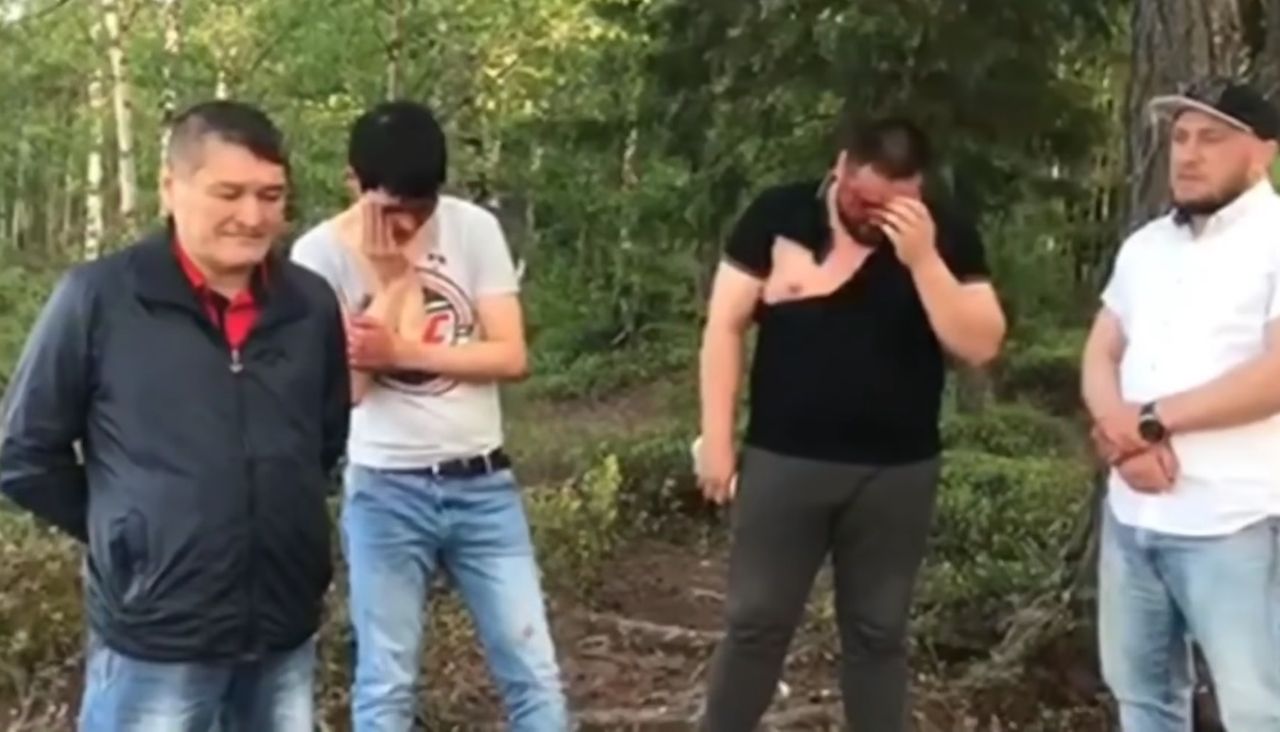
The practice of forced or forced apologies for the camera has become widespread. On December 9, a video appeared on which the student of the RANEPA Oleg Tereshchenko is forced to apologize for the comment on VKontakte that traditions are forbidden to meet the Russians, although according to the law it is impossible to limit their freedom. Two days later, Comedy Club Production Director Andrei Levin had to apologize for a joke about the Ingush girl from the escort agency in the issue of the Comedy Woman show-after several dozen Ingush came to the company's office to find out relations with the management. A little later, the channel released a video in which several TNT employees ask for forgiveness to the Ingush spectators at once. Medusa studied dozens of cases of public apologies of recent years and talks about the features of this genre - and about where it could come from.
An apology on the air
On December 18, 2015, a plot of the head of the Republic of Ramzan Kadyrov with a resident of Chechnya Aishat Inaeva was published on the Chechen State television channel “Grozny”. Inaeva sits on the edge of the sofa, looks at the floor and, it seems, with difficulty holding back tears. The woman is so depressed that Kadyrov cannot force her to speak and turns to her husband, who sits nearby: “Magomet, for the sake of Allah, make your wife ask me questions!” Near the chair occupied by Kadyrov, on the couch is the chairman of the Chechnya parliament Magomed Daudov and at that time the head of the administration of the head of the Republic Islam Kadyrov. Inaeva says almost nothing, only asks for forgiveness and justifies.
Shortly before this meeting in WhatsApp (this application is one of the main informal media in Chechnya), an audio image of an employee of the rehabilitation center Aishat Inaeva appeared, where she complains to the practice of collecting preparations for housing and communal services. Inaeva complains about the poverty of ordinary Chechens and criticizes Kadyrov for the “window dressing” - and because he distributes luxurious gifts. At a meeting with the head of the Republic, Inaeva renounced her words and admitted that she "probably clouded the mind." Ineva was collectively condemned at the gathering of the inhabitants of her native Nadterchensky district: at least hundreds of people under the chairmanship of Islam Kadyrov and local elders gathered in the hall.
The video with an apology of the Chechen blogger Adam Dikaev appeared on the Internet two days after the plot about Aishat Inaeva. In the video, a young Chechen without pants goes along the treadmill, explains that he is nobody, and sings the song "My best friend is President Putin." A week before that, the blogger criticized Kadyrov for the fact that he published a video on Instagram on the anniversary of the beginning of the Chechen war, on which he is engaged in the treadmill under this song.
Probably the apology of Aishat Inaeva and Adam Dikaev, which occurred in 2015, are the first widely known samples of the genre, which actually appeared a few years earlier. He does not have strict canons, but there are common signs: a person in the frame looks humiliated - and it is unlikely that he can refuse to participate in the recording of the video.
The head of the human rights organization "Committee on Prevention of torture" Igor Kalyapin, who worked in Chechnya for many years, has no doubt that people from the rollers with apologies simply have no choice. “I think that his [Adam Dikaeva] somehow very seriously forced such a“ apology ”, because for the Chechen Republic it looks very shameful-without pants on the treadmill.”
According to Kalyapin, before they apologize, people in Chechnya often disappear for several days. So it was in the case of the publicists Rizwan Ibragimov and Abubakar Didiev. They disappeared on the night of April 1, 2016, and a few days later appeared at the meeting of Ramzan Kadyrov with Chechen historians and writers. In the plot of the Grozny television channel, Ibragimov and Didiev stand with frightened faces behind the audience and listen to how they condemn their books. In the end, they do not just apologize to the camera , but after the theologian they repeat the words of prayer for the remission of sins. A few months later, the court recognized the books of Ibragimov and Didiev with extremist. Ibrahimov at the trial showed that after the arrest he spent four days in the Department of Internal Affairs of the Oktyabrsky district of Grozny, where he was tortured by electric shock .
Refusal to apologize can lead to serious consequences. Tatyana Lokshina, program director of the Moscow Bureau of Human Rights Watch, in a conversation with Medusa gives as an example the high -profile case of the Chechen politician Ruslan Kutaeva. He participated in the conference at which Kadyrov’s decision was discussed to transfer the day of memory of the victims of the deportation of Chechens of 1944 from February 23 to May 10 - the day of the funeral of Akhmat Kadyrov. The conference participants were summoned for a conversation with Kadyrov, but Kutaev did not appear. In the summer of 2014, he was sentenced to four years in prison for drug storage. “For a person of the caliber and age of Ruslan Kutaev, the accusation of drug storage is a kind of humiliation, and this is just a punishment for refusing to apologize,” Lokshina explains. According to Kutaev, after the detention he was beaten and tortured .
Since then, several dozen cases of public apologies have been mentioned in the media. Most of them are personally addressed to Ramzan Kadyrov or to the Chechen authorities. According to Lokshina and many other experts, it was Kadyrov who set the standard, which has now spread beyond Chechnya.
Check the complaint
Judging by the plots of the Grozny CHGTRK over the past year, it is not at all necessary to directly criticize the Chechen authorities in order to become a hero of a humiliating report. It is enough to complain, publicly seek help or in some other way to hint that the authorities of the republic are ineffective.
“People in Chechnya should rejoice, praise their ruler, as Kadyrov is called in recent years,” explains Igor Kalyapin. “And every person who is dissatisfied with something is a disguised enemy, he needs to be exposed and forced to apologize.” According to Kalyapin, those “enemies” who dare to file official complaints about the actions of officials and security forces to the prosecutor’s office or the Investigative Committee are very cruel. He gives an example the case of a resident of the village of Kenha Ramazan Jalaldinov, who recorded a video message to Putin and complained of corruption. After that, Jalaldinov burned the house, and he himself was forced to flee from Chechnya, threatening the fate of the dead brothers of the Yamadaevs and Boris Nemtsov. Relatives of the Chechen, who recorded a video message, said that they were taken away at night, threatened to throw them into the abyss and shot over their heads. Those who simply complain about life in social networks do not pursue - but they become heroes of humiliating reports on the “formidable”.
Kalyapin says that such reports are part of the campaign against complaints, which, according to his assessment, unfolded two to three years ago. He notes that before those who complain could put pressure - for example, to dismiss from work - but not so hard.
Medusa studied almost two dozen such stories. All of them are arranged in a similar way and try to convey the same simple thought: to complain on the Internet is bad and ashamed. Here is a approximate plan of a typical report in this format:
The author of the report says that in social networks or in WhatsApp such a video / such a complaint is distributed - in the frame they show a screenshot or a fragment of the roller.
On behalf of the head of the republic, a special commission gathers to figure it out - usually it includes very high -ranking people: ministers, heads of districts and others. In the rarest cases - Kadyrov himself.
It turns out that the author of the complaint or the hero of the scandalous video himself is to blame for everything. His motives may be as follows:
I wanted to attract attention, throwing false rumors and gossip,
I wanted to enrich myself at someone else's expense, to improve housing conditions.
Relatives of the hero of the report and other interlocutors of reporters explain that he is all right, and complaints are far -fetched.
Members of a special commission are indignant that people are dissolving false information, although in the republic so many things are done for public safety / health of people / well -being of the poor / comfort of women in labor. They complain that false complaints distract state bodies from assistance to those who really need it.
The hero of the report admits that he was wrong, and apologizes or simply stands with a shameful look.
The author of the report ends the video with the moralizing that it is impossible to spread rumors and gossip and try to cash in at the expense.
The report of February 15, 2017 entitled “Gossip and rumors in social networks has recently turned into a social instinct” can be considered a kind of manifesto of the genre. The plot tells about the resident of Chechnya, who on Instagram asked Kadyrov to help his sick child. He should not have done this, because helping the boy is in the proper volume. The Minister of Health of the Republic Elkhan Suleimanov explains that the main motive of such appeals is “improving housing conditions or obtaining material resources”. But the main trouble is not even this, Suleimanov continues, but in the fact that experts are forced to be distracted in vain. The boy’s father does not appear in the frame with an apology, but there is a comment by the psychologist Elena Serdyukova - she explains that the spread of rumors in social networks is necessary in order to cause people to discontent with state bodies and destabilize society.
Here are a few more characteristic examples. The WhatsApp got a video from the Grozny maternity hospital - an elderly resident of Grozny in hysteria scolds doctors who treat her daughter. The speaker of the Chechnya parliament, the prosecutor of the republic, the deputy minister of the internal affairs, the Minister of Health and others leave for the place. It turns out that the woman raised a panic in vain. Now she may face criminal prosecution under articles about slander and giving false testimony. A woman with tears in her eyes apologizes and says that she is disgraced and it would be better to die.
Albina Idrisova complained about WhatsApp that school teachers are forced to collect money for children's campaign in the circus. It turns out that everything was wrong. The woman admits that she spread false information without even reading the message. The author of the report ends him with these words: “The rash and frankly ridiculous act of Albina Idrisova put the whole family in an inconvenient position. Forgetting the golden rule of life “to think before doing”, an adult woman is forced to find an excuse today. ”
Other videos made in a similar format:
- The crew of the Grozny CHGTRK clarified the situation with the resident of Urus-Martan Sultan Shidaev
- All new publications appear on the Web, in which they ask to help raise money for treatment
- Gossip and rumors recently flooded social networks in Chechnya
- The appeal of a 53-year-old resident of Grozny has spread throughout the republic in a matter of hours
- The publication of the poor old woman from the village of New Solkushino spread in social networks
- Dzhaubatyrovs from Alkhan-Yurt do not need anything
- The next appeal to Ramzan Kadyrov was an attempt to cash in
Distribution of the genre: not only inside Chechnya
In early 2016, the format of public apologies spread beyond Chechnya. The deputy of the city council of Krasnoyarskastan Senchenko, in response to the insulting statements of the head of Chechnya about the Russian opposition, called him on Facebook “shame of Russia”, which “discredited everything that is possible”. A few days later, Kadyrov published a video on his Instagram, where the deputy asks for forgiveness for his words: he made such a decision after "talked with representatives of the Chechen people." The negotiator was then Buvaisar Saitiev, a three -time Olympic freestyle wrestling champion and an honorary resident of Krasnoyarsk. Senchenko later assured that he did not expect a video to publish, and he apologized in a personal conversation. The deputy said that he was not threatened, but hinted at possible troubles.
The main rabbi of Moscow Pinhaas Goldschmidt in February 2017 said that "99% of terrorists are Muslims." He had to apologize for all Muslims, and published his appeal on his Instagram all the same Kadyrov. He suggested “bring the line under the discussion,” which followed after the rabbi statement.
Since the beginning of 2016, several videos have appeared, where people had to apologize not before Ramzan Kadyrov, but to Ramazan Abdulatipov, who then held the post of head of Dagestan. On one of the videos, unknown people beat a person right in the frame and require an apology.
The most high -profile case occurred in July 2017: a resident of the Nogai district of Dagestan Ravil Tangatarov recorded a video with insults to Abdulatipov; The very next day, he published an apology address - but the story did not end there. Soon a video appeared in public, where tangatars beaten into the blood and his acquaintance ask for forgiveness from the head of Dagestan.
You have to apologize not only to the heads of the republics. In May 2017, the Petersburg Gazeta published an interview that the Ingush should “thank Stalin” for the deportation of 1944. The director of the company, which owns the newspaper, came “strong guys”, as they were called in the editorial office , and recorded a video with an apology.
In November 2016, even Raper's purulent had to apologize : he asked for forgiveness immediately among the Chinese, Armenians and Chechens. Punch, for which the rapper apologized, sounded on Battle in October 2014; However, only two years later - after a wave of apology before Kadyrov - purulent, threats on social networks began to come.
Now anyone can apologize to anyone and anyone, as happened in the case of a student of the RAM Oleg Tereshchenko, whom classmates forced to ask for forgiveness for insulting, in their opinion, comments on VKontakte. In social networks, on request “forced to apologize” there are other similar videos - for example, a video about the Dagestan, who first offends Chechens and Ingush, and then asks for forgiveness. “I did not know what I did,” says the author of the video. “No matter how much a person is, death and Chechens will follow for the insult of the Ingush and Chechens.”
Why apologies are so important
The Chechen society is built on the principles of honor - not only its own, but also a clan, explains the director of the Center for Analysis and Prevention of Conflicts Ekaterina Sokiryanskaya. “If you have humiliated you and your family could not answer, then all your relatives suffer - your sisters will not get married, your brothers will be more difficult to get to work, and the whole family will be reduced in their status,” the expert says. According to her, it is precisely this circumstance that makes the practice of public humiliation with such an effective method of controlling society - even more effective threats to murder, because Chechens are not afraid of death. Another method is to put on relatives; Because any person perceives a threat to their own security than the safety of their loved ones.
Sokiryanskaya assumes (and Tatyana Lokshina, the program director of the Moscow Bureau of the Moscow Bureau of the Moscow Bureau, agrees with her) that the origins of the Chechen forced apologies should be sought in another similar local practice - when relatives of militants are forced to publicly deny their relatives, so completely deleting them from the life of society.
According to experts, coercion to abdication has been practiced in Chechnya from the end of the 2000s. One of the striking examples is the story of Aslanbek Bakharchiev. His son Zelimkhan was suspected of recruiting participants in the attack on Grozny in December 2016, during which several police officers were killed. Three days after the terrorist attack of Zelimkhan’s father, a very elderly person with cancer, brought together with other men of the family to the area of their native village. Relatives of the dead police officers, representatives of the authorities and the clergy gathered there. In the plot on the Grozny TV channel, relatives directly say that they declare “blood feud” to this family (the author of the report is stipulated that the authorities are actually fighting with this practice, but it is difficult to “refuse people in moral law”). After giving, all the men of the Bakharchiev family left the village. Aslanbek Bakharchiev himself died soon, and the authorities, according to one of the fellow villagers , did not allow him to bury him on his native land.
The Chechen authorities have repeatedly openly stated that the close suspects would be responsible for terrorist crimes: more than once, they burned at home, and people themselves were forced to leave the republic. According to Ekaterina Sokiryanskaya, the authorities consider relatives to be a “accomplishment base”, although they are well aware that relatives most often do not know that their children fell under the influence of a terrorist organization.
Igor Kalyapin is also sure that public apologies and public renunciations are manifestations of a “ general trend”. «Это придумали кадыровцы — с учетом местного менталитета: они понимают, насколько травматичным является публичное унижение», — говорит правозащитник.
Правозащитница Татьяна Локшина уверена, что именно чеченская практика принудительных извинений задала стандарт для всех остальных. По словам Локшиной, количество публичных извинений увеличивается, потому что федеральная власть никак не реагировала на чеченские примеры, даже когда извиняться приходилось жителям других регионов, например красноярскому депутату.
Alexander Borzenko