
Translated material
If the evil is stopped
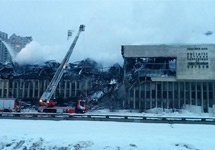
In the Presidium of the Russian Academy of Sciences, they want to liquidate the Institute of Scientific Information on Social Sciences. This was reported by the chief researcher at the Institute of Europe of the Russian Academy of Sciences Yuri Borko, who has been working in Ionia for more than 20 years.
The meeting took place on December 15th. "Several members of the Presidium, as well as representatives of institutes in unison, said that they did not know what INION was doing, and the need for its existence as a center of scientific information in the field of social sciences has disappeared," Borko said. Only two speakers spoke out in support of the institute.
At the same time, the meeting was not originally invited to the former director of INION Academician Yuri Pivovarov, who now holds the post of supervisor of this institute. According to Boro, Pivovarov received an invitation only after he personally contacted the President of the Russian Academy of Sciences Alexander Sergeyev and said that "to discuss the fate of INION without the participation of a person who was 17 years old and remains a supervisor is simply unacceptable."
However, Sergeyev, who came to the middle of the meeting, said that he intended to personally understand the current situation. He invited Academician Pivovarov to a meeting, which should take place on Monday. “This conversation will not bring any final solution, but it retains and, perhaps, strengthens hope a bit,” Borko said.
On the evening of January 30, 2015 , a fire began in the INION building on Nakhimovsky Prospekt, which continued all night . Fire covered 2 thousand square meters. 1 thousand square meters has a collapse of the roof. The fire was localized, but the firefighters could not extinguish the fire for a long time. Separate foci of combustion were preserved until the morning of February 2.
More than 5 million copies of scientific publications stored in the Institute Fund were lost. Almost half of them cannot be restored.
In September last year, the Urban Planning and Land Commission of Moscow decided torestore and reconstruct the burned-out building of INION . Officials assured that after completing the work, the building would retain its functionality and will be used for scientific activity. Meanwhile, a few months before, the INION team expressed concern for the reconstruction project. The project of restoration of the stock of funds that had at their disposal did not correspond to the volume of library funds.
The initial Wiion was placed in a building on Krzhizhanovsky Street. However, on July 27, it became known that the institute received from the "control of special detachments" of the fan order to leave this room . In a letter addressed to the director of INION Ilya Zaitsev, it was stated that the building, built in 1954, needed urgent major repairs. It was noted that the commission with the participation of representatives of the FSB, the Ministry of Internal Affairs and the Russian Guard discovered "hazardous areas and critical elements of the object that do not allow third parties to be in the building." Where exactly the INION should move, the document was not said.
At the meeting of the INION labor collective , scientists refused to move . According to the leading researcher of the Institute, Olga Kiyanskaya, the agency demanded that the institute move to the premises of the All-Russian Institute of Scientific and Technical Information (Vinity), which is not prepared to accept INION. In INION, they fear that in the future the institute can be united with vinity.
On August 2, Fano said that INIONwould not be relocated from the building on Krzhizhanovsky Street until coordination with the leadership of the Institute for the EXTITURE. On December 11, the agency reported that the decision to move has not yet been made. At the same time, the management company demands to free the building until January 9.
INION is the country's largest scientific center in the field of social and humanities. His library has about 14.8 million books in ancient, modern eastern, European and Russian languages, including rare editions of the 16th - early 20th centuries. The library has the most complete, and in some cases, the only collections of documents of the League of Nations, the UN and UNESCO, the US parliamentary reports (since 1789), England (since 1803), Italy (since 1897) and one of the largest collections of books in Slavic languages.