
Translated material
Scientists have created a strong self -healing polymer
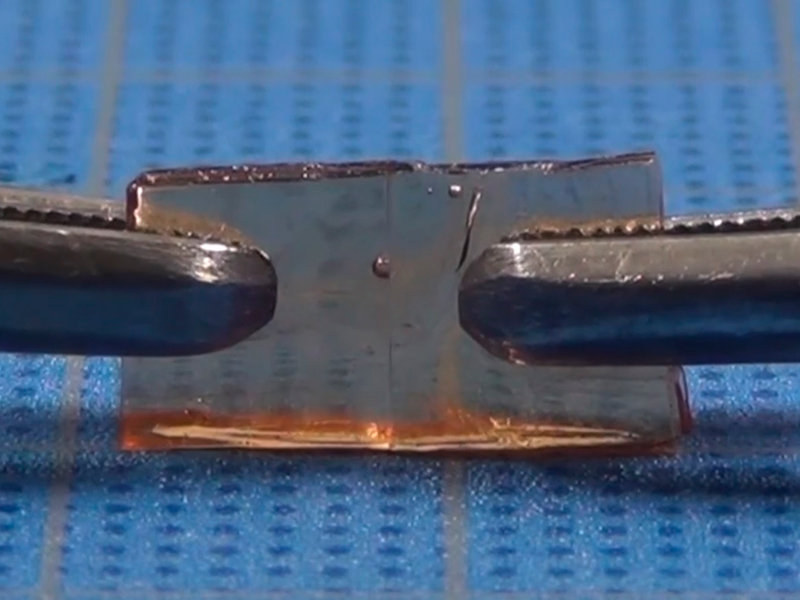
A group of researchers from the University of Tokyo has developed a strong polymer material that can quickly recover after damage at room temperature due to the large number of hydrogen bonds. The article on new material was published in the journal Science .
As N+1 resembles, to date, scientists from different countries have created a number of materials that can restore damage, but they are all not devoid of shortcomings. For example, some can restore a limited number of times, while others are soft in nature, which limits the possibilities of their practical application. In addition, to restore, such materials must be heated to high temperature.
The Tueg3 material created by Japanese scientists (polyifortiomo-based-3) resembles translucent glass and is characterized by abnormal amorphousness . At the same time, unlike some other materials, it does not crystallize during restoration and does not become fragile. This is due to the fact that the chains associated with hydrogen ties are very poorly ordered and more resemble zigzags. At the same time, a large number of hydrogen connections allows Tueg3 to easily heal damage.
Judging by the demonstration video, two rectangular pieces of a polymer of 10*20*2 mm in size, tightly pressed to each other by half a minute at a temperature of 21 degrees Celsius, are firmly interconnected, and the fragment formed with a load with a load of up to three hundred grams. The properties of the damaged material are completely restored in a few hours.
Another attractive feature of the new material is that it is quite simple to synthesize. This increases the likelihood of its entry into the market in the foreseeable future.