Date
Author
Вера Юрченко, Арнольд Хачатуров
Source

Preserved copy
Translated material
Old Guard
The functionaries of "United Russia" may return to "Youth Policy"
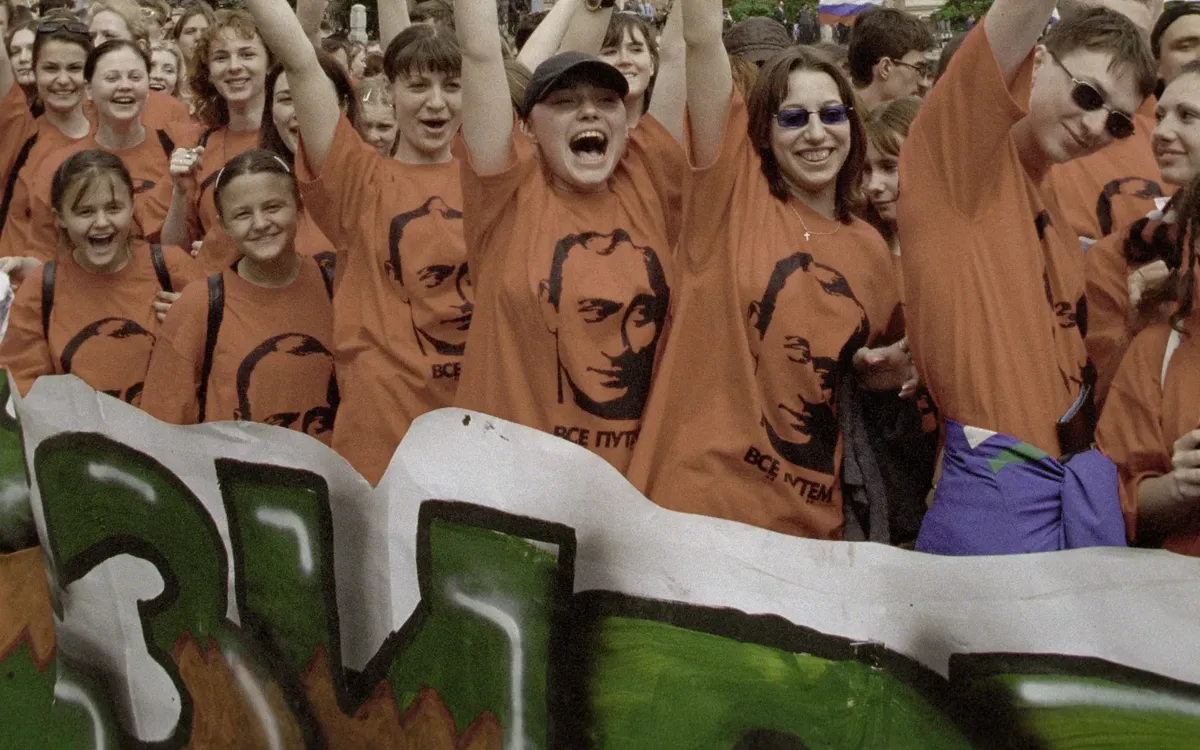
During the press conference of Vladimir Putin on December 14, the VKontakte regional communities began to appear the same posts with the hashtag #Putinkrut and the Prochrevsky movement “The Young Guard of United Russia” (Mger). Users of the social network drew attention to the unusual composition of the participants in the action: some records with quotes of the president were published on behalf of accounts belonging to long -dead people. The press service of VKontakte later said that all “suspicious accounts” were hacked. The representative of the “Young Guard” Anna Rogacheva, in turn, stated that the publication of campaign posts from the page of the dead is associated with an attempt to discredit movement.
The scandal around the activity of the “Young Guard” occurred against the background of personnel permutations in “United Russia”, which can affect the youth structures of the party. In October, Andrei Turchak was appointed acting secretary of the ER General Council, whose political career began with the post of head of the Coordinating Council of the “Young Guard”. According to rumors, Turchak plans to reform the “young guard” due to inefficiency and combine movement with the youth platform of United Russia. “Mger projects should have a specific electoral effect in the elections of all levels of power,” said Turchak at the end of October. "New" recalls how the pro -Kremlin youth movements have changed over the past 17 years.
Hopes of the young man
Young people have traditionally played an important role in Russian politics, says Andrei Kolesnikov, the head of the Internal Politics program of the Moscow Center of Carnegie. “Any power, especially the autocratic type, is interested in the youth constitute the future electorate, future army and secret services. That's exactly why the authorities are very actively working with youth so that it does not go somewhere to the left-to independent NGOs or in informal forms of existence. ” Specific forms of work with youth changed along with high -ranking politicians who oversee this direction. “When it was Vladislav Surkov ( the deputy head of the presidential administration from 1999 to 2008, the first deputy head of the AP from 2008 to 2011 - ed. ) With his sophisticated methods, various organ organizations were created,” the expert notes. “They were quite effective from the point of view of the confrontation between the democratic movement and NPOs.”
In 2000, the protege of Surkova Vasily Yakemenko founded the movement “Walking together”. The organization spent its first significant action, on which there were calls not to drink, not smoke and support Vladimir Putin on November 7 on the Vasilievsky descent. Later, the members of the movement were marked by the burning of the American flag near the US Embassy building in Moscow, conducted a long -term procession on the first anniversary of the president’s inauguration, and in 2002 they built a fake toilet on the theater square, in which specially printed brochures with excerpts from the books of Vladimir Sorokin were burned.
At the demonstration in defense of the 2004 Constitution, activists of the movement threw dirt into the portraits of politicians Grigory Yavlinsky, Gennady Zyuganov, Sergey Glazyev and Vladimir Ryzhkov.
In 2005, “Walking Together” replaced the new Prochrevsky movement - “ours”. It was a time when the authorities needed to solve specific problems - first of all, to prevent an orange revolution and prepare a personnel reserve, says Elena Omelchenko, director of the Center for Youth Studies of the Higher Superior.
Created against the background of the so -called “color” revolutions in Georgia and Ukraine, the “ours” movement became the main shock force of the Kremlin in street political actions. Activists of the movement at different times picked up the embassies of the United States, Japan, Estonia, Ukraine, Latvia, pursued the British ambassador Anthony Brenton, urging him to send him from the country for contacts with the Russian opposition, in December 2011 they tried to prevent protest promotions in the center of Moscow.
The elevator is nowhere
One of the most noticeable projects of “ours” was the educational summer camp on Lake Seliger in the Tver region. In the camp, activists from all regional and city departments shared experience and underwent ideological training. Vladimir Putin, Dmitry Medvedev, Sergey Lavrov and other prominent politicians came to the Seliger forum. However, over time, the events in the camp acquired a scandalous character. At one of the shifts of 2010, the “nurses” arranged an installation “here are not happy with you” against the “enemies of the Russian authorities”: they stuck sticks with photographs of human rights activist Lyudmila Alekseeva, ex-president of Georgia Mikhail Saakashvili, former US Secretary of State Kondoliza Rice, ex-head of Yukos Mikhail Khodorkovsky and even director Quentin Tarantino.
After that, foreign companies (Panasonic, Mercedes-Benz, Moleskine, etc.) refused to spend money on the vacation of Prochrevskaya youth and turned the project financing, motivating their decision to get involved in politics. In 2015, Rosmolodezh and Rosmolodezh discerned from the multimillion -dollar project. Andrei Kolesnikov believes that the pro -Kremlin youth projects did not become social elevators for young people - only units were able to get a real career impetus.
Seliger was often used by young people in their interests, and not in accordance with the political goals of the organizers - for example, to expand social ties, Omelchenko adds.
Simultaneously with the “ours” in 2005, a forge of personnel for the party “United Russia” - “Young Guard” was created. From the very first days, a rivalry for the administrative resource arose between the two youth movements, despite the fact that both the goals and methods of the organizations were very similar - they are associated with the search for enemies of the current government and the opposition of the opposition.
Activists of the “Young Guard”, as well as “ours”, picked up diplomatic buildings, in particular, Estonia Estonian, due to the government’s intention to equate the day of liberation by Soviet troops with the Day of Trira. In 2007, Mger organized a picket of the Coalition Congress “Another Russia”, scattering in the place of images of dollar bills. For participants in the movement, exercises were conducted in Chelyabinsk, where prostious youth worked out the skills of power struggle against the opposition. Later, the main activity of the “Young Guard” migrated from the streets on the Internet. The movement organized the Media Guard project aimed at identifying sites with unlawful content, launched the school of bloggers “Protot”, and also took up the newsletter of political spam in social networks. Last week, Mger was completely accused of disseminating information on behalf of deceased users.
The Russian youth movement gave rise to a whole stream of smaller initiatives. “Some of them were organized by the commissars of“ ours ”who gained experience in serious projects and a feeling of some power,” says Omelchenko. - These movements “for moral order” are not very numerous, but very diverse from the point of view of the composition - these are “stop bole”, “pigs against”, “eat Russian”, “sober Russia”, “pure Russia” and so on. ” Despite the elimination of the movement “ours”, some of their projects today continue to exist autonomously.
The dead end of the "Surkov" model
With the advent of Vyacheslav Volodin, to the post of deputy head of the AP, instead of Surkov’s movements, more straightforward methods of working with youth came to the fore. “Organizations of the Surkovsky type ceased to be mainstream. This power is still easier to form a “unarmia” than to invent different “military” organizations, ”explains Andrei Kolesnikov. The “combat” communities - “anti -Maidan” and “night wolves” - are relatively active today and have a different age composition and poorly reflect the interests of youth.
At the same time, against the backdrop of the protest activity of Alexei Navalny and updating the search for the “image of the future” of the country, the authorities to the youth agenda grew. In particular, the topic of youth was supposed to play an important role during the current presidential campaign of Vladimir Putin. “I see in the young generation a reliable, strong support of Russia in a stormy, difficult XXI century,” the president said in a message to a parliament a year ago. Kolesnikov believes that now the Kremlin takes care of forming an “electoral plankton” - conformist young people who will continue to vote for this power.
However, in comparison with the times of Surkov, Russian youth has changed significantly, which means that the authorities will have to look for new methods of interacting with it. Massive youth importers, as in Moscow in 2011-12, are impossible and even dangerous today, Elena Omelchenko believes. Some traditional forms of youth policy have been preserved-for example, who came to the place of the warlike Seliger “Territory of meanings” and the camp for gifted children “Sirius”-but the authorities are increasingly noticeable to reorient to more point types of associations. “Large mobilization projects organized from above have no more prospects,” she notes. “Politicians are trying to solidarize with fashionable bloggers, to use alternative styles and communication channels.”
As the deplorable state of most youth projects has recently shows, the authorities have achieved extremely modest success in attempts to correspond to the changed reality. Youth Policy can be implemented in several versions, says Mikhail Vinogradov, president of the St. Petersburg Politics Foundation, but now in Russia it has neither intelligible purposes nor effective tools: “It is difficult and generally not clear why the youth should have preferences), an attempt to translate a youth language policy (but this is still unlikely) and involvement in work) and involvement in work) “Activists” - those who are more active than others seek to achieve power and public recognition. ” According to the political scientist, the last model is best worked out in Russia, but it is effective only in conditions of stable youth moods, and not when the pendulum is swinging.
Today, the position of the pendulum of public moods is such that for most young people politics and civic activity are parallel universes:
“Elections behavior is boring and uninteresting, and various projects related to volunteering and lower activity develop very actively,” says Omelchenko. - There was a need for exclusivity and individual self -development, the willingness to join in civil activity if the values of the community coincide with the values of a person.
The only thing that may interest young people in formal policy are issues of justice, inequality and the fight against corruption, the sociologist believes. However, the probability that the Kremlin will build a youth policy around these topics is almost zero.