
Translated material
Thirty years with the right to correspond
The St. Petersburg historian Anatoly Razumov created the "Leningrad Martyrologist" with tens of thousands of names of the repressed
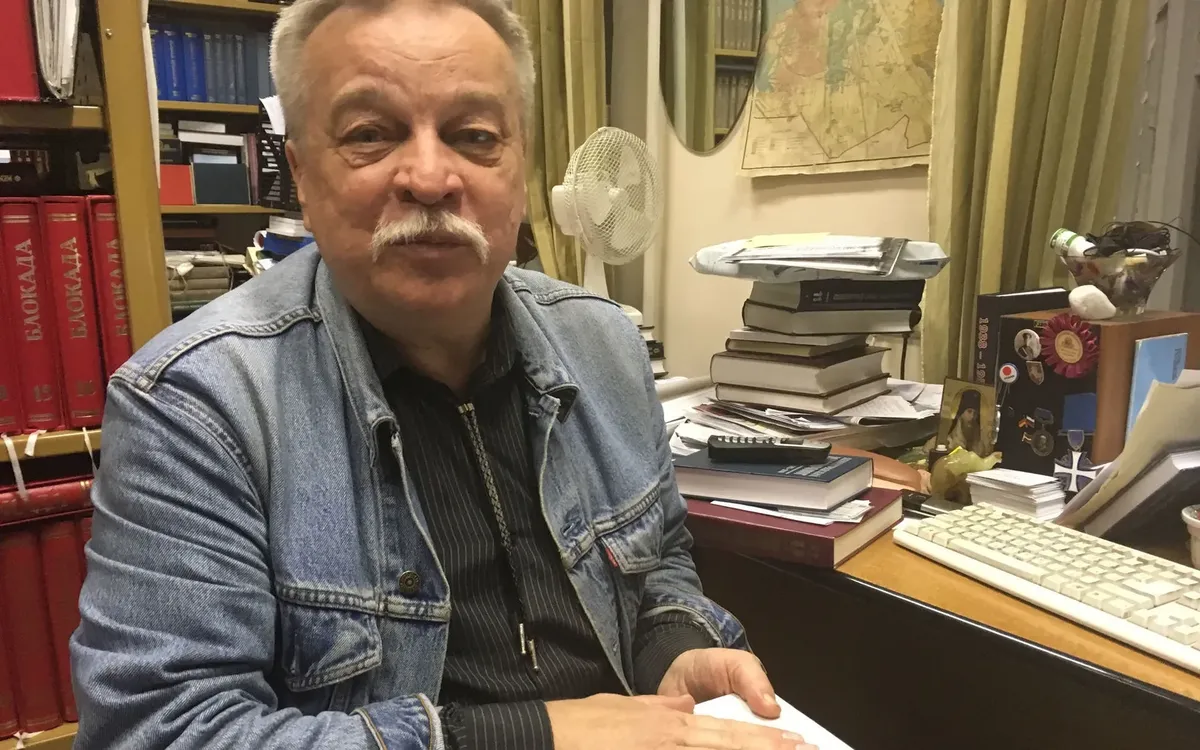
For thirty years, historian Anatoly Razumov has been looking for the names of the repressed and collects by the crumbs of their biography. He has been doing this for exactly as many years as they speak at all about repressions in the recent history of Russia - since 1987. His “Leningrad Martyrologist” is a collection of 16 volumes, they have 50 thousand names and biographies of only executed Leningraders. He is one of the creators of the Levashovskaya Wasteland memorial on the site of the former Fixing Polygon of the NKVD.
We met with Anatoly Razumov in his office in the St. Petersburg Public - the Russian National Library. On the door it is written: the center “Returned names. The editors of the Book of Memory "Leningrad Martyrologist". Below - a portrait of Solzhenitsyn. At the request of the writer, the rations made a named index to the “Gulag Archipelago”.
In a small room, similar to a book warehouse, we were looking for a long time where to stick chairs to sit down. Then they cleared the corner on the table to attach the recorder.
“It seems that they will soon be supplanted from here,” I nod to folders with business, at books that no longer fit on racks, so they rise in piles on tables, on chairs, on the floor.
Reason laughs. To show me some kind of document, he will then accurately reach out to the desired stack and pull out the desired sheet. It will suit the rack and, without looking, will get the desired book.
“For a year and a half,“ Great Terror ”is the most murderous period of Soviet and Russian history,” says Razumov. - Murderous - in the most literal sense. He reached the goal: the country's population was paralyzed by fear. The logic of the action of this power is amenable. After all, they just didn’t shoot like that: they had to accumulate megatons of papers. It was necessary to create the appearance of justice - the most advanced in the world. Cases, criminal articles, everything had to be preserved. “Accounting and control”, as Ilyich taught them. But in fact, these were mass killings. People were dumped into a hundred -meter trenches, as in Butov, half -dead. Nobody watched the executions. But then - with the entire paper "lining". And then for another 50 years they lied to relatives.
"We did not miss a single name"
Anatoly Razumov began to look for the names of the repressed in 1987, when there was still no access to the archives, but there was a public library, where he, a historian, purposefully came to work. In 1989, the USSR prosecutor’s office began to revise the affairs of the Stalin years. Rehabilitated names were published in newspapers. With this, the “returned names” of Razumov began.
- I became one of the compilers of the Digest "Pages of History". We gave a completely new historical journalism - about the executed, about the places of executions.
Now on the site “Returned Names” you can find all the information that has been preserved about the victim of terror. And in the 1990s, everything that appeared in the press, he handfully transferred to catalog cards, and put them in alphabet into library boxes.
“The site is 14 years old,” Razumov says. - When we created it, we immediately decided that we would write about everyone: war, blockade, repression. I do not divide our great story into parts, it is alone. In one family, people died in the blockade, and at the front, and were shot.
So the Leningrad Martyrist multi -volume appeared.
“We have not missed a single name,” Razumov is sure. “Over the years, I have worked out all the documents I knew to me related to executions in Leningrad and by orders from Leningrad.” From 1918 to January 1942. All. So the names are known.
For 30 years, he read a thousand investigative cases in the archives. “Probably a thousand,” adds. Because he never kept the accounts read. But the first thing that he read in the FSB archive in 1991 still remembers.
“That was the case of Malyar Vasily Zhgutov,” says Razumov. - Very convex. Zhgutov was a malarus, but he could have plastered and build, do everything. The family lived in the Yaroslavl region. Collectivization came, and they were given the so -called solid task. That is, they took everything from the peasants. It meant death. And he escaped. He left for earnings, created the Shabashnikov brigade and worked. He lived in Lomonosov. They caught him on denunciation. After all, people now do not understand how it was done. Zhgutov received a denunciation from a secret informant: I, they say, was sitting at the house on a bench, and nearby a citizen of Zhgutov reasoned that the war in Spain, they say, would end, and then they would attack us. And this year was idle. And in 1937, a plan for arrests came-and Zhgutov was taken. In the case, there are, as it were, denunciations of members of his brigade. It was “how”: the investigator called these people and asked what the burning bothers them? The workers said: it does not give drink, stingy, presses with money - he himself distributes everything. And Zhgutov was shot. According to plan.
"Chekists painted the things of prisoners"
Zhgutov’s case began to look for rationov in the archives, because the granddaughter of the malarus wrote to him. She found the name of her grandfather in the newspaper and asked the historian to find out the details. Until now, minds receive two dozen such letters per week, someone comes to his library, someone writes on the site. This is a source of information for both parties.
-Everyone who turned to me, I ask you to write something on behalf of the family: what was the person that was remembered about him today, how arrest happened, how they recognized the truth, how it all affected the family. These are key questions. And then, please, write what you want. And many write. Sometimes completely beautiful texts.
He and now on the monitor screen - a letter. When I came, he just wrote the answer to the unfamiliar Larisa Viktorovna. A woman is looking for a grandfather who shot in 1938.
“She found his name on our website,” says Razumov. - He writes that I would like to get acquainted with the case. I will explain where to go, to whom to write, what documents to cook. And I will send her the pages of the "Pomeranian Martyrologist", where her grandfather is mentioned. When contacting the authorities, she will be able to attach them to, this is an official book published by the prosecutor's office in Arkhangelsk.
On the walls he has drawings and portraits. These are those who helped him look for the repressed, those who were repressed, those who were looking for relatives. In one picture - a man with glasses with a sad smile. Razumov himself was never familiar with him. But he talks about him as a close one.
“This is the architect Boris Genrikhovich Kreutzer,” he raises his eyes to the picture. - His wife Tamara died in a week how I began to get acquainted with his business. But there are many of his friends. I persuaded them to write about him. And I have an image of a fantastic person. There were always some camp stories and bitter humor with him. Boris Genrikhovich told me a lot. Already "from there." A lot of things that we did not understand about that time before.
The architect Boris Kreutzer miraculously escaped the execution: the investigator lied in the papers. The Chekists turned everything in, so as not to shoot inadvertently the wrong one who was “necessary”. Not out of pity for people, but because the reporting had to converge.
“Kreutzer was sentenced to death,” says Razumov. “But the investigator, in order to more restorely bring him to the highest measure, attributed to him another nationality and another place of birth.” The cruisers were brought to the execution, but referred and postponed the execution until the fall of 1938.
On November 1938, historians dating the completion of the “Great Terror”: “deuces” and “three” were eliminated, the prosecutor's office entrusted the supervision of the investigation. Mass executions stopped.
“Apparently, they decided that the enemies have already been destroyed,” Razumov grins. - And even with the overfulfillment of the plan. In Leningrad, it was necessary to shoot 4 thousand, and shot 40 thousand. Where is it next?
They did not have time to shoot all the sentenced ones. Among such “unreliable” were the cruiser.
“Those who still had to be shot in the fall of 1938, 999 people remained in Leningrad,” Razumov continues. - Of these, as it turned out, two hundred to the executions did not live, died in prisons. They tried it by pieces of paper, not seeing people. Five hundred people were released. And three hundred were locked in the camps, including the cruiser. He survived in the camp and in 1954, when it was revised, he told the prosecutor the whole story. He recorded this as a novel. Boris Genrikhovich possessed a phenomenal memory, he even remembered the names of the investigators, the numbers of their offices.
And so, thanks to an unfamiliar “unheard of” cruiser, Razumov found out how investigators cooled the protocols, how people were killed on these protocols, where this happened.
“The cruiser drew the attention of the prosecutor to the fact that the interrogation protocols are handwritten, and there are printed ones,” Razumov continues. -We thought that the manuscript was a draft, but it turned out-on the contrary. Printing is what the investigator worked with. He “agreed” with the case on some version of the testimony-the protocol was reprinted. Until they finally agree or until the investigator is lost patience. Then the printed sheets were copied by hand - as it were, this is the protocol. He led the corridor to the execution, Boris Genrikhovich describes how the clothes were thrown into a heap, how their hands were knitted, how they were interrogated for the last time. And this happened not in a large house, but in a prison on Nizhny Novgorod Street, which is now Academician Lebedev Street. There and now a prison - pre -trial detention center No. 4.
But there are things in the file cabinet of affairs in which no one writes letters. Natives either do not remain, or they are not looking for anyone, or do not know what can be sought. Or, the historian adds, they are afraid. Because fear still has not gone anywhere. And then all the information for books of memory is what you find yourself. Where? Often - in prosecutorial documents of the first “thaw”.
“It was such a thing Vanya Ovekosnov-a 12-year-old boy who only ran into his village from Estonia,” Razumov recalls. - He was taken by the border security officers - and they blinded the matter of a huge spy organization. They shot everyone with whom Vanya at least met. So he went into some house-it means that there are all spies. And the boy himself could not be shot. We often say that then from the age of 12 they shot, but this is not true. They shot from the age of 18. It happened that with the help of the examination, they established whether there are eighteen. Vanya was determined in the colony, he survived. His business was also revised in the 1950s. The prosecutor's office worked out amazingly.
A lot of information information finds in the papers that the Chekists themselves executed executed in affairs.
“Here, let’s say, the Moses Burt,” from the stack attached to the chair, the historian pulls the leaflets. - Burt was sentenced to death, but announced a hunger strike and died during violent feeding. And they were not told to his relatives about it. And in the case there is a note - supposedly on his behalf: what he would like to get from them in the transmission. People were received, knowing that there is no one to give. The Chekists painted the things of prisoners, extorted on dates. There was such a Chekist Slepnev - he slept with the wives of the arrested to give them a date with her husbands. And his wife at that time was waiting for the child. There are many such stories.
The main thing, notes the minds, be able to read everything in archival affairs. When you look at 20–25 cases a day, adds, every life passes before your eyes. And suddenly some details shed light on the entire system, give an idea of the scale of that nightmare.
“There are murderous stories,” he tells from memory and warns that he will not call names so as not to break. - One prisoner had to be conducted for interrogation. But in the investigative prison, all the cabinets for interrogations were busy. He was transferred to the building of the Big House itself, but there were no free cabinets there. Everywhere someone was interrogated. Then he was brought into a room, especially for interrogations, not equipped. The investigator was distracted for a couple of minutes to say something on the phone. The prisoner broke the window and thrown off the third floor. Right on the street Voinov. At twelve in the afternoon. We know about this because everything was recorded in the case: the investigator wrote an explanatory, he even served several days, having received a disciplinary punishment.
"We missed this moment in the country"
Among the characters of these searches to Razumov were people who were not afraid of the systems. And then the car failed. Small, but in those conditions amazing.
“Jan Grinevich was sentenced to death in December 1937,” the historian says. -But he died in a prison hospital in January 1938. So, his family knows the date of his death, they have a certificate, moreover, the grave of his father is known. I found his daughter Galina Yanovna. He called her. It turned out that at the same time, in January 1938, her mother walked and demanded: say that I would not retreat with her husband. And she was told that he died in prison. She began to demand a certificate. She was given. She did not calm down and demanded to show the grave. And she was not arrested, but sent to the theological cemetery, where she was shown the place where two were buried on the indicated day. Grinevichi erected a monument. My daughter told me that when my mother died and she was tidied in this grave, there really was one coffin on another.
The name of the second person in that grave could not be established. This, Razumov says, is the biggest problem in his search. In a hundred -meter trenches at execution training grounds, where the bodies were dumped, the mountains of nameless bones lie. The names of the dead can be established, but it is unrealistic to compare them with the remains.
“Unless there is any personal subject,” Razumov suggests. - There is such a rare case: the remains accidentally discovered from Petropavlovka. There, according to the anatomical features, it was determined that among them, most likely, Major General of the Fleet Rykov. Relatives were found, there was an opportunity to get genetic material, the examination confirmed.
Often relatives ask not to turn the bones, let them, they say, lie like they were lying. Razumov believes - this is wrong. What if during the exhumation there is a subject, what is the Metochka? You look, and not one, but several people at once could be buried with names.
“There is, for example, the assumption that six shot in the Leningrad case lie at the Levashovsky training ground in one pit,” he explains. - The document says that six people were shot on October 1, 1950 at 2 hours, and at 4 hours they were buried in a pit at a MGB special object. If you explore Levashovo completely, this grave, where there are still six, and not fifty people, can be determined accurately. But now they will not conduct such studies. We, I think, missed this moment in the country.
"Drummer memory of the past"
I asked Razumov, why did he need all this? Why is he thirty years from morning to night, during working hours and on weekends he shifts old typewritten leaves, travels to shooting training grounds, writes letters to strangers, talks about their dead relatives, reads and listens to stories-such that he can’t always retell, so many terrible details in them?
-Did you have someone close to you? I suggested.
“I have only one story in my family related to repression, about my grandmother’s brother, and even then I recognized her relatively recently,” Razumov answered. “But my father is a military man.” He served in Germany, we lived there. And since the age of five, I have the history of the Second World War in my mind: there are places of memory, they need to be read, graves should be sought. And I was born in Belarus, Belarusian pain - it is akin to Leningrad.
- War is a war, and repression is completely different.
- I do not agree. In Germany, I traveled around German concentration camps and saw there the Germans keep the memory of atrocities. And from his youth he began to ask the question: why have we have for so many years, generation after generation people live only with a drum memory of the past? Now I have numbers: from 1991 to 2014, about four million people are rehabilitated in the country. Millions were rehabilitated in the first “thaw”. How many more are there? We are talking about millions of people. About tens of millions.