Date
Author
Алан Кросби; Наталья Кондрашова
Source

Preserved copy
Translated material
Internet without neutrality
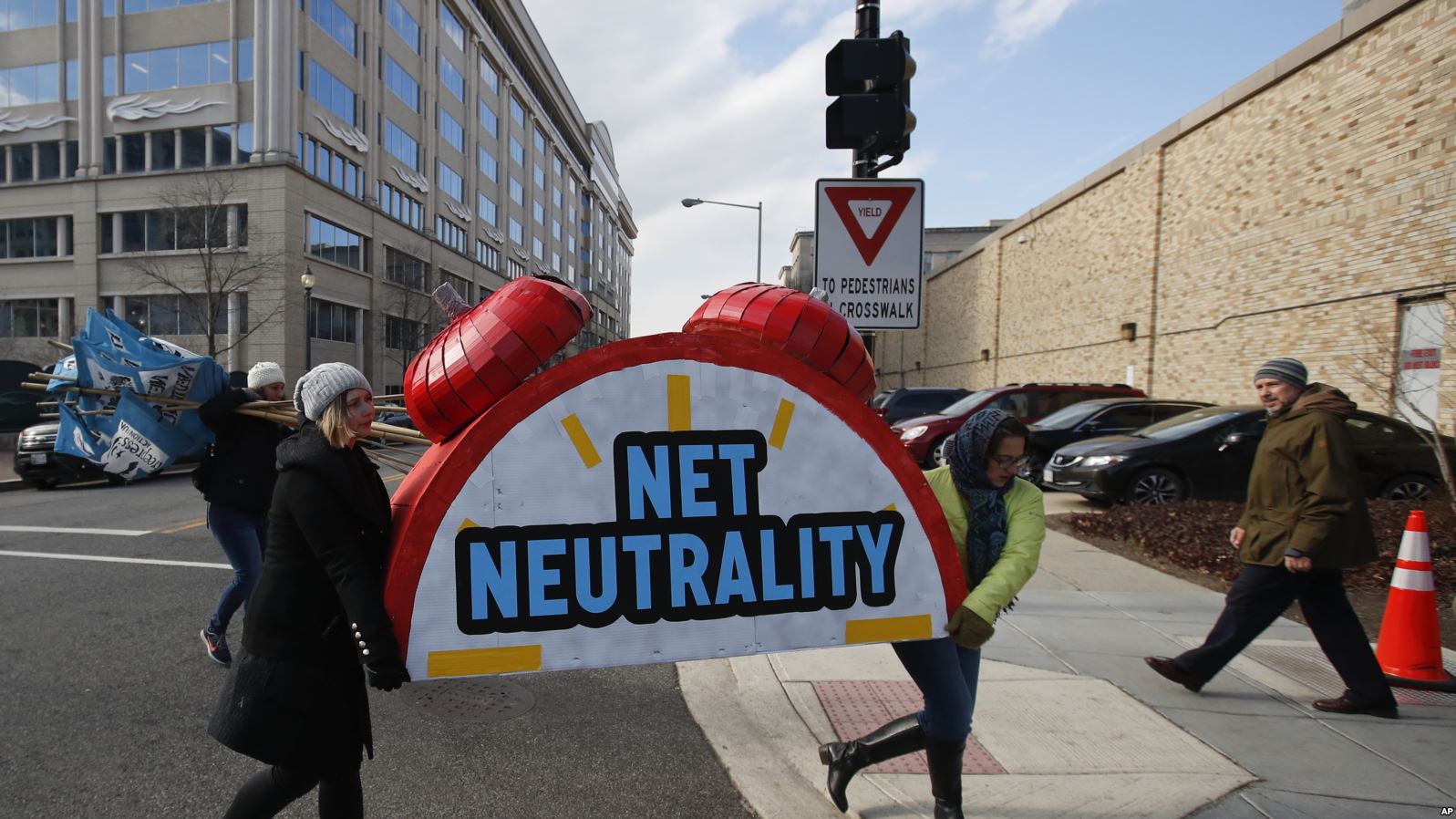
In mid -December, the US Federal Commission for Communications took place on the fate of the principle of "network neutrality". Three of the five members of the commission voted to cancel the decree on the free Internet, adopted in 2015 under President Barack Obama.
The commission also adopted a new document - the initiative to return the free Internet. It provides providers with more authority to selective restricting access to Internet resources in favor of certain data streams. For the most part it is a struggle within the United States. Opponents of the initiative and its supporters argue about the choice of consumers and how the Internet will work. Nevertheless, the abolition of “network neutrality” can have a significant impact on users and outside the United States, especially those who regularly use American network resources.
Mobile application Radio Liberty.It's not too late
Changes, most likely, will not happen overnight. However, many critics warn: in the long run, Internet users around the world may not know what products or services they miss due to the refusal of the United States from the principle of “network neutrality”.
What is the principle of “network neutrality”?
The abolition of “network neutrality” in the United States can put an end to open, capable of interacting free Internet
The term “network neutrality” was introduced into use in 2003 by Professor of Colombian University Tim Wu. This is the principle according to which the Internet provider must equally process all the data provided to customers. In fact, he prohibits the provider to choose which data to transmit faster and access to which sites will be blocked or limited. The blogger Adam Baner explained the principle of “network neutrality” easier: “Imagine that you are using the Google search engine, and your neighbor is a Bing search engine. But your common provider receives money from Bing and therefore slows down the work of Google, Yahoo and other search engines.
Subscribe to us in Telegram
Why is the principle of “network neutrality” important?
The principle of network neutrality is established by the law in more than 40 countries, including the United States and States of the European Union. Due to the decision of the US Federal Commission, equality in cyberspace, according to experts, may disappear. Companies or private individuals who want to access a more free or faster provider will pay more. This can lead to the appearance of two classes of Internet users: some have money and information, others have neither one nor the other.
“The abolition of“ network neutrality ”in the United States can put an end to an open, capable of interacting a free Internet,” said Cuinn McCuu, deputy executive director of the British non -profit organization Article 19. “ The question arises of how a short -sighted decision to enrich companies that have established an almost complete monopoly on the Internet in the United States, will affect the freedom of expressing opinions in the network.”
For example, if a company from the Balkan countries from Russia or Central Asia develops its own streaming video service, then the provider can slow down its program. This will happen if the organization does not agree to pay a higher price for the distribution of its products. Obviously, this is not only about entertainment content.
The Internet is the most valuable invention of the 20th century, and we must fight for his freedom
The American non-profit scientific and publishing project Public Library of Science warned: the decision of the Federal Commission opens doors for corporate and government censorship. Providing providers with the opportunity to independently generate traffic, the authorities will significantly complicate access to scientific information around the world. “If you want to distribute another culture in the United States and begin to manage a large number of Internet traffic through the United States, then you will have to use providers who can strangle you,” said Dwayne Vincer, Professor of the University of Karlon in Ottawa and Director of the Canadian research project in the field of media.
Can a rejection of the principle influence the protection of human rights?
As in many other areas, in the field of the Internet, the United States is perceived as a world leader. Therefore, critics of this decision are afraid that the weakening of the regulation system will prompt other countries to a hacking system of an open Internet. Estel Mass, senior political scientist Access Now (non -governmental international organization advocated for free Internet), expressed its opinion about the new restriction of the United States: “The abolition of“ network neutrality ”isolates the United States from an extremely important problem regarding the future Internet - as an innovation engine and a field of human rights, to the detriment of users.”
Some critics are sure that the abolition of the “network neutrality” of the United States will be able to prevent political and social events similar to the “Arab Spring” - then social networks played an important role in organizing the campaigns of anti -government protest in the countries of the Middle East and North Africa. “The Americans are not the only ones who will suffer from the US decision to cancel the rule of“ network neutrality, ”said Hadi Gayemi, the executive director of the Human Rights Center in Iran. In his opinion, the decision of the United States can give“ green light ”to authoritarian countries, for example, Iran, in the continuation of the policy of repression. This is the most valuable invention of the 20th century, and we must fight for his freedom. The United States must, figuratively speaking, carry the torch of “network neutrality”, and not follow the interests of autocrats, ”Gaemi believes.
How will this decision affect Russia?
In Russia, the principle of "network neutrality" is not fixed at the legislative level. But if providers impose content, they can be punished for violation of the law on communication. However, the adviser to the President of Russia on the development of the Internet German Klimenko admits that he has not heard about such cases for a long time. Klimenko claims that providers in Russia observe network neutrality and that the price tag is always the same for access to Russian Internet resources. “In this sense, we will quickly see the extent to what the cancellation of the principle of“ network neutrality ”will affect the Internet in the USA. The American market, of course, indirectly affects the whole world, and we have to see both positive and negative stories. I don’t see anything terrible in this. You know, it’s better to try it, and not on ourselves,” Klimenko said in an interview with Radio Liberty.
Klimenko also believes that the cancellation of the principle of "network neutrality" is unlikely to be able to affect the expansion of censorship on the Internet and will not affect the protection of human rights. But he adds: "This can only be found out after the decision comes into force."
Can other countries benefit from this?
One of the arguments in favor of the abolition of "network neutrality" is that this principle prevented investments and innovations, and this could, in turn, damage the growth and development of the Internet. Ultimately, the decision can become a blessing for innovators outside the United States - but only if American entrepreneurs understand that they are in an unfavorable position. Now large companies spend a lot of money to get quick access to the Internet. Jeniffer Ye, political adviser to the Free Press public group, noted in Washington, noted that the abandonment of "network neutrality" may limit the receipt of new content outside the United States. At the same time, he believes that the decision of the federal commission can push many innovatively thinking people to leave the country "to realize their potential somewhere else."
And it seems that some are ready to seize on this opportunity. "Maybe I have to invite recently deprived American startups to the EU so that they have another, fair chance?" - wrote on Twitter the commissar of the European Union on the digital agenda of Neil Kroes.