
Translated material
Berlin Staatsoper celebrated the 275th anniversary
2017 was not declared in Germany either the year of music or the year of culture, but this year three large music halls were opened in the country. In January - the Hamburg Philharmonic who struck everyone with his architecture; In March, the Pierre Bouleza Hall in the very center of Berlin, a two -step from Statatsoper (is curious that in both new halls, the visual rows are located oval around the perimeter of the scene).
In the fall, the Berlin Staatsoper herself returned to Unter-de-Linden, closed for reconstruction back in 2010 and for a long seven years, who had been waiting for his return to the historical place on the stage of the Schiller Theater. The history of its long-term repairs and repeated postponements of the opening even broke the temporary record for the reconstruction of the Bolshoi Theater of the 2000s, which lasted a year less (though for the Berliners themselves, a comparison with the main long-term construction of the city and the whole country-the Berlin-Brandenburg airport, has been under construction 11 years, but so far without light at the end of the tunnel). However, at the December anniversary concert, Statatsoper Daniel Barenboim with obvious pleasure stated that the opera had come to a historical platform finally and more rehabilitation would not be needed.
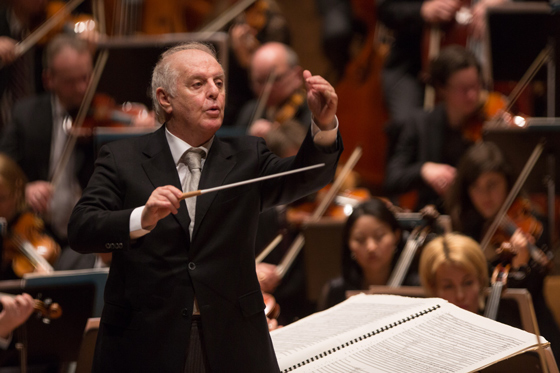 © Holger Kettner Daniel Barenboim
However, for the maestro, the advance is important not so much the terms or architecture as the acoustics of the concert space. In both halls built under his auspices, the first concerts were a kind of acoustic samples. At the first evening in the Bouleza Hall, from those where the Barenboy was not involved as a performer, he was in the auditorium, moved from the sector to the sector, from the stall to the balcony, listening to whether there were “acoustic pits”.
The concert program for the 275th anniversary of the Statatsoper, according to the conductor himself, was compiled in such a way as to demonstrate the sound qualities of the hall using the example of works that are contrasting in dynamics and texture. The listeners were offered an air scherzo from “Snow on a Summer Night” by Felix Mendelssonon, the large -scale “life of the hero” of Richard Strauss, and several plays from the cycle of Pierre Boulez in the author’s orchestral version sounded between them. So the old new Barenboy Hall opened the old new essay-after all, Boulez has made transfers of the piano “notations” of 1945 from the late 1970s specifically for the Barenboym (Maestro has performed the premieres of Paris and the Chicago Symphony in the early 1980s and in the late 1990s, respectively). It is unnecessary to say that with the orchestra, the Statatsoper from the leading world teams can be consumed only by the Berlin Philharmonic, so the execution of such a diverse, but classical program of the program, caused a warm welcome even among demanding German criticism.
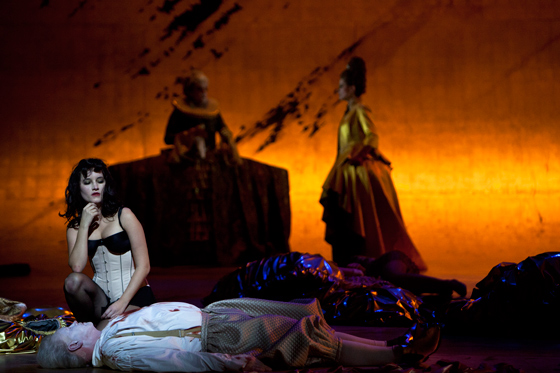 © Bernd Uhlig Coronation Poppei
According to the principle of contrast, three December opera premieres were also chosen, and here everything was also symbolic in its own way. The Renaissance in the Renaissance Theater was represented in the year of his 450th anniversary of the opera genre Claudio Montveiredi (the Coronation of Poppei was responsible for the conductor of Diego Fazolis and the director Eva-Maria Hokmeier; Party Poppei-Anna Prokhazka). Perhaps the most popular Christmas Opera Henzel and Gretel, Engelbert Humperdinka (musical reading - Sebastian Waglle, stage interpretation was Ahim Fraeier; Genzel's Party, Katrin Wunzam, Elsa Drezig), was chosen.
The premiere of our contemporary T-shirt of freedom on the chamber stage of the theater (slightly smaller than the center of Meyerhold) was focused on the public of the future-children from four to five years old. His modernist musical fairy tale about the prince, the princess and the king, whose throne is a children's chair put on a stepladder, introduces children into the culture of a musical performance in a playing and semi -interactive form and unobtrusively tells about the specifics of hearing and sound (to lull the vigilance of the king, the princess and the prince put on his head - the music is interrupted). Perhaps it is thanks to such performances in the "adult" halls of Germany that the problem of changing generations of the public is felt not as acute as in other countries.
 © Monika Rittersaals Genzel and Gretel
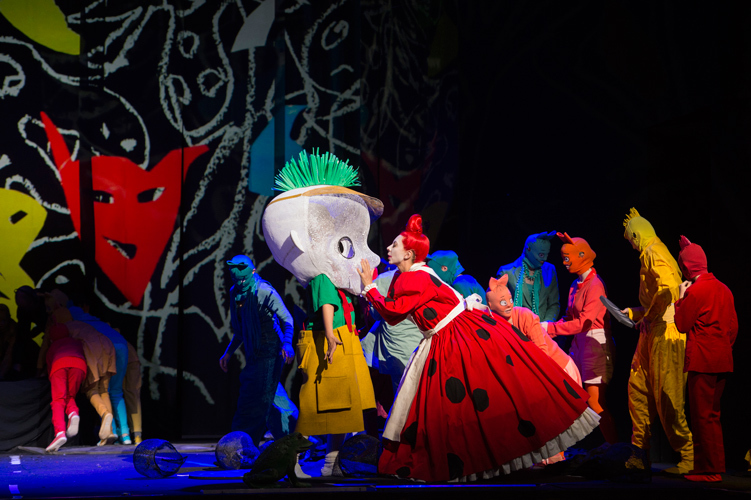
“Genzel and Gretel” in the version of Ahim Freyer is also more likely a children's performance (especially when compared with the multifaceted production of Kirill Serebrennikov in Stuttgart , which, however, also likes the children). But here everyone has something to see: the production of Freyer with incredibly bright costumes of fairy -tale characters and an elegant scene - the feast of the fantasy of the stage and the artist (however, Freyer secured both of these functions).
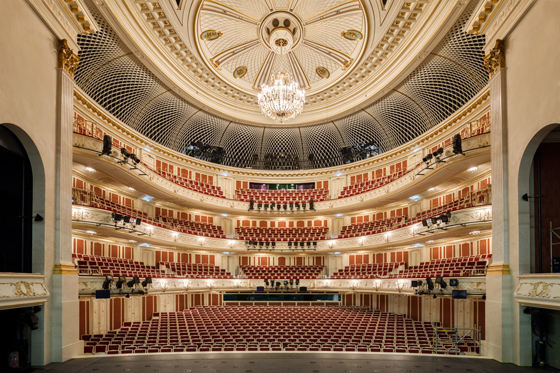 © Gordon Welters Historical Scene Stiataper after reconstruction
In the calendar of the Statatsoper, until the end of the season, the repertoire was equally wide in temporary and stylistic coverage, as in the anniversary days, from the resumption of the “King of Arthur” Henry Persella (transfer to the historical scene) to the world premiere of the “abstract plays” of the Tsangaris, the current sorurator of the Munich Biennale of the Modern Modern Opera. The season of the German premiere of the opera Salvatore Sharrino “ T I Vedo, Ti Sento, Mi Perdo” , first performed in La Scala in the past year, will end. Thus, Staatsoper will continue to cooperate with the theater, which Barenboim led at the same time at the same time.
And the nearest premiere, the “Tristan and Isolde” of Wagner in the production of Dmitry Chernyakov under the control of the Barenboym, will be held in February. The cooperation of the conductor and director has been going on for 12 years (the previous joint work - Wagnerovsky Parsifal ); Thus, the upcoming premiere does not marry the debut, but Chernyakov’s return to the historical Berlin scene.