
Translated material
This is not a regular situation
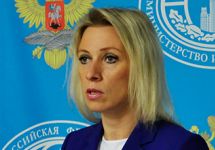
The official representative of the Ministry of Foreign Affairs, Maria Zakharova, accused the US State Department of interfering in the Russian elections. She wrote about this on her Facebook page.
The reason was the commentary of the representative of the American foreign policy department of Clai Noel to the decision of the Central Election Commission on the refusal to register the politician Alexei Navalny. "And these people were allegedly indignant at Russia's intervention in their electoral process?! This is a statement by the State Department, which, I am sure, will not become single - direct intervention in the election process and the internal affairs of the state, - Zakharova wrote. The funny thing that the same people who have just packaged the RT and Sputnik in the wrapper of the inagents are now said to the Russian media. The world is investing in a lot of money in the "opposition of Russian propaganda."
On the eve of Noel commented on TASS to the decision of the Russian Central Election Commission. “We continue to express concern in connection with the existing application of strict measures by the Russian government in relation to independent votes - from journalists to activists of civil society and opposition politicians. Such actions indicate that the Russian government could not protect the space in Russia to exercise human rights and the realization of basic freedoms,” the State Department said. On a wider way, Noel continued, the United States "urge the Russian government to hold honest elections that will be transparent, fair and free, and also guarantee the free expression of the will of the people in accordance with international human rights obligations."
On Tuesday, the European External Relations Service stated that Navalny’s unnecessary “ has a serious doubt about the presence of political pluralism in Russia and the democracy of the elections that will be held next year.” As noted in the document, the ECHR recognized the sentenced sentence to Navalny in the Kirovles case, indicating Russia's violation in relation to the opposition of Article 6 (the right to fair trial) of the European Convention.
“The accusations dictated by political considerations should not be used as an excuse for the unreasonable person to participate in political activity,” the statement emphasizes. “We expect that the Russian authorities will provide equal conditions for political activity for all subjects, including in the context of the presidential election on March 18.”
On Monday, the Central Election Commission refused to register an initiative group to nominate a Navalny candidate for the president, indicating the presence of a conditional criminal record in the Kirovles case. Meanwhile, part 3 of Article 32 of the Constitution deprives sufficiently only citizens who are in places of imprisonment, but not those who are serving conditional terms. Thus, the ruling of the Constitutional Court on the ban on the conventionally convicted to run in the elections before the criminal record to which the officials referred to, contradicts the Basic Law.
“The decision of the CEC to prevent me will exclude millions of people from these elections,” Navalny emphasized. “You make this decision not against me, but against those 16 thousand people who nominated me yesterday. Against those millions who would vote for me.”
Immediately after the decision of the CEC on the YouTube channel of Navalny, his appeal appeared with an appeal to the boycott of the elections. The politician later said that together with his supporters would begin to prepare a street protest. “It should be really all -Russian,” Navalny remarked.
On the afternoon, on Tuesday, Vladimir Putin, spokesman Dmitry Peskov, said that Navalny’s call to the boycott of the elections "is certainly subject to a very meticulous study for compliance or contradiction to our legislation."