
Translated material
Confrontation
Do not succumb to trouble - are taught by the books of the largest historian of Russian culture Inna Solovyova
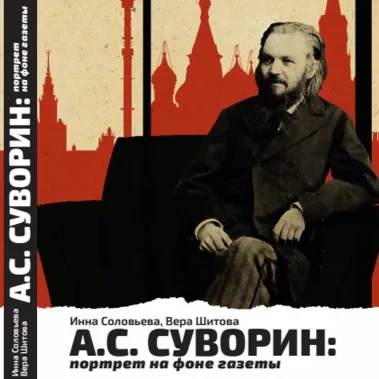
“The topic is interesting and urgently relevant, even topical: how to manipulate the consciousness of a broken, sprayed society; How the secondary, artificial national intolerance is grown and planted, no longer connected with any patriarchal skills and prejudices, but, on the contrary, compensating for the representative of the atomized mass, the complete absence of something “organic”. So Sergey Averintsev in the mid-1980s began a review on a book written in the mid-1960s and published in full only now. "A. S. Suvorin: Portrait against the background of the newspaper ”(M, Navona, 2017).
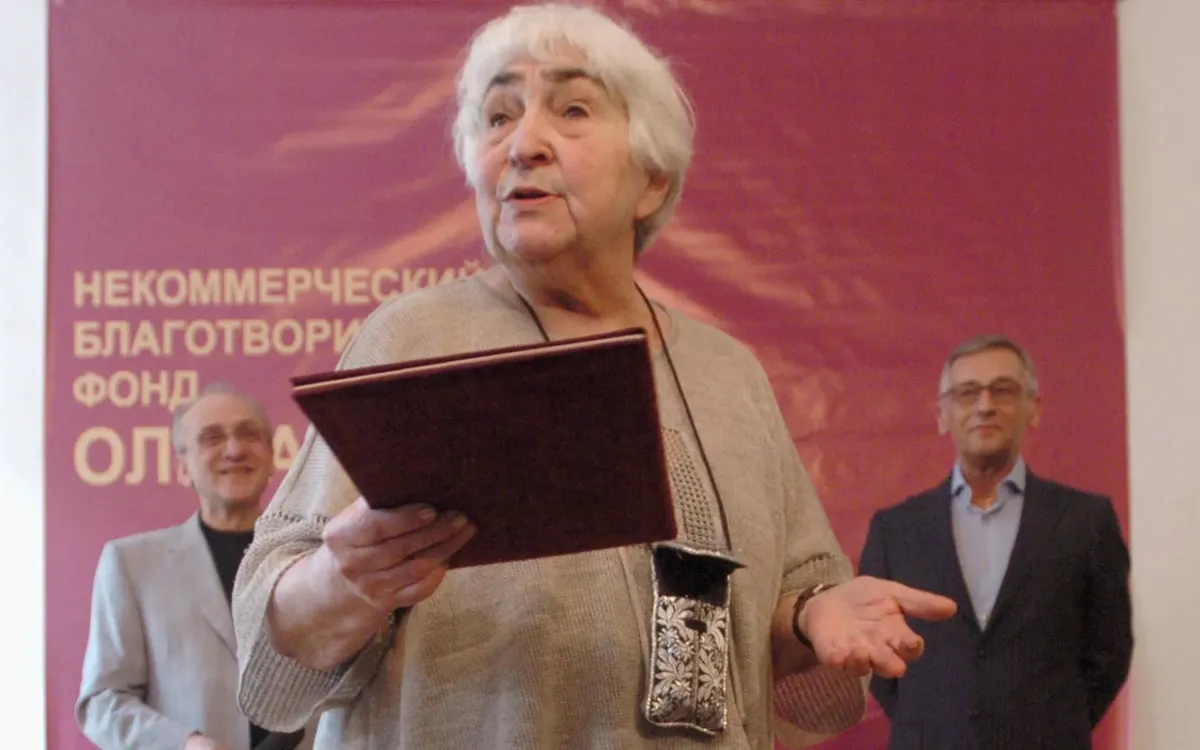
Her hero is the publisher of the New Age, one of the most influential newspapers of the end of the nineteenth and early XX century, "organizer, ideologist and genius of everyday consciousness." The book, written by the largest historian of Russian culture, I.N. Solovyova, co -authored with V.V. Shitova, has not lost any relevance, and the number of “followers” of Suvorin only increased over the years. Inna Solovieva, who celebrated the 90th anniversary this year, remains a powerful opponent of the Suvorin manipulation. She is usually called the historian of the theater and culture. But the talent of Solovieva is connected with the poetry and philosophy of life to the same extent as with history. About that.
I thought to start with how a warm May in the evening of 1987 was in the west of Moscow in the apartment of Inna Natanovna. I was 17 years old, I was preparing to enter a medical one, to which my soul was not lying - she lay for the theater. At the same time, it was assumed that it was from entering the theater institute Inna Nathanovna, a scientist with an impeccable reputation, and had to dissuade me because of a good attitude to my father, who dreamed that I was engaged in a “business”.
How she “dissuaded me”, I don’t remember. But I remember how we sat on the floor in her apartment, took out books from the shelves and talked about Pushkin. I played Don Guan in a school performance, and Solovyova told me about “little tragedies”, by heart reading Pushkin in large pieces. I did not make discounts on age, spoke with that measure of seriousness, which was determined primarily by her respect and love for Pushkin. Most of all, how she described the scene in which Laura says Don Carlos:
Come - open the balcony. Like the sky is quiet;
Requalable warm air - night with lemon
And the laurel smells, bright moon
Shines thick and dark on blue -
And the watchman shout lingering: I see! ..
Pushkin, who was never in Paris or in Madrid, did not know warm Spanish nights, ended the “stone guest” in the fall of 1830 in Boldino. Solovyova was amazed at the power of a poetic imagination that transferred him to where "the night smells of a lemon and a laurel." After three or four hours of conversation, there was no more doubt. I calmly announced to my parents that I was going to enter the theater faculty - to Solovyova. Studying at her course for the next four years determined fate. Friendship and communication with it continue to determine life, whatever I do.
Pursuing journalism, observing the effectiveness of the Suvorin methods of processing consciousness during Crimean events and war in Ukraine, each time I check myself with what Solovyov laid.
She taught the very concept of history as a reality of life and respect for this reality. At the same time, she taught to fix and accurately describe the performance - a fleeting reality. As exercises, she gave the task - to watch the architecture of Moscow, describe from memory and then check itself. You won’t leave right there: there are as many columns as there are, their order is determined unambiguously, the construction date cannot be confused (although I confused). We walked with her around Moscow - we settled the characters of Russian plays in houses where they could live.
All that Solovyova was engaged with us was based on a firm faith: the reality of life is unconditional and inviolable. She believes that inaccuracy in a review or report cannot be covered with the phrase "but I see differently." What is happening on the stage, as well as what is happening in life, can be liked or not, to cause protest or consent, to excite those associations or others, but you must describe for sure.
The accuracy of her own observations and descriptions is amazing. Moreover, accuracy is not limited to facts. Few people have that independence and power of thought that Solovyov. And few have a thought so much on real knowledge (or knowledge of reality). These two qualities are interconnected - and are associated with the date of birth.
Solovyova was born in 1927 - on the eve of the "great turning point" of Russian life.
At the same time, the organic of her own life did not succumb to the breakdown, remaining tightly protected, primarily the spontaneity of perceptions and all the same respect for reality, no matter how terrible it was. She was completely devoid of fear and was never fenced off from reality. Having once introduced the concept of “homeland, time”, Solovyov to his homeland, time, and the place was always true.
In the Russian language there is no difference between “house” and “home”. She lives in the house of Soviet building, but her house lives according to the laws, she herself once and for all established. Solovyov is the most “non -Soviet” person of all I know is not “anti -Soviet”, but not Soviet. Horo neither yesterday nor today, it is not amenable to.
Ideology did not penetrate it and does not penetrate not only because this place is occupied by another faith and another culture, but also because Solovyova trusted her vision and hearing.
If I saw a girlfriend’s mother with light or peasant children who asked for bread in the city in prison, then she did not look for motivation and obeyed her own feelings, and not the idea of a world revolution.
It is impossible to knock it down.
The same perception of reality gives power to her historical works. Reading Solovyova’s books, you are amazed at the ability to visualize and reproduce the historical era through the word, image, rhythm of the phrase. Thought is born from the exact description, from facts. Her books and articles, of course, artistic and poetic, but also historically verified. The question is how history and fantasy, memory and imagination interact.
Memory cannot be trusted. Memoirs are a historical evidence of the time in which are written to a greater extent than the one written. Any memorization implies distortion, mythologization. But the mechanism works in the opposite direction. In order to restore the picture of the past, it is necessary not only to knowledge of dates, names, events (Solovyevsky memory in this sense is hostile: “Well, why do I remember this?” - she often speaks this with sincere surprise), but also fantasy and imagination - literally entering the image of another life, another era.
In one of the sketches of the preface to the “war and the world”, Tolstoy formulated the thought, it would seem, paradoxical: “I was afraid that the need to describe to significant persons of the 12th year would force me to be guided by historical documents, and not the truth.” The description of the “truth”, that is, that truly and accurately, required an artistic imagination. Those who created the Art Theater also possessed such an imagination - the main subject of Solovyova’s study. Both theater itself and its researcher with Tolstoy are connected by roots.
Soloviev, it seems, the first to study the directorial copies of Stanislavsky as independent texts, reproducing motives and psychology of the era and characters, in the play described. The fact that this reality exists has no doubt. Solovyov’s work on the history of the art theater recreates not only performances, but also the life and the course of the creative thought of their authors, the act of creation itself.
The effect of presence also arises when reading a book about the Suvorin, originally written by order of the New World, Twardowski, and at the same time with the training of directorial copies of Stanislavsky.
The book recreates the techniques and motives of not only the publisher, but also the subscriber - the consumer of the newspaper, its ideas (or rather misconduct) and objects advertised in it. Solovyova describes the apartment in a two -story St. Petersburg house on a roadway, and - most importantly - the consciousness of her tenant, who believed that the “eternal” issues that torment, for example, the owner of Yasnaya Polyana, with a barbid fat. The Suvorinskaya newspaper imposed a choice between the “revolutionary circle” and the “house on the road” as if there are no “three sisters” and Tuzenbach with his “what beautiful trees, and, in essence, what a beautiful life should be next to them”.
Singing “sound mind” and the stinging of good, the newspaper persistently proposed nationalism - also as a product of consumption. She regularly wrote about “Turkish atrocities”, calling for the country to save the Slavs in the Balkans. "A rich, blessed country, brought by slavery to powerlessness, to dense despair, prays Russia about getting rid of heavy yoke." It is a sin not to help, and after all, he is not at a loss: the country is rich, blessed by God ... ”Nationalism and anti-Semitism are instilled slowly, without rage, through repetitions,
Through the neighborhood of notes about children's corpses or animals, about how the Russian old priest did not give tea in the Warsaw buffet, or how foreigners marry Russian women to sell them in a harem.
“The newspaper, which initially raised sanity, made a quiet daily substitution: they did not allow common sense to understand anything, taught not to evidence, but to the authority of the printed.” What happened at the time of the contact of “misunderstanding” and life outside the history with the idea and history, Suvorin, who died in 1912, did not see. The consequences were experienced by the authors of the book about Suvorin.
When preparing to write it, the authors read all the bindings of the Suvorin newspaper from the first issue on February 29, 1876 to the last, printed to the death of Suvorin in 1912. “It turned out to be excitingly interesting. To what was happening outside the library, Suvorin was related to alive, even too alive, ”recalls Solovyova. The authors did not attract the story of a hundred years ago. Attracted life. Solovyova responded to this rapprochement, captured and transferred historical currents. Continues to capture them and transmit them today, having some super-sensibility and spontaneity of perception. Her books are deprived of politics and filled with a sense of time. Reading the book today is excitingly interesting, ”and Suvorin also has a relationship to“ what is happening behind the walls of the library ”. The most important thing in the gift of Solovyova, perhaps, is the ability not to give in to frost - neither yesterday nor today. She once formulated the idea that art reflects life on the principle of reflection of a blow, and not copying. Solovyova itself is opposed by Suvorin and the reality inspired by him. Her books and her life are an antidote that preserves her life.
Arkady Ostrovsky , especially for "New"