
Translated material
Complex equation
The Diet of Latvia adopted a law designed to equalize the status of veterans who fought on the side of the USSR and the Third Reich in World War II
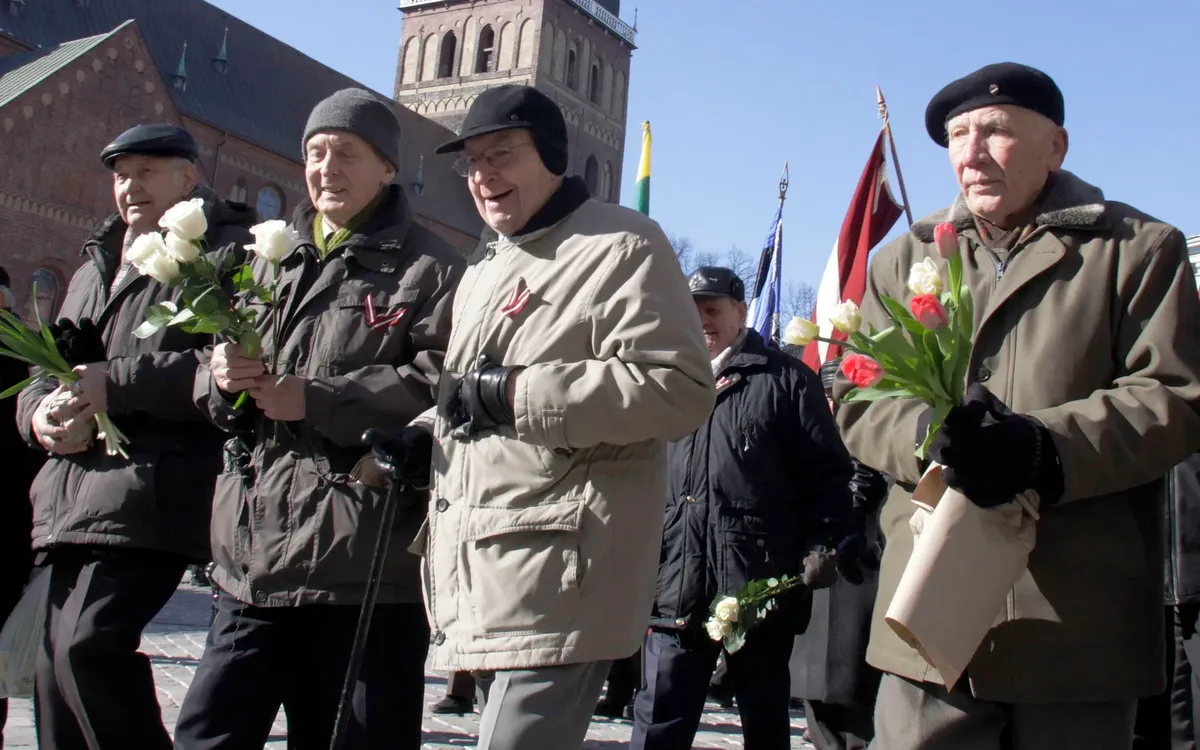
The Federation Council on Tuesday published a statement in relation to Latvia - criticizing the country's law “On the status of a participant in World War II”. The law has already passed the last reading in the Sejm, but has not yet been approved by the president. According to the law, those who fought against Nazi Germany and those who fought against the USSR - on the side of the Third Reich fall under this status. It was this “equalization in the rights of Nazi criminals and their accomplices with those who heroically opposed them” outraged Russian senators. The Federation Council sent its statement to the parliaments of the EU member countries, the European Parliament and the Assembly of the OSCE.
The bill “On the status of participants in the Second World War” was initiated by deputies of the Parliamentary Commission on Human Rights and Public Affairs and adopted in the last reading last week. Only the Party “Consent” traditionally relying on the Russian-speaking population voted-due to the fact that it violates the rights of veterans who fought on the side of the USSR, and not because of the very idea of the law.
The fact that such a law of Latvia was needed, none of the fractions of the Sejm doubted - the discrepancies were on separate points. For Latvia, the idea of “equalization in rights” does not sound wild: during the Second World War, about 150 thousand Latvians fought as part of the SS legions and about 130 thousand as part of the Soviet army. No wonder the wording in the law is just this - it concerns those who fought against the USSR or the Third Reich, and not for the USSR or the Third Reich.
This is the political essence of the law - to emphasize that the inhabitants of Latvia fought precisely for their independence with any totalitarian regimes, whether it was Hitler Germany or the Soviet Union.
“This is a law of a purely humanitarian nature,” says Boris Tsilevich, deputy chairman of the Parliamentary Commission on Human Rights. - He is by no means aimed at justifying the crimes of Nazism. We believe that it is very important to be equally equal to all victims of historical events. Latvia as a state did not participate in the war, for Latvia it was rather a civil war. On both sides, there were those who walked voluntarily, for ideological reasons, and forcibly mobilized. Therefore, in this case, it seems to me inappropriate appeal to historical truth. ”
The idea of the bill matured for a long time - for the first time, former President Andris Berzins, who turned to veterans who fought as part of the Soviet Army and in the SS battalions, with an appeal to reconciliation, spoke with it for the first time. He proposed to endow all the participants in the Second World War with a special status. True, if additional benefits were discussed at the initial stage for the owners of such a status, then in the approved edition there is no this point. Veterans will receive only a certificate of a special model and a memorable icon.
The status of a participant in World War II will not be assigned to persons convicted of crimes against humanity, members of organizations recognized by criminal Nuremberg Tribunal (including members of the National Socialist Party of Germany, its secret police and security services), as well as KGB officers.
The law applies only to those veterans who were citizens of Latvia by 1940, or by this moment they could claim Latvian citizenship - and does not apply to non -citizens, as well as those who have received citizenship through naturalization. Thus, the law delete everyone who arrived in Latvia as part of the Soviet Army after 1940.
Critics of the law believe that because of this norm, most of the veterans who fought on the side of the USSR will not be able to obtain the status of a war participant-unlike former fighters of the Latvian SS divisions, consisting of Latvia citizens.
“Unfortunately, this law provides for the possibility of obtaining status only for a small part of veterans who fought on the side of the anti -Hitler coalition,” says Boris Tsilevich. - In fact, there is no same attitude to the participants in the war. And of course, there is a purely legal problem. There is a 4th article of the Law on Citizenship, which provides that the rights and obligations of citizens are the same, regardless of the method of obtaining citizenship. The law on the status of war participants is the first norm that introduces differences depending on the method of obtaining citizenship. ”
The Consent Party hopes that in such an editorial office the president will not approve the law, but will return it to finalizing the parliament. Otherwise, the deputies of “consent” are ready to apply to the Constitutional Court.