
Translated material
On the edge of the oikumen
Punta Arenas, the main city of Chilean Patagonia, claims the status of the southern city in the world. The New Times sailed the route of Charles Darwin
For lovers of exotic routes, Punta Arenas is primarily a gate to the Antarctic. Like the Argentinean Ushuayya, who competes with Punta Arenas in the “southern”. It is best to get by an airplane, and then transfer to the ship - unless, of course, you have a sea cruise on your own yacht around all of South America.
Another route to these edges begins in San Diego (California) or halfway-in the Chilean Sea Port of Walparaiso, from where the Holland-American company is taking about 1000 passengers (almost all pensioners) in a cruise around South America to Rio. The main bait in this cruise is the road along the west coast of Chile, or rather, through the coast, because there are no shores here in a simple linear form. This is the labyrinth of fjords, straits and islands. Charles Darwin's route on the Bigl ship. There is his name on the map: Darwin’s channel, Cordiller Darwin. The great naturalist made up the most striking injury in these places.
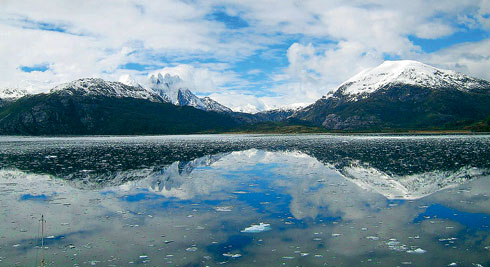
The banks of the Strait Magellanov is a monotonous spectacle, but exciting
Strait of Magellan
Almost a kilometer line of snow. On the sides of the Darwin channel - a healing fence of spiers in the background with ribbons of water flows along the slopes, gloomy wooded hills in the foreground. The spectacle is somewhat monotonous, but exciting. The variety is introduced by the languages of glaciers crawling into the sea. The ice collapses all the time, but not so often that this spectacle is guaranteed to a tourist. Darwin, however, spent much more time on the canal and saw everything himself. And he even talks about how the boat from the “Bigla” almost fell under one of these collapses. The roar, reports Darwin (and Captain Fitzra), was terrible, and the wave was with the house.
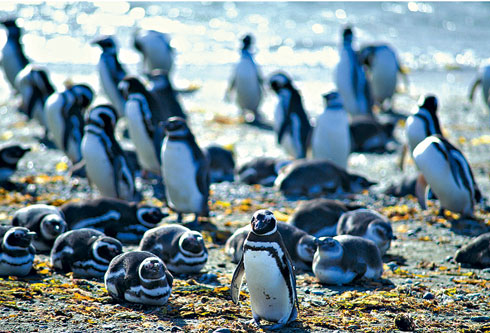
Patagon Penguins
“I can’t imagine anything more beautiful than the Beryl blue of these glaciers against the backdrop of white snow,” wrote Darwin. He noticed that the glaciers reaching a 56th degree of latitude in the summer-this is a unique in nature. In Norway, this is not 70 degrees at a latitude. It’s not at all to approach the glacier, it goes into a dense ice pack. But the ice floes are visible everywhere and far from the glacier. Darwin calls them “small icebergs”, they are the size of Bigl. From the side of a 12-story cruise ship is just an ice trifle.
* The extreme southern point of the Archipelago Fiery Earth, located on the island of the Horn, washed by the waters of the Drake Strait
The Strait of Magellanes looks approximately the same. In the narrowest place, the width of the strait is approximately 2 km, the length is more than 500 m, the strait is very closed and was once, by the way, for the detour of South America, as it avoided the stormy latitudes in the view of Cape Gorn*.
But it is not easy to enter it, and many ships could not cope with this. Magellanov Strait goes already through mountain Patagonia. The Europeans who arrived here found the local population here. The natives survived hunting for sea lions and did without clothes, despite the cold, they were warmed by bonfires. European sailors, who saw the lights of bonfires in the night, gave this region the name Thierra del Fuego (fiery land). Why the natives did not want to dress is still certainly unknown. Some people think that they were coated with animal fat and they were not cold. There is another opinion: the natives, that your ichtyander, spent so much time in the water that clothes would not dry. And two sets of resource clothing were not enough.
For some reason, at one time, no one asked for explanations from themselves, and now there is no one to ask. The missionaries, who introduced the natives to civilization, naturally, first of all dressed them, which, as ethnographers say now, the poor Aborigines were destroyed. They immediately began to hurt and quickly extinct.
After them, no one settled here for a long time of his own free will. For many decades there was a prison and nothing more. 2/3 of the population were convicts. The imprisonment regime was weak, stabbing and riots raged. After one such riot (1851), the city was empty for almost a whole year. Later, Punta Arenas revived as a port parking lot for ships who enveloped America from the south, especially when they found gold in California. It seemed that he would become something like San Francisco. But the Panama Canal ended this hope. A new incentive to the life of Punta ARENAS was given whaling fishing, and then anti-farms and sheep breeding.
The capital of the Antarctic
If about old England they say that there once “sheep ate people”, here, on the contrary, they fed the sheep of people. And later, tourism helped the city a lot. Tourists are sailing from here by the Magellan Strait, they are noted at Cape Gorn and go to watch Patagonian penguins. All this is enough to support about the 200 thousandth population.
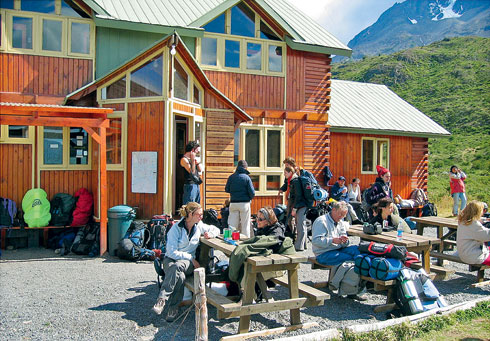
Tourists who come from all over the world are sure to visit the National Park Torres del-Pein
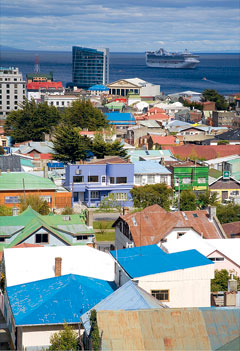
It is notable for its own
colorfulness. View of the city
From the surrounding hills
For a long time there was actually an extraterritorial capital of Antarctic. From here they went south of the polar explorers and they returned here if they were destined to return. On the building of the former English club you can read the names of its members - polar researchers of varying degrees of celebrity. Of course, the most famous of them Ernest Shekleton and Rual Amundsen. Shekleton was here more than once. He arrived here after his ship wiped the ice and the crew had to land on the Antarctic coast. With two comrades, Shekleton on the boat reached the island of St. Jorde, crossed him on foot and went to Punta Arenas from the local whale-lane base, from where he equipped a rescue operation. This feat is completely unique in the history of polar expeditions: not a single person died from the Shekleton team.
It is amazing that the guide does not tell anything about this. Maybe he was so guided by patriotic tourist authorities. But passing by the most noticeable building in the city-the mansion of Sarah Brown,-through the glass wall of the Conservatory in the style of Ar-Nuvo, you will see written by very large letters “Shakelton bar”. Then he has been and now you can drink coffee or something stronger in the presence of his great shadow.
It is even more surprising that they do not recall here about the great whales that trained in the South Atlantic. Meanwhile, one of them is buried here. This is the Norwegian Adolf Amandus Andaren (1872–1940). He arrived in Chile in 1894 and at first engaged in towing and rescue work in the Magellan Strait. Then he became a whale, using his tugboat with a harpoon gun. He obtained the first whale in 1903, founded the base near Punta Arenas and then a flourishing company-first one, then the other. He had a whole small whaling fleet. He himself constantly went to sea with his wife, a parrot and Angora cat. Andresen was buried in the local cemetery in an impressive crypt. However, here he does not have one impressive crypt. This cemetery is not simple. It looks more impressive than the city itself.
A person paints a place
Punta-ARENAS itself is through straight streets intersecting at right angles, low-rise buildings, except perhaps with its colorfulness, which is interesting, but not particularly original, since it is quite usually for all later (not older) cities in the south of South America; By the name of the homeland of the tango of the old porty part of Buenos Aires, this style could be called "La Boka." It is necessary to look at all this from above, from the hills encircling the old city and the port. Then colorful roofs are visible. A funny handsome look, but nothing more.
But the local Catholic cemetery is a real monument. In the same class with some cemeteries of the New Orleans and, as they say, the second like this is after the famous Recleo in Buenos Aires. The most noticeable crypt belongs to the Brown Mennes family. Here lies the only and unique Sarah Brown. Sarah Brown is said to be Russian origin. In fact, Brown Gamburgers were Jews from the Baltic states, most likely from Latvia. The family arrived here in 1874, it seems, after unsuccessful attempts to get a job in London, then in Buenos Aires. A spectacular woman (and Sarah was noble beautiful) at that time one career was shining - to get married well. But Sarah, apparently, was needed not just a rich, but an interesting husband, which is called “with a spark”, which, of course, she herself was. She found her hero in 1887 in the person of a Portuguese named Zhose Nogueira.
Nogueira was a gold miner and sheep, a businessman with a great imagination, of those who lay new cities and states. The name of his brainchild Sociedad Explotadora de Tierra del Fuego is characteristic. The fiery land became literally his feudal estate. In 1886, he received a huge territory of a million hectares on the banks of the Strait Magellanov. A certain Moritz Brown entered his work as an accountant, and Sarah was his sister. Nogueira married her. He burned from tuberculosis at 48 and left her a huge condition, which she managed successfully herself.
Moritz Brown, meanwhile, also did not doze off and married in 1895 to the eldest daughter of another local tycoon named Jose Menendes. These, in essence, dynastic marriages connected the three largest states on the fiery land. The Brown Mennes family-financial pool became actually the owner of the Chilean Patagonia. The interests of this very vast clan permeate the entire local economy, give work to a lot of people, and the Brown-Mennes Foundation presented in 1983 a luxurious mansion built by a French architect with a somewhat strange name of Nyum Mayer. The house is stuffed with beautiful things brought from Europe. Here is now a luxurious Nogueira hotel, Club de Unin, the already mentioned shekleton bar and the Brown Mennes family museum.
From all over the world
Punta ARENAS is also interesting to ethnic variegation. All American cities are as follows, but for a city with a population of 150-200 thousand. Two dozen socially full -fledged ethnic communities are a lot. The fact that there are full of citizens of Spanish and Portuguese origin is not surprising. More unexpectedly, the presence of a strong English, Scottish and Irish element, there is even a “little Scotland” quarter. The Scandinavians look even more exotic here, although in fact, at some point, they mainly settled here, and among them a nostalgic myth of the local lands is stable as a lost “Scandinavian America”. The landscape similarity of Chilean Patagonia and Scandinavia thanks to the Fjords and glaciers is really striking. In addition, the Norwegians are the main in the world of whalers.
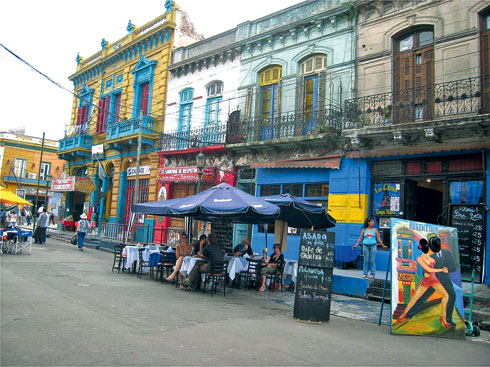
Old area of Punta Arenas
But the biggest surprise is a huge Croatian community. Croats and their descendants make up half of the population of Punta Arenas. There are a lot of Croats in Chile, but most here. An exciting activity is to walk along the luxurious cypress alleys of the famous municipal cemetery and read names in crypts. Croatian names go mixed with Spanish, German, English, French. Names, names, names ... and one nameless grave. The grave of the nameless Patagonian.
First published in NT No. 22 of June 27, 2011