
Translated material
Why nature is sex
The task will have to solve science of the 21st century. But there are hypotheses
Sex has already arisen among distant unicellular ancestors of man more than a billion years ago. Almost all animals (with very rare exceptions) can multiply sexually. Even Medus has a male and female sex. Those animals that are deprived of this happiness (for example, some types of lizards) undoubtedly had ancestors breaking sexually.
Why do you need sex?

Sexual reproduction is so common in nature that up to the 19th century, people did not even ask the question of why animals and plants multiply by copulation or in another way of combining germ cells. This issue arose in the middle of the 19th century in connection with the spread of Charles Darwin about evolution and natural selection. Indeed, according to this theory, in order for sexual reproduction to be preserved, it should help the survival of the species, and there should be more “profit” than the costs of sexual reproduction. Otherwise, to continue the species-man, including nature, would find something more effective.
The price of sexual reproduction
Any action has its own price. Propagation with sex is also very costly. Flowering plants are forced to work, to produce nectar to attract bees that carry pollen from flower to a flower, helping plants carry out sexual reproduction. And men of the species of homo sapiens, for example, are forced to buy bright sports cars to attract girls, girls - well, it is known that “the devil wears prada” ...
In addition, only half of sexually propagating individuals - female - gives birth to children. If in the population of creatures that propagate sexually, a mutant multiplying by the budding would have appeared, then ceteris paribus (for example, the birth of an average of 2-3 children), the descendants of this mutant would easily displace the descendants of a couple of sexual creatures - after 11 generations the difference in the number of descendants would be more than 1000 times (211/2 = 1024). Why are we still propagating sexually? The answer to this question became clear only after the development of genetics.
From the point of view of genetics
Charles Darwin believed that the existence of sex is beneficial for heterosis - the effect of increased survivability of the estates of various animal breeds, often observed in animal husbandry: it is known that mestizo of different breeds of horses run faster than their “clean” relatives. But nature, of course, does not give a damn about the jumps - it is interested in the survival of the species. At the same time, Charles Darwin could not explain the nature of this effect, since in his time it was believed that the heredity of the two parents was mixed like blue and red paint, as a result of which something middle is obtained - lilac paint.
After the work of Gregor Mendel, August Weisman and other pioneers of the 19th century genetics, an explanation of the usefulness of sex was found. According to genetics, each person carries two sets of genes: one is received from the mother, the other from the father. Moreover, due to shocking genes as a result of a process called a crossingover, a person receives a rather complex collection of genes from all his grandfathers and grandmothers. However, the genes sometimes get broken - defective. So, genetics showed that the healthy gene obtained from the father can cover the negative effect of the defective gene obtained from the mother, and - vice versa. So the observation of Charles Darwin about the increased survivability of the estates of various animal breeds became clear.
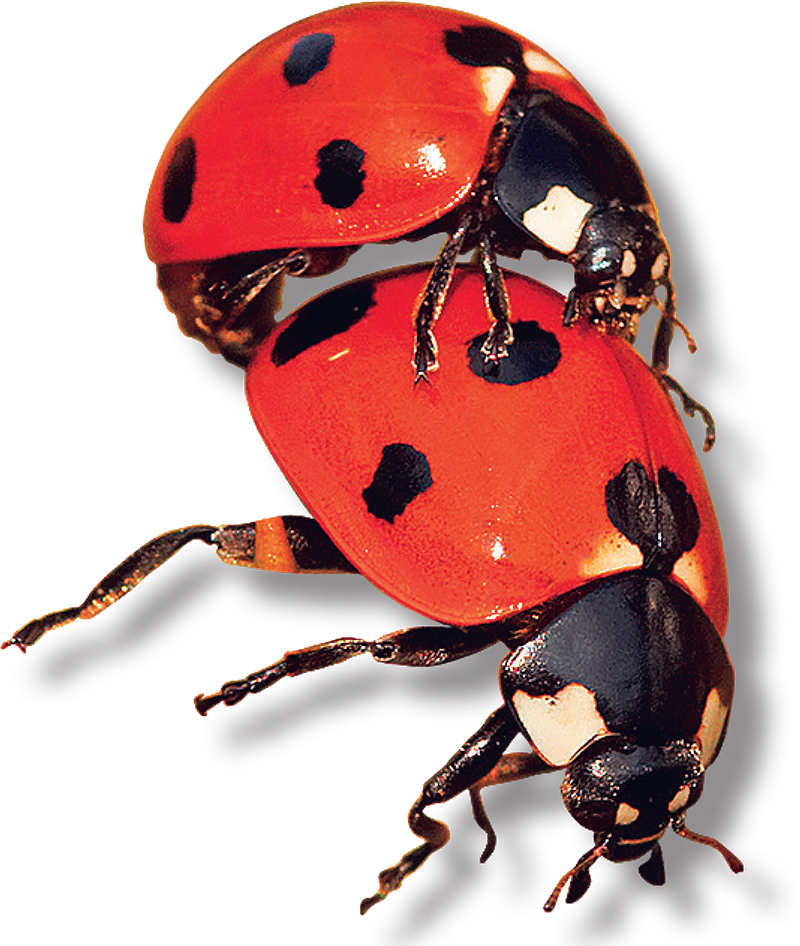
However, the survivability of mestizos is not the main benefit of sexual reproduction. The possibility of combining several positive mutations is much more important. This phenomenon is most clearly in bacteria. Despite the fact that bacteria are propagated by simple division, some species have sex in the form of an exchange of genetic material through a special hose (pilus), which bacteria are connected to each other, like aircraft during refueling in the air. It is in this way that bacteria exchange stability genes with each other to each antibiotic newly discovered by doctors. Without sex, bacteria would take millennia in order to consistently acquire all mutations that protect them from several antibiotics. Due to sex, they can acquire these mutations independently, and then exchange “achievements”.
Evolution puts on egoists
Explanations for the usefulness of sex for the survival of the species were considered sufficient until 1962, when the British zoologist Vine Edwards began a dispute about the essence of Darwinism with the American biologist George Williams. Edwards believed that evolution takes away the species, and Williams was convinced (and was able to justify) that evolution was selected by egoist individuals. According to Williams, the hare in the forest is not competing with a wolf, but with another hare. If one hare will run a little faster than the other hare, then it is another hare that will be eaten by a wolf, thereby ensuring the evolutionary victory to the first hare.
In other words, any feature of the body (including sex) will be fixed by evolution only if this feature helps right now to a specific individual, and not all his species in the abstract future. A large number of observations and mathematical models confirmed the correctness of the “individualist” of Williams. Even further this theory was developed by Richard Dawkins, who generally stated that the true players of evolution are not species or even individuals, but genes. The body is only a way to provide the future for the gene.
Inadvertent sex
After the release of Dawkins, the selfish gene, many researchers made attempts to explain the sexual behavior of a person as the optimal strategy for transferring these genes to the future imposed by his genes.
Matthew Ridley, for example, showed how a person evolved in small groups living in African savannah. In such an environment, the men of the men told him to have one wife and the maximum number of mistresses. Wife - for the birth of children to whom he would transfer his status in the group, and mistresses - for the most widely spread of his genetic material. And the genetically justified strategy of women, according to Ridley, was another - to become the wife of a “reliable mining” for food for children, but at the time of ovulation, try to get genes from a “pirate” accidentally running a nearby with more “high -quality” genes than her husband.
When people began to build cities and large states, this genetically reasonable strategy led to the formation of societies where most women were usurped by large bosses (kings) and specialized Don Juanas. The rulers of China, the Inca Empire, Babylon had thousands of concubines - and the “beloved wife” to transfer the status. In ancient Rome, the slave owners, without hesitation, used their slaves for the sexual purposes, leaving most men-slaves without women.
According to Ridley, these trends led to a large amount of violence and a low level of cooperation between men in the ancient world. In his book, Ridley suggested that the fall of the Roman Empire in the face of German barbarians was partially connected precisely with the fact that the Germanic tribes had a rigidly planted monogamy, which helped men unite against a common enemy - Rome.
Why is sex not disappear?
Biologist George Williams explained this so. Suppose a tree grows in the forest. It produces thousands of seeds that can fall into a variety of places - sunny or shaded, wet or dry. Therefore, it is important for a tree to produce different descendants - with more or less long roots, different trunk height. The descendants will compete with each other, and the most successful will survive. In other words, Williams believed that sex produces a variety in which the brothers compete with each other.
The opposite hypothesis was expressed by American biologist Michael Giselin. He believed that, on the contrary, sex and the variety associated with him allows the brothers to avoid competition with each other, as they begin to occupy a little different ecological niches. For analogy, suppose that a blacksmith family lives in a small village. If all five children of the blacksmith inherit his craft, then four of them will die of hunger, since the village needs only one blacksmith. But if they have different professions (weavers, roofers), then their total income will be more, since they will not compete in one place under the sun.
The third hypothesis was expressed by American biologist Lei Van Valen. It was called the "hypothesis of the Red Queen", by the name of the character from the work of Lewis Carroll. For the Red Queen, Carroll's quick run was the only way to stay in place. According to Van Valein, sex arose as a way of struggle an individual with parasites. In the process of this struggle, there is no victory-the individual and parasites evolve simultaneously, remaining in one place in relation to each other due to the simultaneous “arms race”.
Finally, in the last two decades, a great contribution to the clarification of the question “why do you need sex” made a Russian-American biologist Alexei Kondrashov, who emigrated from Russia to the United States in 1991. According to Kondrashov’s theory, sex is primarily not necessary for a combination of useful genes, but for combination and removal from a population of harmful genes. Each of us, the representative of the species of Homo sapiens, carries dozens of new mutations that our parents were not present. Most of these mutations do not have any influence, some (about 1%) are harmful, an insignificant part is useful.
Sex, according to Kondrashov, allows you to collect combinations of harmful genes in a small subgroup of individuals in number, after which these "vague" die, "cleansing", like a vacuum cleaner, their population from harmful mutations.
The beginning began
Theories of Williams, Giselina, Van Valein and Kondrashova explain why sex retains its usefulness, and not replaced, say, by budding. Unfortunately, they do not explain how sex arose. There is a lot of hypothesis. Unknown - even more. Find the answer is the task of the science of the future.
First published in NT No. 45 of December 17, 2007