
Translated material
Dodon fell from the chariot
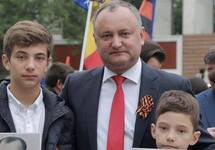
The Constitutional Court of Moldova, at the request of parliamentary deputies from the ruling Democratic Party, temporarily limited the powers of the President of the country Igor Dodon for the third time, now depriving him of the right to introduce the accepted bills. It is reported by Newsmaker.
The reason was the re-refusal of Dodon to sign a bill prohibiting the relay in Moldova of Russian news and information and analytical television and radio programs. As the chairman of the Constitutional Court of Tudor Pantsyra indicated, the president of the country has the right to return the adopted law for a review to parliament only once, presenting his comments. If the parliament adopts the law again, the head of state is obliged to introduce the document into action, "despite doubts about its constitutionality," noted Pantsyra.
“The president’s refusal to fulfill constitutional duties is a violation of the 93rd article of the Constitution and the oath of the president,” the chairman of the Constitutional Court concluded.
Now the law on the ban on Russian propaganda will sign the speaker of the parliament Andrian Kandu or Prime Minister Pavel Philip.
The law on the ban on Russian propaganda, introduced by the Democratic Party, was adopted on December 7, 2017 in two readings at once. According to the document and radio of the country, relaying only those news and analytical programs that were released in the USA, Canada, the European Union and other states ratified the European Convention on cross -border television. Russia did not ratify this convention.
For violation of the law, committed for the first time, a fine of 40 to 70 thousand lei (about 2300-4100 dollars) is provided, and for repeated violations - from 70 to 100 thousand lei (up to about $ 5850).
On December 20, Dodon returned the law to parliament, but on the 22th, the deputies re-adopted it without any changes. Despite this, the president refused to sign the document, citing the "higher interests of the people", and he himself turned to the Constitutional Court with a request to verify its compliance with the basic law.
On Friday, even before the Constitutional Court made a decision at the request of the deputies, Dodon said on his FB page: "I will not give in to the regime under any pretext. I will not approve the candidates and will not sign the laws that contradict the interests of citizens." He expressed the hope that after the parliamentary elections of this year, "we will have to change and correct a lot" - "" both in the government, and in parliament, and in the Constitutional Court. "
The president regarded the law on the ban on Russian propaganda as "a frank encroachment on the freedom of citizens of the Republic of Moldova in obtaining information." “We are talking about censorship based on double standards,” Dodon emphasized.
“I urge citizens to unite all patriotic forces against the Euroonionist (unionists - supporters of Moldova’s accession to Romania. - Ed.) The regime, confident that he will be able to subjugate the will of the people by force and pressure,” the head of state concluded. “The victory will be behind us.”
Dodon, known for his frankly pro -Russian position, during the year of stay as the president repeatedly came into conflict with the European oriented parliamentary majority. The first time the KS limited the powers of Dodon on October 17, 2017, when he refused to approve Eugene Sturz with the country's defense minister. The second time such a decision was made literally three days ago , on January 2, after the head of state re -rejected the candidacy of five more new ministers proposed by Prime Minister Philip. This explains the mention of the "commenting candidates" in the current post of Dodon.