
Translated material
The human rights activist, a former Soviet political prisoner Viktor Sokirko, died
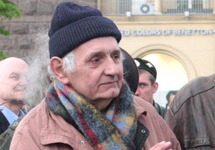
On January 5, a human rights activist, a former Soviet political prisoner Viktor Sokirko, died in Moscow. This was then announced at his FB page by the son of the deceased Alexei Sokirko.
“He was sick for a long time, he didn’t get up in the last year,” the human rights activist remarked.
Sokirko was born on January 1, 1939 in Kharkov. In his youth he was an active Komsomol member. In 1955, he handed over to the director of his school comments on the “Brief course of the history of the CPSU (b)”, after which Father Sokirko at work was faced with problems.
In 1961, a student of the Moscow Bauman School, Sokirko sent to the CPSU Central Committee his “criticism of the CPSU program project” and for this was expelled from the Komsomol. Then he wrote a letter to the Central Committee in which he admitted that he incorrectly interpreted certain points of the project. This allowed Sokirko in 1962 to protect the diploma.
In the future, he worked in the specialty in industries and at the Research Institute.
In 1968, Sokirko signed a number of letters to the power structures, including in defense of convicts in the “four process” (Galanks, Ginzburg, Dobrovolsky, Lashkov) and in the case of “demonstration of seven”, as well as for granting the Crimean Tatars the right to return to their homeland. Was expelled from graduate school. The candidate dissertation prepared by Sokirko by the beginning of the 1970s remained unprotected.
In 1968-1972, he reprinted and distributed the "chronicle of current events." In 1969-1970, he wrote under the pseudonym K. Bourgeoisiedemov published in samizdat the book "Essays on the growing ideology" dedicated to the rudiments of the market and democracy in the USSR. Already in 1970, the book was published in Munich.
When the dissident Peter Yakira went through the first search, Sokirko convinced him to start a dialogue with the authorities. After the arrest of Yakir, he called on the editorial office of the Chronicle to take steps in order to "return to the framework of legality." “We must live not in prison, but at large, live and work with everyone, including with the authorities and with the majority supporting it,” the human rights activist explained his position.
In 1973, in interrogations in the case of Yakir and Viktor Krasin Sokirko, he refused to testify. For this, he was condemned for six months of service.
Meanwhile, the Yakir and Krasin themselves announced the recognition of guilt and repentance and testified to more than 200 activists of the human rights movement.
In 1977, Sokirko sent the Secretary General of the CPSU Central Committee Leonid Brezhnev, as well as human rights activist Andrei Sakharov, proposals regarding the new project of the Constitution of the USSR. These texts were published in Samizdat.
The following year I wrote an article "I accuse the intellectuals-servants ...", in which I declared the need to fight primarily for a free market. The article and answers to it were published in the 1st issue of the Samizdat collection "In defense of economic freedoms." Until the beginning of 1980, the human rights activist prepared and distributed six more issues of this collection.
Since December 1978 - co -editor of the Samizdat magazine "Search for mutual understanding." After the arrest of another co -editor, Valery Abramkin , the editorial board decided to suspend the issue of the publication.
Despite this, on January 23, 1980, Sokirko was arrested. The Politzek refused to testify to colleagues, as well as recognize his activities by slanderous. At the same time, he signed a statement that his articles were used in the West to the detriment of the USSR and that he "was engaged in his deep delusion for many years, which defeated the Soviet system."
In September 1980, the accused was condemned by three years conditionally.
In the dissident community, a compromise, which Sokirko went to, caused a negative reaction.
In 1989, Sokirko organized a group (subsequently - society) of the protection of convicted business executives and economic freedoms. The company acted until November 2001; In total, about 700 people became its clients.
Also, after the fall of the USSR, the human rights activist sought the introduction of a jury in Russia. In 2000, he published the book "The amount of the votes of the jury in the search for faces of economic freedom."
Since 2001, Sokirko has played a member and organizer of the anti -war picket, who had been held weekly on Pushkinskaya Square for many years, and then on clean ponds.
On May 15, 2009, he organized on the Pushkin picket for the reform of the police; He was detained .
On January 5, 2011 , the human rights activist was detained by the Moscow City Hall during the picket in support of the opposition sent under administrative arrest after the strategy-31 campaign.
Sokirko is also known as the author of dozens of historical and local lore films, which he shot since 1966.