
Translated material
Khan - or is there?
The protest in Iran is suppressed, but for how long - and what will happen to oil prices?
It all started with eggs. Prices for chicken eggs in the Islamic Republic of Iran began to rise on December 16 and by the 28th rose to 170,000-200,000 Rials ($ 4-5). Financial analysts explained to the population that the eggs were risen due to the increase in feed prices and will soon fit back, the merchants urgently brought a large batch of cheap eggs from Turkey. But it was too late.
The first to protest against prices in the three-millionth city of Mashhead in the northeast of Iran. The police immediately arrested 52 people, but the protests had already thrown into other large cities: Rasht, Kermansh, Shiraz, Isfahan, Hamadan, ahvaz.
On December 30, the unrest began in the capital of Tehran, then in small (50-200 thousand people) provincial cities like Nezhefabad, Kajugan or Tuiserkan, so unknown that the world news agencies did not immediately realize how to read their names for Farsi.
December 31. In the video, protesters march through the streets of the 80,000th provincial city of Eligucerz in the province of Lorestan.
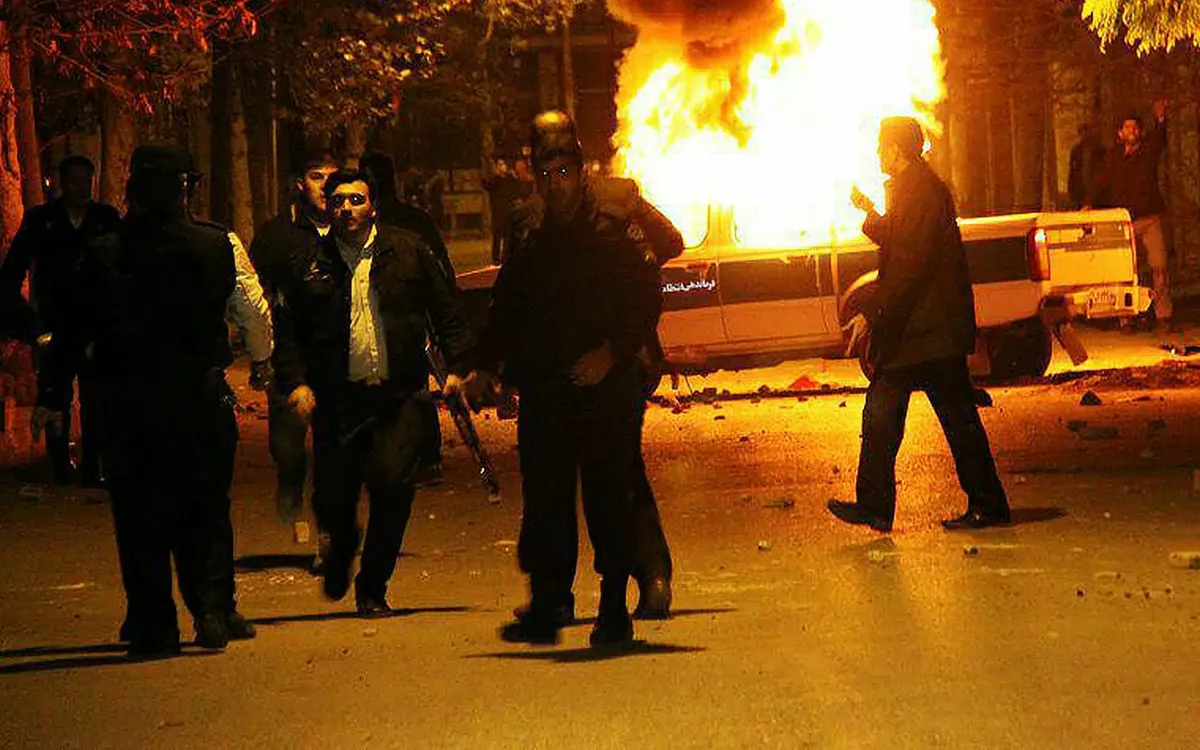
For a week, crowds of people took to the streets of more than thirty cities, from rural areas of Iran Kurdistan to industrial Ahvaz. Peaceful first, rallies soon turned into clashes with the police and the forces of the Corps of the Guardians of the Islamic Revolution (Xir) - an elite military formation created to protect the conquests of the Islamic revolution and the Ayatolle Ali Khamenei, which is directly subordinated to the Supreme Religious Leader. The police used vodtetes and tear gas, protesting - stones, reinforcement and Molotov's eggs - chicken eggs with gasoline poured inside.
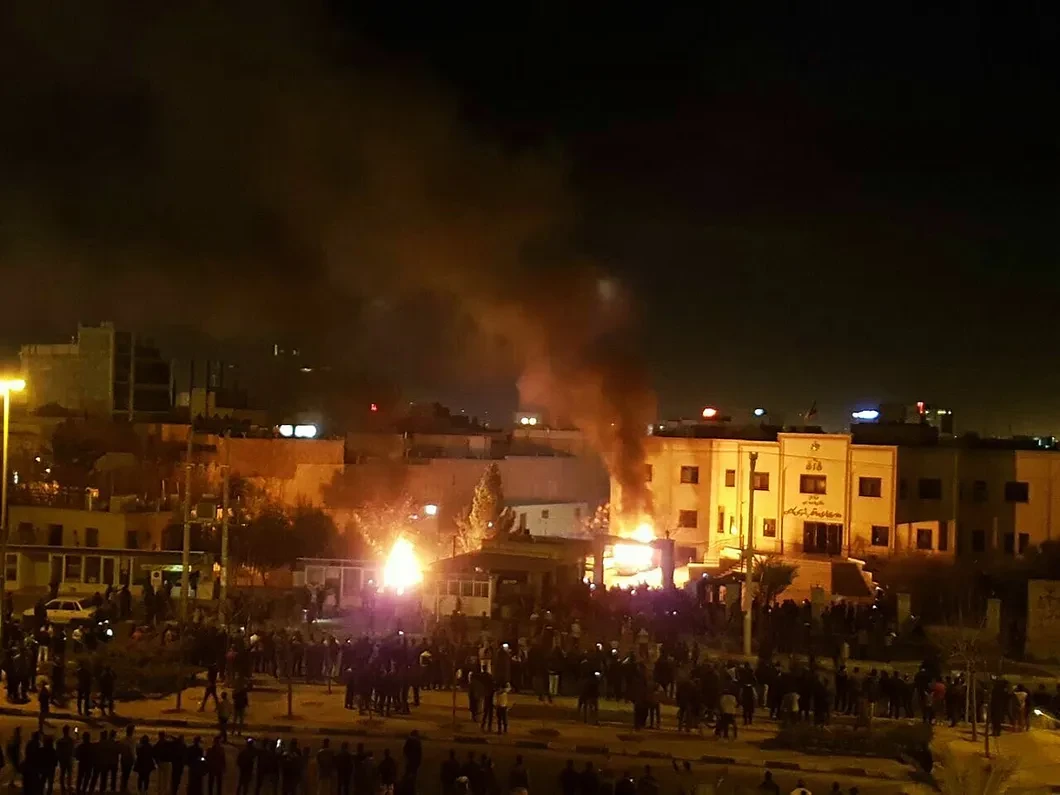
The case was not limited to the polite pogroms of the European model: in the Nezhefabad, according to the Tasnim Iranian Agency, one of the protesters shot police officers from the hunting rifle (one person was killed, three were wounded). In Kermanshah and Kakhdaridzhan, protesters set fire to police branches. In Harramabad - the office of the governor. In Kajugan, they tried to storm the city walls, but retreated when the police shot five people.
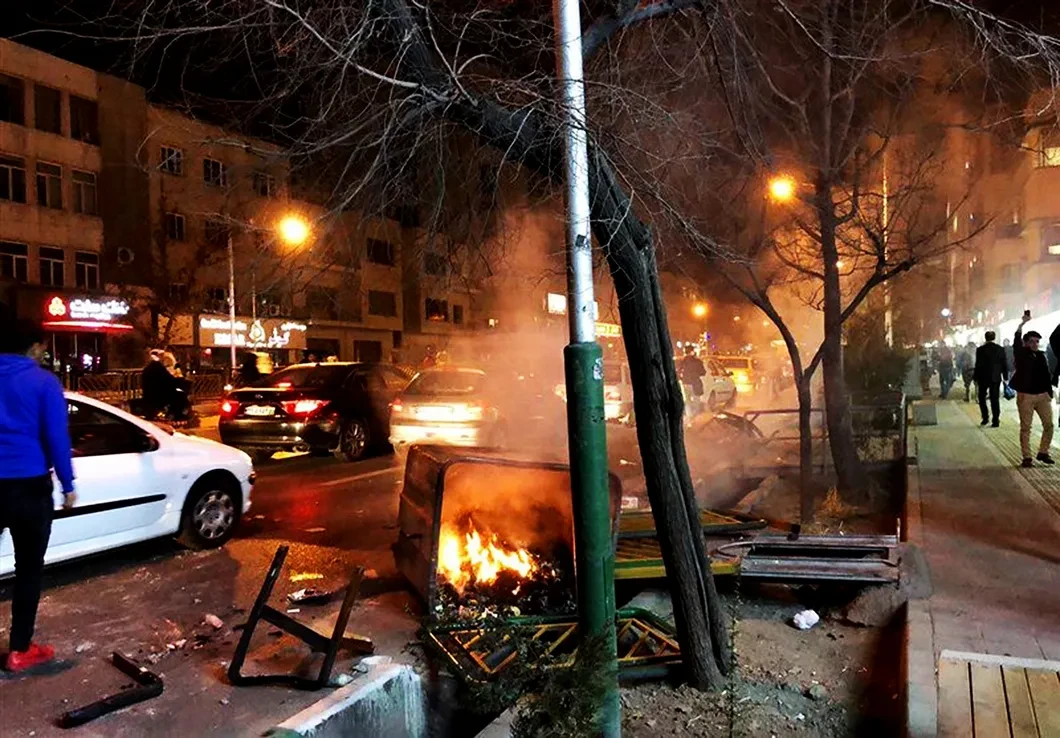
For a week, almost martial law was established in the country: the Persian Central Bank limited the issuance of currency, the Internet and social networks were periodically subjected to blocking.
In total, according to the official information of the authorities, 22 people were killed in the riots, according to the opposition information - more than 50. Only in Tehran more than 450 people were arrested, how many in the country were still unknown, but definitely not one thousand. The head of the Tiegran revolutionary court (a specific Iranian judicial system aimed at combating the enemies of the state) announced that all of them were facing the death penalty.
Such mass protests occur in Islamic Iran not the first time. In 2009, after the elections, in which, by a wide margin and obvious stitching, the last President Mahmoud Akhmadinejad won, the mass processions of supporters of the loser of the loser of the world-Hosean Musavi passed throughout the country. In Tehran, more than one hundred thousand people took to the streets. Peaceful rallies quickly turned into clashes with the police: the protesters were dispersed with batons and tear gas, eight of them were killed, at least three later were scored to death in prisons.
In power, the conservative and religious Mahmoud Ahmadinejad has been established for a long time. He threatened the West with an atomic bomb, stated that the Zionist regime should be “erased from the face of the Earth” and the confrontation of Israel - the national and religious debt of each Iranian; He denied the Holocaust, accused the US authorities of the Tower of Twin-twin and, as the Iranians said in a whisper, at the dinner he set another, empty, in the event of the second coming to the land of the Prophet Isa next to his plate.
The Ahmadinejad era ended ingloriously. In 2013, the enjoying reputation of the liberal reformer Hasan Rukhani won the presidential election, and a holiday came in all houses of the Europeanized Iranian intelligentsia.
However, everyone understood that it was not worth waiting for great changes: the whole fullness of power in Iran belongs to Rahbar - the religious leader, Ayatollah Ali Hamenie, chosen for life. No matter how unpopular the secular political leaders are, Ayatollah has always been above criticism - above mullah, below Allah. And now, in December, Iran first opposed him.
Why did the inhabitants of Iran protest this time? Initially, the requirements were only economic: to stop the increase in food prices, to reduce unemployment, corruption, expenses for foreign policy - for example, participation in a campaign in Syria.
The requirements were true. In recent years, due to the economic sanctions of the West and the reduction in revenue from the sale of oil, the standard of living in Iran has fallen sharply. Corruption has reached approximately Russian proportions, in small cities, unemployment reached 20% (according to information distributed by protesters on social networks). Instead of the fight against poverty and corruption, the authorities continued to spend on religious organizations of various respected mullahs, comparable to the annual budgets of small cities. Their inhabitants went to rallies. “MARADOM GODAI MIKONEH, AGHA KHODAI MIKONEH” - “The people are starving, and the uncle prays,” they chanted.
In addition, a huge part of Iran’s budget continues to spend money on a military campaign outside the country. “Not for gas, not for Lebanon, my soul burns for Iran,” people shouted in the squares.
In many cities, the protesters demanded to mitigate Islamic requirements for clothes and allow women to go out without a mandatory hijab and head scarf. The iconographic photograph of the girl proudly standing on the barricades with her head uncovered, parted in all the world media (however, later it turned out that she was shot at a rally against the hijabs, which was held before the start of mass protests).
Through social networks, the Iranians spread the requirements to abolish the authorities of Ayatollah, separate religion from politics, and create an independent court and free media.
However, the most popular was the unprecedented slogan “The Death of Hamensa!” For the first time in the history of modern Iran, portraits of Ayatollah began to set fire.
Portraits of a gloomy person in a turban and glasses hang on half of the Iranian billboards, in all state institutions, offices, shops and even hotels, but no one decided to spoil them before: firstly, Ayatollah was really popular for many years. Secondly, an insult to his name is a direct path to the Evin political prison.
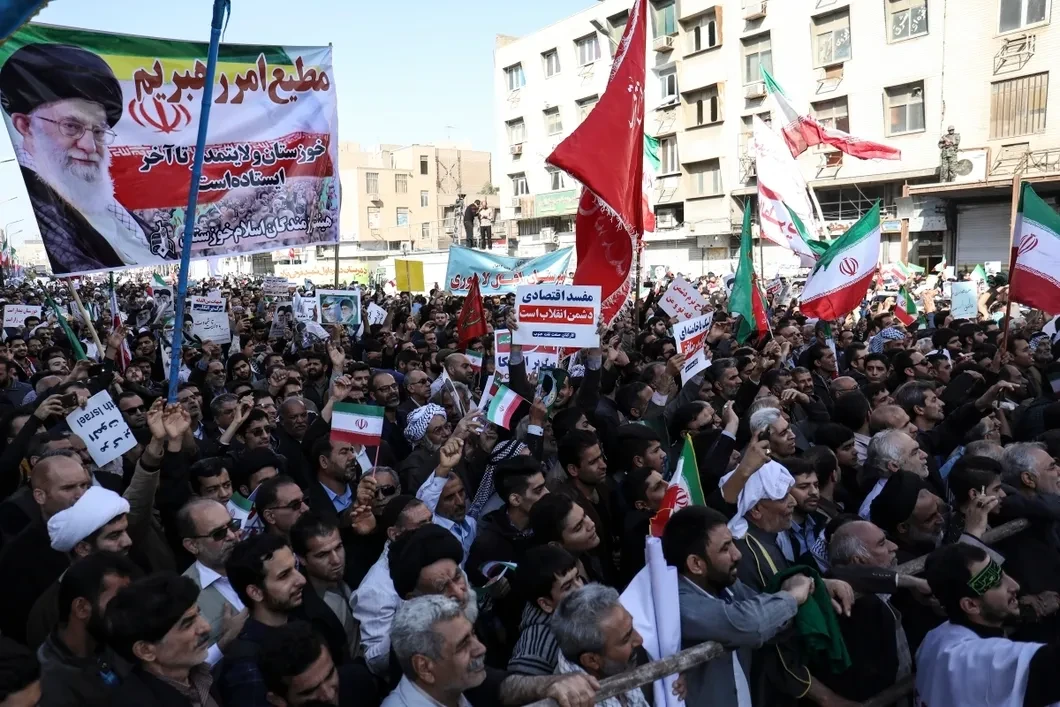
Iran’s authorities responded to opposition speeches in about the same way as in 2012 of the Russian authorities: throughout the country, huge pro-government demonstrations with national flags, crowds of mullahs in the turban, patriotic slogans and the Scandilization “Death of America!” Were held.
All the blame for the "rocking of the boat" was laid on the United States. On January 1, Iranian President Hassan Rukhani said that the USA, the Zionist regime (i.e. Israel) and Saudi Arabia are trying to destroy Iran's unity "and cannot bear our progress and success in the region." On the same day, Iran’s special services said that they had already detained several West agents standing beyond the riots.
The authorities of Iran failed to find more convincing enemies. As in 2009, the protests did not have a single leader. All information was distributed through the most popular social network of the country of Telegram (40 million inhabitants of the country use it in total, and the most popular telegram channel on protests has 1 million 300 thousand subscribers).
In addition to the Zionists and the United States, one of the main enemies for the Iranian authorities for many years remains the left-winging organization of the Mujahideen of the Iranian people of Mujjedin-E Hulk. In Iran, it was recognized as terrorist, prisons are stuffed with supporters, and 90% of the country's death executions fall on those who had the misfortune to be suspected of relations with her. Naturally, the Mujahideen became the first suspects in the current wave of riots.
The first time they were remembered in Friday prayer. Seven religious leaders throughout Iran hit the organization, accusing her of another attempt to rock the Iranian boat. The next day, the leader of Mujahedin-E Hulk Maryam Rajavi issued an appeal in which she supported Iran’s people and called for "freeing our occupied homeland." Iranian media exploded with curses. Alas: When the hundred thousandth crowds of indignant Iranians rushed along the squares of Iran, the appeal of Maryam Rajavi received only five hundred likes on Twitter.
If immediately after the Islamic Revolution of 1979, Mujjedin -e Hulk really waged an armed struggle against the Iranian authorities and enjoyed the support of Saddam Hussein, who is fighting with Iran, then it turned into the organization of retro-retirees, peacefully residing in Western Europe and threatening the mullahs exclusively with the help of Facebook and Twitter.
Protests began to subside on January 6-7. On January 8, Tehran announced that he was canceled an emergency introduced due to riots. Probably, the Islamic police are now dulling throughout the country, looking for hires of the United States and world Zionism, and the political prison "Evin" is rapidly filled.
On January 7, the media announced that the former President Mahmoud Akhmadinejad was arrested and placed under house arrest for supporting the protesters in the city of Busher on January 4. However, on January 8, the lawyer of the ex-president denied his arrest.
In Iranian social networks, a decline in tension is felt, cities are returning to ordinary life. Analysts believe that the protests in Iran were completely calmed down. More precisely, until the next reason for them - after all, the Iranian authorities, judging by the reports of official media, are not going to reduce the costs of war in Syria, or fight corruption, or monitor the cost of eggs.
"The Supreme Leader is old and sick, and the mullahs behind him are ready to start a struggle for his place"
Muhammad, a resident of Tehran (we do not name the surname at his request) - about how Iranian protests from the inside of the country are seen:
-I live in Tehran near the central prospectus of Vali-ASR and Azadi Square and watched the protests all days. If in 2009 most of the rallies took place in Tehran, then this time there were relatively few here. Protesters gathered mainly around Azadi Square and the city theater, after five in the evening, when students are freed from universities. In the first two days of protests, the city was filled with police, with the third - people in civilian clothes. They wandered around the squares, watched whether anyone shouts the slogans, and instantly scattered groups of people if they tried to gather.
It seems to me that these protests have several reasons. The main thing is discontent with a poor economic situation and more than thirty years of two -digit inflation. The income of the middle class from year to year is reduced due to chronic structural economic problems, corruption is widespread.
The last scandal erupted in November around the ruined banks. The state for a long time easily issued licenses for the opening of private banks, the so -called cooperatives. Any person could issue a cooperative and begin to issue loans to 25% per annum - the state earned on this.
Recently, several such banks went broke. The depositors expected that the government and the central bank would return the money to them, but they refused, saying that the banks worked illegally. As a result, the depositors rareded every day in front of parliament and the Central Bank, but achieved nothing.
In early December, the government published a plan of the country's budget for next year. It turned out, at a time when the country is in a difficult economic situation, and 40% of young people sits without work, most of the budget funds will be allocated to the work of religious organizations - that is, it will settle in the pockets of the mullah.
In addition, it was laid in the budget that within a month the price of gasoline increases by 50% (from 10 to 15 thousand Iranian rials). At the same time, the price of eggs, which have always been food for the poor, in just two weeks increased by 80%. People realized that a new wave of inflation began. All this was the first cause of protests.
Another cause of protests is connected with the struggle for power within the Iranian elite.
In Iran, traditionally there are two powerful groups: more conservative (it usually has more power) and reformal. The President of Rukhani enjoys the support of reformers and some moderate supporters of the conservative line. Opponents of the President of Rukhani are mullahs from a group of conservatives. For example, Ayatollahs Ibrahim Raisi and Ahmad Alamolkhod from the Holy Iranian city of Mashhead - the very one where the protests began. Ayatollahs control the multibillion -dollar assets of the Holy Church of Imam Cuts in Mesheda and the holding company that engages in his economy. Just imagine the assets of the Vatican and his economic subsidies. Here the temple in Mesheda is about the same.
In Iran, there is talk that the mullah tried to remove the president of Rukhani from power. To do this, they decided to organize protests against him, and then declare impeachment, explaining it to the dissatisfaction of the people. But the mullahs did not calculate that the inhabitants of Meshed really suffer from poverty and corruption. When people realized that it was possible to protest without fear of arrest, from the slogan "Death of Rukhani!" (which, by the way, has a double meaning on Farsi: “Rukhani” can be called both the president and the Muslim clerics as a whole), they quickly moved to the slogans against the Iranian regime in general.
This version is also confirmed by the fact that at the height of street clashes, the vice president of Iran Eshak Jahangiri, a close ally of Rukhani, said that "street protests began, and the others will end themselves, and the first to break their neck on this."
Since the Supreme Leader, Ayatollah Ali Khamenei Star and is sick, all the mullahs behind him are ready to start the struggle for his place. They try to show trump cards ahead of time, but still here in Iran, it is noticeable that all players of the political scene are in a state of cold war. If we proceed from the fact that they are about to begin the struggle for the main position in the country, it is easy to foresee that troubled times are waiting for us.
Do residents of Iran need West Support? My answer is not. We are very afraid of intervention, we are afraid that Western countries will turn Iran into a new Syria. Interviewing in our affairs, all states will defend their own interests. Better we will figure it out without them.
Alexey Malashenko
Head of Research at the Institute of Dialogue Dialogues
- What was the impetus for protests? I think the general situation. Unemployment in the country is 12%, among young people - 24%. Almost 40% of the population lives below the poverty level. And then there is an increase in egg prices. The event is small, but nevertheless. Any steps that adversely affect public in such a situation cause protest.
The riots went throughout the country. According to various sources, the second generation of youth participated in them, that is, people 25-30 years old. It is not clear what they wanted and opposed to whom - it seems, against the system as such.
If in 2009 the opposition candidates Mahdi Karubi and the world Hossein Musavi participated in the protests after the presidential election - by the way, it is still unknown where they are now - now there were no leaders. There are no charismatics in Iranian politics, and when they appear, they are not reformers, but by the conservatives, like Hameni himself or last president Mahmoud Ahmadinejad. There can be no charisma of moderate Islam, and Iranian society is not ready for the secular-charismatic leader.
The number of protesters also remains a mystery. The head of the KSIR says about 15 thousand people, but he is unequivocally lying, this is his work. But it is clear that the protesters are much less than in 2009, when there were from one and a half to three million people. Probably, in 2009, Iran missed his chance of radical restructuring and is now not ready for large -scale social actions. The protests were quickly crushed, the regime demanded, but I have the feeling that it benefited him. If earlier Ayatollah Khamenei did not get along with the president of Rukhani, now they will have to rally.
There is another important detail. Khamenei Star ( 78 years old - ER ). Rumors go through Iran that he is going to leave, even potential candidates are called in his place. It is interesting how the protests on the upcoming Ayatollah elections will affect, will a person who is more susceptible to reform ideas come to his place? Previously, Ayatollau was supported by Xir, but now these guys have lost 2,000 people in Syria and will not intervene in the situation. And if they are, but it is not clear on whose side.
Mikhail Krutikhin
Partner of the Consulting company Rusenergy, an oil and gas market specialist, Iranist
- Political events in Iran have not yet been reflected in the work of local oil companies: tankers go to the market, oil production is not interrupted or reduced. All Iranian plans to increase production remain in force.
At the end of December, oil prices rose slightly, it was a logical reaction to political protests, the outcome of which has not yet been completely clear. But no strikes on oil fields, as during the Khantishah movement in 1978-1979, did not happen. Тогда сперва тоже не было перерывов в нефтедобыче, но когда восставшая интеллигенция в Тегеране прекратила выходить на работу и перечислять деньги рабочим, они включились в революционное движение и перестали добывать нефть. Теперь ничего подобного не происходит.
Самое ожидаемое событие на рынке сейчас — продажа пакета государственной нефтяной компании Саудовской Аравии Saudi Aramco, которую уже преобразовали в акционерное общество. После продажи саудовский фактор перестанет воздействовать на рынок даже психологически, и цены вернутся к более-менее равновесному положению, которое будет определяться спросом и предложением.