
Translated material
Kits against Daikon
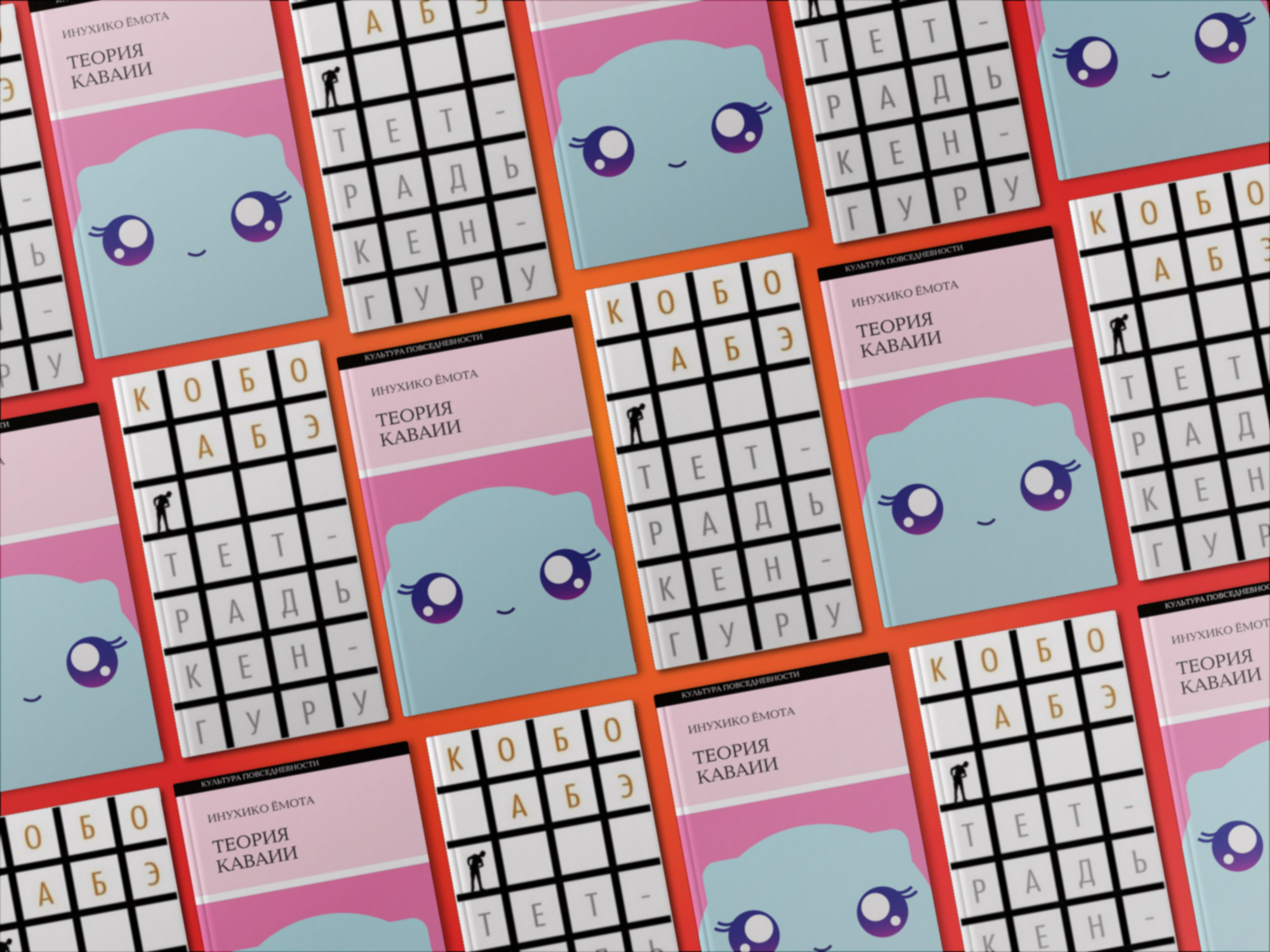
Why do we protect the cute and expel the strange - two books of Japanese authors in the book review of "such cases"
Kobo Abe. "Kangaroo notebook." "ABC-Atticus." 2017
Six in the morning, a young man is waiting for the opening of the hospital. He had already taken a ticket, but the nurse says that if there is no high temperature, then it will not work out of turn. The man’s legs are covered by the young shoot of Daikon, the local radishes. This plant is eaten throughout Japan every day, including a doctor who examines this strange patient.
In the story of Kobo Abe “Notebook Kangaroo”, the action takes place in two spaces: Japan at the end of the 20th century and the world of fantasies and dreams, in which the patient patient disappears most of the time. There are no specialists in his disease, the only advice is to go to sulfur springs in the AD valley, maybe there, radishes will cease to grow from his body. The experiments showed: if you transplant the processes of the plant into the ground, nothing happens. Radis feeds on human juices, like a closed and self -sufficient ecosystem.
In every text, Kobo Abe explores a person’s relationship with his body and between an individual-marginal and society. Most of all, the appearance of Radis worries the very victim of this magical transformation. Doctors, nurses, other patients - all of them approach the problem pragmatic. Although the case is unusual, in the capitalist world everything can be cured. However, no one is trying to treat. The doctor pushes the hospital mobile bed with the narrator at night, instead of the recipe, prescribing a sulfur source. In another scene, the nurse displeasedly notes that "the most unpleasant patients - who is fixated on himself." Metaphorically, this scene resembles how the system gets rid of an uncomfortable person who is difficult to integrate into familiar mechanisms.
Everything abnormal finds a place in the phantom, oneric world of the narrator: the “help” choir, consisting of ragged children-demons, begs tourists because there are not enough funding for their education with the municipality. The pragmatism of the heroes of Kobo Abe is rooted in the system of the victorious capitalism. The main character, even in his nightmares, promises that as soon as he returns to the hospital, he will give his assistants all the borrowed money, and one of his new acquaintances reminds the storyteller that insurance acts even in hell.
By the middle of the book, the patient is no longer afraid of his anomaly, but is trying to rationally solve the problem - as far as possible, because most of the time the narrator spends in a semi -conscious state. Radis not only allocated one patient among others and remote him from a healthy society. The appearance of this plant made the narrator constantly think about his body, about how other people see him. The nurse does not perceive him as a man, because her legs overgrown with greenery do not fit into her idea of sexuality. Some fellow travelers even take him with the bed for the subject, the narrator even remarks: “I have the feeling that I have been living in hell for a long time, although he has not yet died.”
Narcissism, imposed by an unexpected disease, leaves the hero only at the end of the book. He enters the department, where they discuss the right to euthanasia and want to help one old man. But soon the storyteller again returns to his problems with the almost Hamlet monologue: “Well? Two positions. Which one to choose? Suppose it turns out that my Daikon is an incurable disease. Will I agree to euthanasia? If these sprouts cannot be removed, they can be hidden under socks. But suddenly the seedlings will spread throughout the body, germinate in the eyes, nose, ears, mouth, then into the urethra, into the anus? Suddenly, in the end, will I turn into a plant resembling a huge ball of green algae? Then, of course, euthanasia is the only way out. Probably, the right to suicide should be assigned to a person. ”
The patient is thinking about his past life and about working in a company that is engaged in clerical goods, only at the end of the book. An anormality knocks it out of the usual story. Moreover, no one recalls and does not worry about him, in only one of the delusional states he meets his dead mother in cabbage. Almost all the time the patient travels like all the spaces for him, and only the bed can be called the bed that appears in every scene and almost pursues the main character.
The “Kangaroo Notebook” resembles another cult novel Cobo Abe, “The Hush-Man,” in which the hero puts on the cardboard box as the answer to the capitalist world, which constantly looks at him and thereby “consumes”. In Kangaroo Notebook, contact with the world breaks off even tougher. In fact, Radis appears on the legs of the narrator as a punishment for the irrational sentence that he expressed to his chef at work. It all starts with an inconspicuous difference, and ends with the final exile.
Read on BookMate
Inuhiko Yomota. "Theory of Kawaii." UFO. 2017
In 2004, Japanese scientist Inuhiko Yomota was invited to give a course of lectures in Kosovo. A refugee camp was located in the university building: “While the Serbs and Albanians fought violently in the building of the former younger school, which was temporarily used for not their intended purpose and where I was invited several times,“ Sailor Moon ”was again played on TV. Anime was shown as it is, in the original: neither credits, nor translation, no explanation. Despite this, the children of refugees could not tear themselves away from the screens, they sat like chained. ” A lun girl, who is a little bewildered, simple and always defeats evil, won the hearts of millions of spectators around the world. Its image represented in the West the popular culture of Japan of the 1990s. Too big eyes for an ordinary person, other clothes, frequent cries of the main schoolgirl, who became superheroine - everything in this girl looked “kawaii”, sweet. In 1998, The New Yorker chose Pokemon, another bearer of kawniya, a person (character) of the year.
Manga, anime, films, souvenir products (mercha) - only one, the material side of the Dickening industry. Cozy plots, characters, sounds and pictures from the 1990s to the 2000s have become an important part of Japan's export to the world market. A country that has long been in voluntary self -isolation from European civilization, began to supply aesthetics of Kawaii to other countries.
In his book, Kinoved Inuhiko Emota talks about the emergence of a “sweet” and “safe” style in the popular culture of Japan and describes the main stages of Kawaii's expansion to the West. The scientist is interested in how the meaning of the word “kawaii” in Japanese has changed, and the author, in the framework of his travels to Europe and America, is inquisitively looking for whether there are analogues of this concept in other cultures (almost no). The scientist methodically question hundreds of his students, trying to figure out the gender features of this phenomenon: it turns out that boys less often want to be kawaii than girls who, in turn, compare such an assessment of their image or behavior with moments of happiness. Inuhiko, everyday meanings and circumstances of the use of this word are important. The sociological view of the scientist turns to the covers of magazines - the forge of gender roles in the consumer society for those who are up to twenty -five, and the image for more adults.
Thinking about the aesthetics of Kawaii, the author explores another, perhaps more important question: why some works of art are more popular than others. He notices an interesting paradox: ““ deprived of citizenship ”” novels by Murakami are translated into dozens of languages, while the novels of Kenzi Nakagam, in which a local flavor is strong, are not popular abroad to the same extent. ” In fact, along with the story of the history and use of Kawaii, we will learn how the memory of a tourist works, who finds the atmosphere of the “Japanese world” in the muraki novels without immersion in national details. In one of the chapters, the scientist considers the carriers of this atmosphere - souvenirs as a symbol of a kawaii. Small, most often harmless and cute figures can be taken with you as a memory, but rather not about the very place, but about what you once visited. Sentimentality, immersion in a pleasant past becomes the foundation for oblivion, abandoning historical reality with all its problems and shortcomings.
By the end of the book, it becomes clear that the researcher has turned into a chamber that registers a pot everywhere. He notices images of kittens even in showers of Auschwitz. This find is a point of no return. The initial message of the drawing does not coincide with the situation that, "looking at Kawaii, behind which the idea of a terrible tragedy is hidden, people may no longer obediently admire Hello Kitty, not to mention the present to each other as a gift."
Inuhiko, already saying goodbye and distributing gratitude, calls for colleagues and readers to discuss and criticize his compositions written on occasion. After all, Inuhiko, Emota cannot call himself a specialist in the manga or other storage facilities. He became a cavalist in the course of reasoning over a variety of plots of world culture: from the paintings of the naive artist of the 19th century, who painted endless adventures of warrior crumbs, to Japanese literature of the 20th century, not so famous outside the country of the rising sun. And the first Russian -speaking criticism of this book awaits us directly in the vast preface of the translator, Japanist Alexander Belyaev, who considers his duty to build relationships between the examples of kawnii from Japanese and Russian culture to the Russian reader. During the guidance of these bridges, Belyaev searches for not so obvious kawaii examples among Griboedov and Nabokov and at the same time indicates to the Japanese colleague to thematic books, for some reason who were without attention.
Given the liberty of the style and many research strategies, the book of Inuhiko Yomota is the most affordable history of the nurse, translated into Russian. The scientist managed to combine the tasks of education with the genre of the scientist’s journey, which formulates the functions of Kawaii for representatives of different cultures: “Human society feels helpless if it does not protect and defends anyone.”
Read on BookMate
Do you want us to send the best texts of “such cases” to you by e -mail? Subscribe to our weekly newsletter!
Books Relations with the Body