Date
Author
Ирина Андрианова

Preserved copy
Translated material
Sanatorium or apartment hotel?
On the territory of the Sestroretsky resort sanatorium, the historical medical building “Forest” of 1900 is demolished.
Two other corps, Soviet times, were demolished in the fall. About 40% of the sanatorium park is fenced by the fence, and the guards convincingly put out the walks from there. On January 9, heavy equipment was brought to the forest building, which works without ceasing.
Thus, the RBI Group company implements its plan to turn part of the territory of the oldest St. Petersburg resort into an apart-hotel. Having acquired 5.4 hectares of a park from the Sestroretsky Resort OJSC with old buildings there, the company announced the construction of the so-called lounge studios in their place-a new euphemism instead of boring apartments. In fact, we are talking about business class apartments at a price of 130,000 rubles. for sq. m. From ordinary housing, they are distinguished by the inability to register. A little lower along the shore of the bay, on the site of the former Dunet boarding house, under the guise of sanatorium-resort apartments, the residential complex “The Bright World inside” is already being built. Gosstroynadzor claims that new houses will not go beyond the dimensions of the old buildings - the same area of buildings and the same five floors. But the calculations conducted by ecologists by the correlation of the area of existing buildings and the area that the developer plans to use as a result of the reconstruction, we can conclude that at least 50 thousand square meters of the sanatorium park will be cut down.
In total, 300 lounge studios are expected on the RBI section, which, with current practice, will give the park extra 450-600 cars in two cars per family. It is unlikely that they will be parked outside the sanatorium: underground parking lots are designed in the lounge-new buildings, which means that cars with exhaust gases and noise will drive right through the park.
Despite the fact that building work permits were issued only in relation to the territory of 5.4 hectares, RBI grabbed at least 18 hectares with a fence, that is, about half of the park area. The developer reacted equally voluntarily to other provisions of permits. For all three buildings, only the reconstruction was allowed, but two of them (including the one where the overhaul was carried out a year ago) were completely dismantled. The permit for the work in the forest building issued by the State Construction Supervision Bank also said about the “reconstruction with reconstruction”, however, a project declaration is placed on the website of the Russian developer, which directly mention the demolition. Whether they know about this in the KGIOP, it is unknown, but work is carried out in the zone of the guarded landscape of the resort district of Zol 1-1. For dismantling, the sanction of the KGIOP is required, which was not given in the department.
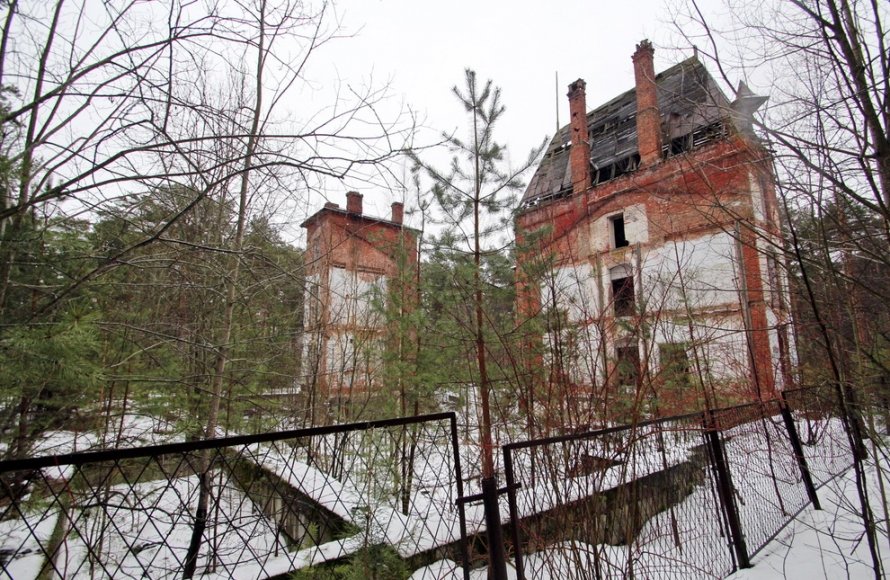 Lesnaya boarding house in February 2014 // Photo: Kanoner.com
Resort - whose?
For many years, citizens naively considered the oldest city sanatorium (opened in 1898) to the state. Well, how, since they are freely allowed to walk into the territory and there are economical numbers of 1,500 rubles per day, it is only a state. (By the way, it was the economical corps, as well as the “Mother and Child” branch in the first place.) In fact, the “Sestroretsky resort”, and the boarding house “Dunes”, and “Black River”, and “Vostok-6” belonged not to the state, but to trade unions. In Soviet times, this format was not very different from state property, and in post -Soviet times allowed the successors of trade union organizations to conduct several delightful geshefts.
The question of how the most valuable park on the shore of the Gulf was in private hands is necessary to ask Vladimir Derbin, the former chairman of the Committee for Labor and Social Protection of the Population of St. Petersburg, the head of the Leningrad Federation of Trade Unions and the director of CJSC Sestroretsky Kurort in the 2000s.
It was during the period of his reign of the sanatorium without the knowledge of the members of the Federation of Trade Unions that was transformed from CJSC to OJSC, which allowed shareholders to sell their shares without coordination with each other. Very quickly, the federation turned from the main shareholder into a minority, and most of the shares have become the property of individuals. The spin of the sanatorium tried to dispute the privatization of the sanatorium - but to no avail. The initiated criminal case of fraud was suspended.
The history of the sale of land has ended - the most valuable asset. 40% of the territory sold the pool of investors, which included RBI, St. Petersburg Bank and two more offshore companies. In 2015-16. This part of the park was placed in 9 sites, and their boundaries pass directly across historical alleys. Which eloquently shows that the pool of investors is not interested in maintaining the pre -revolutionary resort and the rest of the allotments will be subjected to the first development. 60%remained behind the Sestroretsky Resort, but they partially belong to offshore. Hopes for preserving the park, and with it the resort status of the entire area of the same name are melted before our eyes (especially in the light of the buildings of the Dune boarding house, the recent sales of the Dunes of the LSR company and the most egregious cases of the Apart-Ploles right on the shore of the bay in Repino and Zelenogorsk).
Suddenly, for everyone in the protest public “Protection of the sanatorium of the Sestroretsky resort”, the general director of the institution Mikhail Gorba spoke. In his opinion, activists thicken paints. The fence of such a significant territory is, in his opinion, "a forced measure, given the dense forest and the uneven landscape." He assures that after the reconstruction of the corps, no more than 15% of the section of 5.4 hectares will take: “Therefore, it would be time to end the speculation on this subject, as well as the theory of closed territory after the reconstruction.” As for the elimination of economical corps, "nostalgia for megadeshop numbers for one and a half thousand rubles is understandable, but the sanatorium would not have lived for a long time on such a deplorable economy."
PS By the evening of January 11, the demolition of the forest building was almost completed. Only one tower remained in place.