
Translated material
Funny funeral
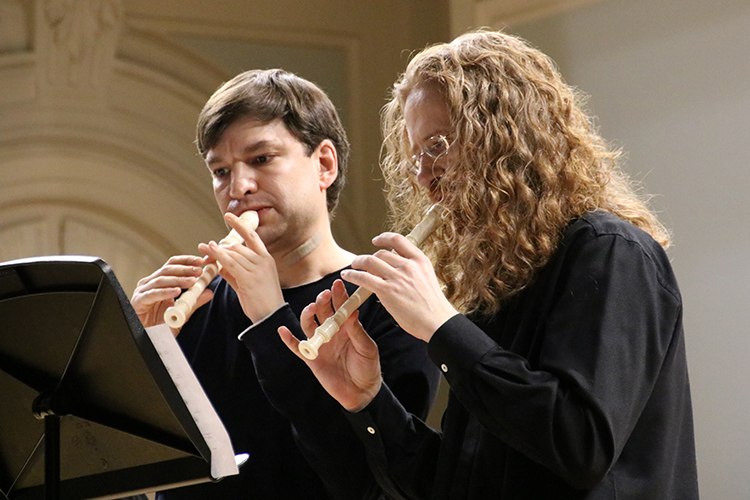
Today, the 21st Festival "Return" by tradition ends with a non-gram "concert on the request". It contains four large ensemble works of Rachmaninov, Richard Strauss, Schenberg and Brahms, which, performed by the most selected instrumentalists, represent a luxurious holiday of chamber muscles. The previous three evenings - again, by tradition - claimed a more difficult statement. The festival has existed for so long that one of its formal and at first innocent principles is not to be repeated - it acts more sharply and more conceptual. With each new “return”, deposits of unknown music are found, which is also inventively overtaken into thematic blocks.
This time, a selection of programs has developed defiantly gloomy. On the first evening called Opportunism , those who bent were taken to clean water. In principle, of course, almost the entire history of music is a continuous composer desire to provide their creations with the love and money of those in power. But they decided to say their special ay-yai-yai-yai-yai-yay to tell the Soviet classics Khachaturian and Shostakovich, the authors of the XIV century Filippoke Kasherstsky and the master Egidius, who composed the flattering ballads of Antipape VII (with them at the festival, the Labyrinthus ensemble debuted), Bekhovenu, Bachu and Bachu Saint-Sansu, who composed musical compliments to the royal persons, as well as the successful composer of the Third Reich Karl Orfa.
Khachaturian, who opened the Festival “Poem about Stalin”, shifted for the piano four hands and performed by two bright pianists Vadim Kholodenko and Jacob Katsnelson (the first of which, in addition, was the virtuoso of the Facebucchus Stable), immediately set the festival tone - a combination of surprise, skill, enthusiasm and saving irony. By and large, the “return” with his branded jokes in the texts of the booklet (for example, in a biographical certificate about Kholodenko, it is reported that the pianist’s concert in Lviv “brought down a Bitcoin course by a thousand points”) is such an island of healthy musical crossedings in the ocean of high and pure art. It does not surprise anyone here that for the performance of the “street song” of Orfa, the leaders of the festival Roman Mints and Dmitry Bulgakov instead of the violin and Goboy easily pick up children's puffs.
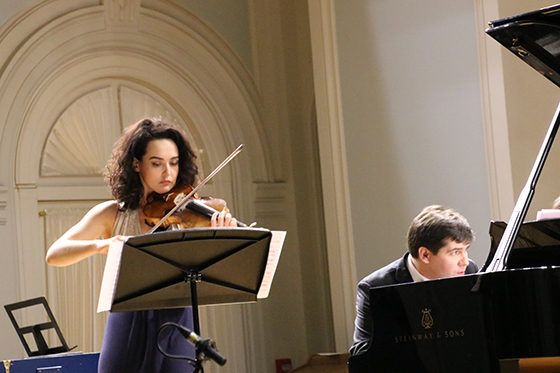 © Inessa Kudryavtseva Alena Baeva and Vadim Kholodenko play the Opestanist Saint-Sansa
The second evening was called "Non -free." For atmospheric, they first launched a folklore vote in the school Pushkin text “I am sitting behind bars in dungeon raw” . The main program was almost all assembled from unique scores composed and recorded (whatever hit on anything, even coal on toilet paper) during the location of their authors in conclusion. The most important such text - the “Quartet at the end of time” Olivier Messian - really was not. The most famous “sidelts” from this program is Vsevolod Zaderastsky, who survived in the Stalin camps (Ksenia Bashmet executed one number from his large -scale piano cycle of 24 preludes and fugs written on Kolyma ) and Viktor Ulman (“Three Songs”, accompanied by violinist Boris Abramov, Altist Ilya Hoffmann and The cellist Alexander Neustroeva sang Svetlana Zlobin; the booklet spokely said that the composer was the string quartet performed by the forces of the prisoners, but, apparently, only three Strunnikov in the camp remained).
This is such an island of healthy musical overlain in the ocean of high and pure art.
It is difficult to deny that the circumstances of the birth of music in this case often obscure the music itself. The American composer Henry Cowell, the inventor of the musical cluster and the Drama Mashina, a colleague of John Cage, was arrested in the late 30s for homosexuality. In 1967, the South Korean follower of Novovenets was stolen in Berlin's native special service and sentenced to death on charges of espionage (the composer managed to defend, many celebrities, including Stravinsky and Karayan). A student of the Dvorzhak and a participant in the Czechoslovak resistance Rudolf Karel died in Terezin, not having time to add the background (the “returners” performed him unfinished). After the war, Matvey Pavlov Azancheev was accused of “anti-Soviet defeatical agitation” and exiled to the camp in Krasnodar, from where he sent his friends plays for the guitar: “Sorry, Sasha, that if I had a pen Rondo, I write with a pencil. Raw paper and ink passes. ”
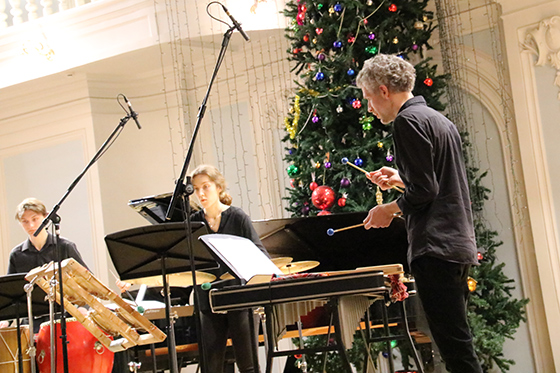 © Inessa Kudryavtseva Ensemble of percussionists under the direction of Dmitry Vlasik plays the plays of Henry Cowell, written in prison San Kentin
The final number of this program was summed up by its powerful protest pathos. The stubborn and angry major of the minimalist Frederic Rzhevsky in his work “ Attica ” for the reader (in this role, Roman Mintz without violin and with a microphone looked very organically) and the instrumental ensemble is a response to the bloody suppressed uprising of the prisoners, which occurred in the American Attica prison in 1971. The last point in the growing musical riot of this composition puts the sound of a siren.
Finally, the third program this year was called " Mort " . Death, TOD , Death , Moro , Funebre , Macabre - at all times and in all languages this topic worried composers. Here it was just that it was possible to do without unique scores. But not at the Festival "Return". One of the excellent finds is the play of the modern German composer Wilfried Hiller “Death - Beauty” for the violin and piano in the magical performance of Boris Brovtsyn and Ksenia Bashmet. Graceful pastabricial beauty was added by a choral frame - QueSta ensemble Musica Philip Chizhevsky began the concert Madrigal Jezualdo “I am dying of suffering”, and ended with the canon of Haydn “Death is a long dream”. In the “Chardash of Death” of the sheet, Vadim Kholodenko was no less success than a few days before in the “Poem about Stalin” (and, it seems, both works - about the same thing). With the next debutant-a baritone from the theater of Stanislavsky and Nemirovich-Danchenko Anton Zhayev, who spared the Four Strict Nass, Brahms, accompanied by Alexander Kobrin-the festival should be warmly congratulated. As with the ability to remain alive in the most dead circumstances.