
Translated material
Asthenic syndrome
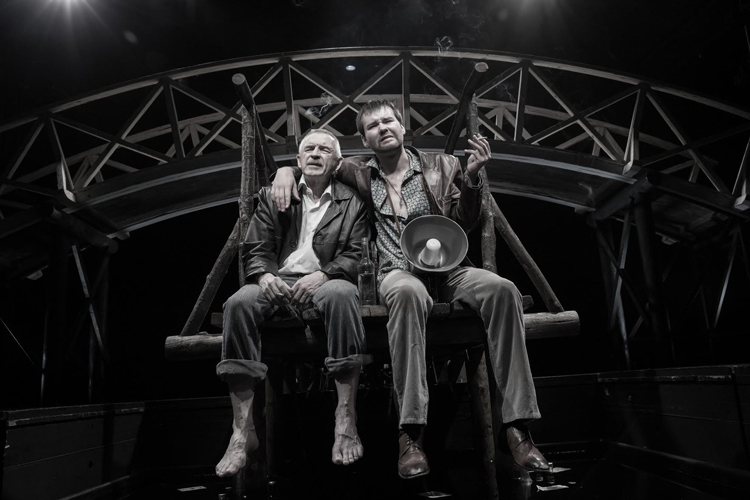
The first that burned me in the “Reserve”, released by Sergei Zhenovach in the “Theater Art Studio” on the very eve of the new, 2018, year, was a sharp dissonance with expectations. The holiday on the nose, a beautiful author - the performance could be very funny: about the abominations of the “scoop”, of course, - but with such melodramatic piercing, which would quickly forget about abominations and drown in bright sadness.
But instead of the funny to the colic, the sarcastic and at the same time lyrical story about the Soviet stagnation in the idyllic landscapes of Pushgor in the performance of Zhenovach was discovered and somehow the intonation, murderous in its hopelessness, was immediately established.
This intonation, of course, went from the artist. The hero of the story, Boris Alikhanov, is played by Sergey Kachanov-the same actor who, together with Sergey Taramaev and Vladimir Toptsov, determined the acting intonation in the troupe of Sergey Zhenovach in the early 90s and created the theater that became the most important in the artistic atmosphere of the new Russia. Natalya Krymova, who had recently lost her husband, who died in 1987, blessed the arrival of the already famous young director, student of Peter Fomenko, to the theater on Malaya Bronnaya, where he worked and from where he went to his Tagan Calvary, Anatoly Efros.
 © Alexander Ivanishin
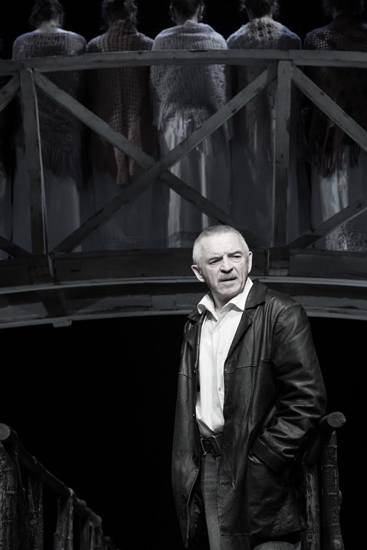
The classmate and closest associate of Zhenovach, who has long teaching acting his students, Sergei Kachanov played a lot of beautiful roles on Malaya, but the first of them - King Lear - became a sign of the era. Stated in 1991, this performance proposed to look at the division of the country as a matter of purely homemade, family. Lear Kachanova knew that social cataclysms are rooted in carpets and home comforts, hid in warm slippers, wrapped in shawls. Its intonation of the timid and humble pronfile, performed by confusion and hopes of the tramp from the city lower classes did not fit with the royal grandeur. From the core of an intimate, homemade comfort he asked a new global village - a world that we all knew about.
The long-long beginning of the “reserve” is exactly the epigraph to this distance between “then” and “now”. Through the scene - overlap with a cross - two bridges are thrown, literally repeating the memorial Mikhailovsky bridges (one of the best works by Alexander Borovsky, with their symbolic capacity resembling the masterpieces of his father, the great scenographer David Borovsky). The end of one of them rests right on the hall. Here, at this end of time and spaces, he will sit almost the entire performance of Kachanov-Alikhanov, saying “Words, Words, Words ...”-and physically conveying a strange feeling of suffocation, expanding it, deepening, making it unbearable and funnier, more commonplace and more acute, bringing to that asthenic limit that you have never concerned with alcohol, hopelessness.
Stress, contrast between narrative and theatricality for the first time appear in Zhenovach so sharply, almost posterly.
Sergei Kachanov is annoyingly slow in this state. He winds up more and more turns of despair, and the Zhenovach does not offer any subpoons - he leaves him alone on a bare bridge in the middle of a space, crossed, as if with a rainbow, another bridge. It turns out, whatever one may say, the cross.
Zhenovach has long been telling the history of the Russian/Soviet intellectual, feeling his mismatch with the world. Both Bulgakov , and Venichka Erofeev, and even Chekhov with notebooks, read differently, turned out to be close to each other. But, it seems, in the “reserve” tension, the contrast between narrative and theatricality for the first time appear in Zhenovach so sharply, almost posterly.
 © Alexander Ivanishin
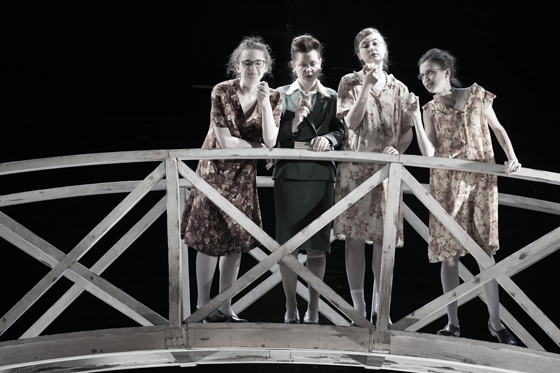
Moreover, we are talking about a prose writer, capturing the Soviet degrading world through a joke; It would seem much easier to embody him in a series of theatrical escapades. But the visual ascuse of Zhenovach precisely in the case of Dovlatov reaches some kind of anecdotal limit. The main character sits almost all the time, and the “theater” in the sense of his various capabilities arises only on the rainbow bridge. There, women and girls in multi-colored claw dresses, enthusiastic representatives of the Soviet “education” of the 70s, sing, dance, carry unusual school nonsense.
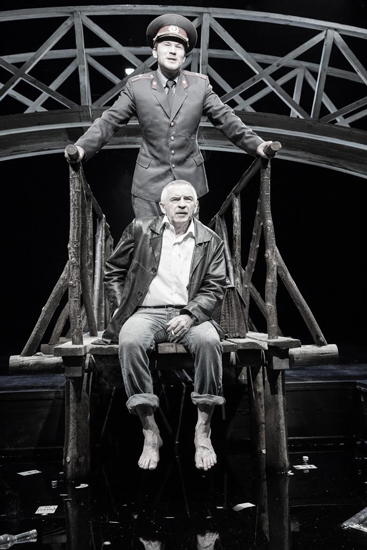
The character of Sergei Kachanov reacts to this extremely stoically. That is - literally - with the complete awareness of the meaninglessness and doom of all efforts. The timelessness, walking the throat, is most strongly expressed in the play not by genre scenes with rustic drunks and romantic young ladies, but by this gloomy melancholy of the Kachanov character, the Shutovsky and alcohol at the same time. Some constant, never-asked question nests in the very core of his speech, deprived of any pathos of denial, exclusivity or heroism. In it, by the way, is a very acting, theatrical unraveling of the nature of that friendship that Joseph Brodsky, who did not like dissident exclusivity, showed in relation to Dovlatov. Here, perhaps, the desire of the late Dovlatov is also rooted "to be similar to <...> only to Chekhov."
 © Alexander Ivanishin
In Kachanov’s stoic-bribe game, such a repulsive at first, the spirit of the 70s and 80s is completely reconstructed with his special type of escapism, the dream of escaping-the escape of anywhere. Despite the theatricality of the second act and lovely singing girls, Zhenovach staged a performance, gloomy to stupid. Gloomy so that for a long time you do not believe that it has to do with Dovlatov.
In the final itself, Kachanov leaves the bridge into the distance in order to read Pushkin’s poem “from Pindemonti” there - “all this, you see, words, words, words ; / Other, the best, the roads are right to me ... ”But no matter how the Zhenovach insisted on the“ other, better ”freedom, which is dear to him bypassing the journalistic severity of today, in his performance is felt not freedom, but only a hopelessness that has been strikingly returning us to the psychocomplex of the Brezhnev stagnation, not even to the Dovlatovsky darkness.