
Translated material
Putin and "Rothschilda Egg"
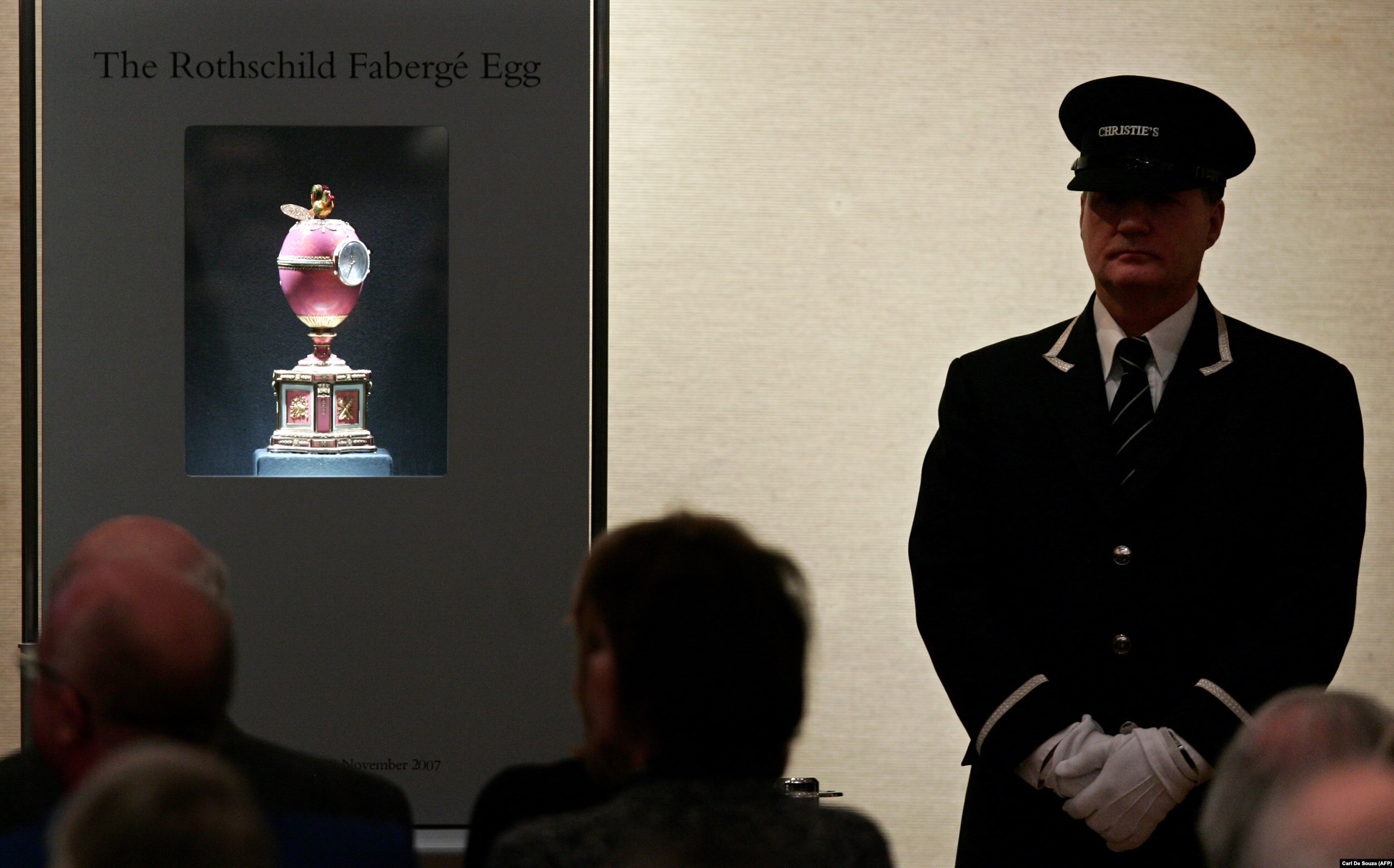
His name is not in the lists of the richest people in Russia, but legends go about his collection of art of art. Alexander Ivanov is one of the most famous collectors of jewelry of Karl Faberge. One of the pearls of his collection-the unique “Rothschilda egg”-he bought in 2007, and seven years later it was in the hands of Vladimir Putin, who presented a precious trinket to the Hermitage on the occasion of the 250th anniversary of the museum. The authors of the new investigation of the anti -corruption project "Municipal Scanner" claim that most of their major acquisitions, including Rothschilda Egg, made Ivanov with the money of Putin's masseur Konstantin Goloshchapov. The collector himself decisively rejects this statement, but many of his words contradict official documents that are in the public domain.
At the end of December, the "Center for Investigation Management", one of the Internet projects of Mikhail Khodorkovsky, told his readers the story of "Massage therapist Putin" by Konstantin Goloshchapov. Goloshchapov was talked about as one of the closest people surrounded by the president for a long time: back in 2002, detailed publications about the former orderly of the Mariinsky hospital in St. Petersburg, who had moved to Moscow along with other comrades of Putin, made the New Gazeta and the version of Version. As the Novye Poloshchapov was a partner of the brothers Arkady and Boris Rotenbergs for the Bank of the Northern Sea Road (SMP) and was especially close to key figures in the Russian Orthodox Church (in 2002, Goloshchapov organized the delivery of the relics of St. Nicholas the Wonderworker from Italian Bari to Petersburg ). Later, the entrepreneur tried to help Putin’s closest friends, Arkady and Boris Rotenberg, buy the Bari football club, but could not do this because of the sanctions against the brothers introduced by the United States and the European Union after the start of the war in eastern Ukraine.
Massector-frame
According to the publication of the "Agency for Political News", the preserved copy of which is available on the website "COMPROMAT.ru" , Goloshchapov is the "spiritual father" of some influential representatives of the "Leningrad team" of the president. It is included in the nearest encirclement of a number of influential figures of the Russian Orthodox Church, which allows him to arrange a “pilgrimage” trips to Greece for the “Petinsky” “Petinsky call” to the famous monastery on Mount Athos, where, according to rumors, “problems of rotation of leading personnel” are solved. The "masseur" Konstantin Goloshchapov was allegedly called because back in the 70s he saved Putin from back pain, he received as a result of judo classes. Another nickname, allegedly available to Goloshchapov, Padre, is associated with his religiosity. According to journalist Sergei Kanev, Goloshchapov owes their appointment "at least 500 officials and deputies."
As the “Investigation Management Center” found out, another country, in addition to Greece, which Konstantin Goloshchapov really loves, is Croatia. Here he bought a villa on the island of Syapin, promising local authorities in exchange for the approval of the transaction to make a five -star hotel out of the old historical building and build on the island of the road, a transformer station and other infrastructure facilities. He did not hold any of these promises, says the CUR , and the villa and modern cottages built next to it are used as private residences.
So what does the Faberge egg, donated by Putin, have the Hermitage in December 2014, - but not simple, but one of the rarest, the so -called "Rothschilda egg"? In the new publication , the project "Municipal Scanner", specializing in the study of assets of the immediate environment of the Russian president, claims that Alexander Ivanov bought an egg in 2007 at the Christie's auction for $ 18.5 million (at the time at the time of purchase) not with his own money, but at the funds received from Konstantin Goloshchapov.
Subscribe to us in Telegram
The performance of Vladimir Putin in the Hermitage on the occasion of the 250th anniversary of the museum. At the end of the video, gifts from the collection of Alexander Ivanov are solemnly made to the hall: “Rothschilda egg” and Faberge’s hours made for the 25th anniversary of the marriage of Alexander III and Empress Maria Fedorovna:
A mysterious collector
Alexander Ivanov is one of the most famous Russian collectors of Faberge factory products, which have become one of the main symbols of pre -revolutionary Russia for the whole world. However, numerous caskets, figures, and even the famous Faberge’s eggs were far from always: after the revolution, the Bolsheviks sometimes sold them to the west for mere pennies, and only by the middle of the 20th century the number of zeros in price tags for Faberge products began to increase rapidly. Ivanov claims that he bought many things from his collection in the early 90s before the explosive increase in prices for them, which allowed him to earn money for new and new acquisitions.
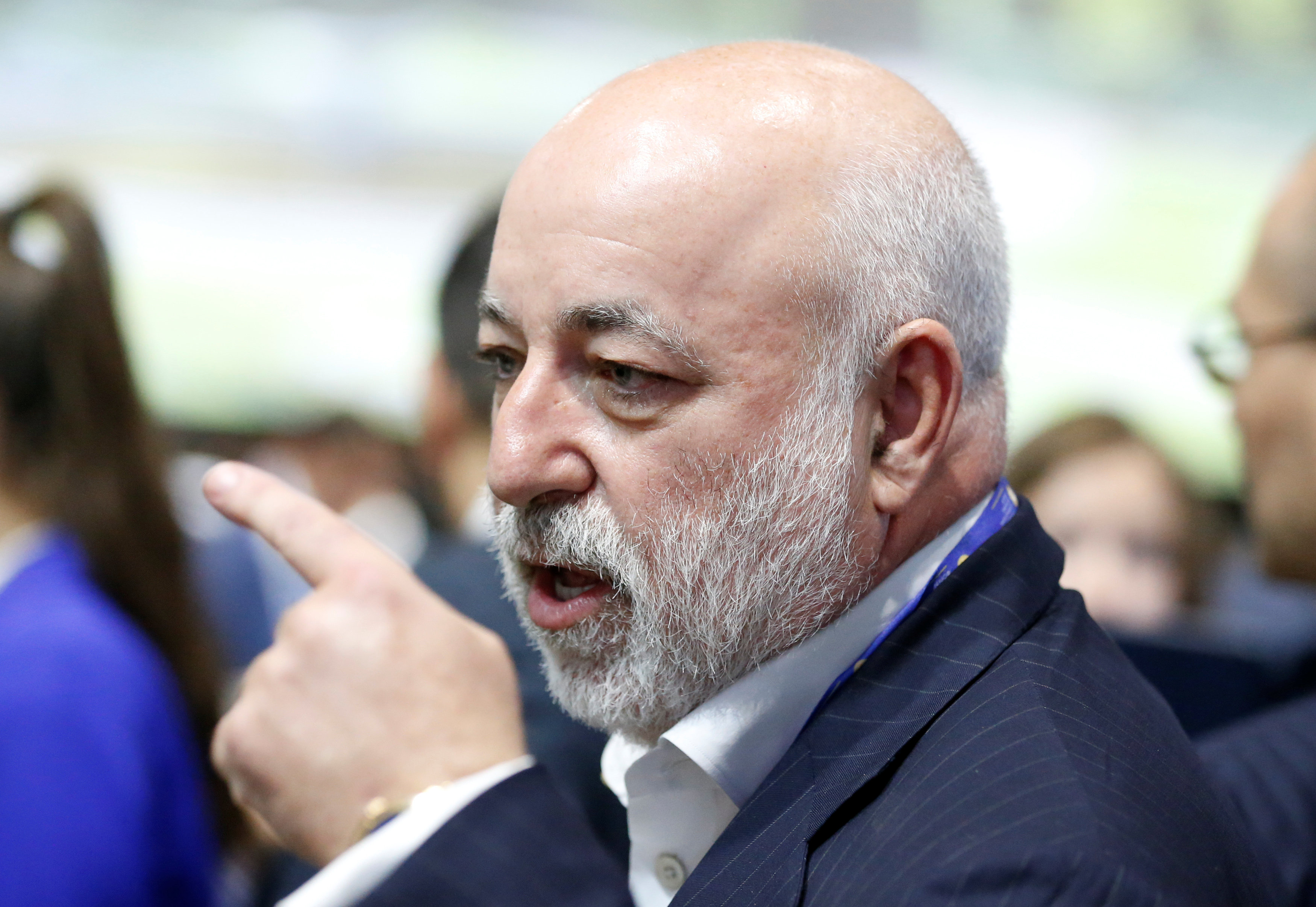
The main Russian collector Faberge is considered, however, not Ivanov, but Victor Vekselberg . In 2004, he bought a collection of more than 300 production items of the famous jewelry factory, including 9 “Imperial Easter eggs”, which belonged to the publisher of Forbes magazine Malcolm Forbes. Spended by the relatives of Forbes for auction after his death, she went to Vekselberg without trading: one of the richest people in Russia ( 3rd place in the Forbes list at the time of purchase ) agreed to buy the entire collection auctioned auction date for an amount, the estimate of which is ranging from 130 to 250 million dollars.
Now Vekselberg has settled in the list of the richest Russians to 10th place, but the name of Alexander Ivanov in this ranking cannot be found at all, although he spent tens of millions of dollars at Sotheby's and Christie's auctions-including interrupting the rates of representatives of Vekselberg . Ivanov, in his own words, collects not only Faberge, but also other art objects, although the jewelry of the famous factory remains his real passion. In the early 90s, as Ivanov said in several interviews (including inan interview with Radio Liberty in 2016), he made a state of importing computer technology into Russia, but later, having gotten angry, abandoned the business and devoted himself entirely to artistic collecting.
A collection of Faberge products belonging to Ivanov is estimated at 1.5 billion dollars - although no one knows exactly its volumes and no one has ever seen it entirely. To store the collection (or part), Ivanov founded the Faberge Museum in the German resort city of Baden-Baden, with the support of the German authorities. The purchase, restoration and equipment of the museum building cost it 17 million euros. Shortly before it was a gift to be donated, the famous "Rothschild egg" was exhibited here. It was made by Karl Faberge in 1902 for the family of the merchant of the 1st Guild from Berdichev Efim (Joachim) Efrussi. One of the sons of Efrussi in 1883 married the daughter of Alfons Rothschild Beatrice, who in 1905 gave him to engagement to his younger brother - Baron Eduard Rothschild. For more than a hundred years, there was no information about the existence of the Rothschild eggs: it was not exhibited, not resold and was the property of the Rothschild family until Ivanov’s sale in 2007.
Faberge Museum in Baden-Baden:
In an interview with Radio, Freedom Alexander Ivanov answered the question of where he got the money to buy works of art:
"I was not a poor person when I started collecting this collection. Now we spend several million dollars a year on the purchase of new exhibits. With some things that are not in the exposition, I will sometimes part. It is enough for me to sell one or two things to buy for several million. However, I have been selling things that have been in the collection for at least five years so that the tax authorities have no complaints against me."
Nevertheless, it was the tax authorities who had claims to Ivanov-in 2014, a search was arranged in the Museum in Baden-Baden in which employees of the tax authorities of Great Britain and Germany participated. According to investigators, Alexander Ivanov illegally returned the VAT on the purchase of “Rothschild eggs” in the amount of more than 800 thousand dollars: according to the rules for the return of the tax, he was supposed to take out the purchase outside the EU, but allegedly did this immediately, but only in that very 2014, when the egg was presented to the Hermitage. Ivanov himself denies all the accusations against him, they were not officially presented to him, moreover, in the correspondence with Radio Liberty, the collector said that in December 2017 his lawyers filed a lawsuit "regarding his illegally persecution" to the British Ministry of Internal Affairs in the amount of $ 2 billion.
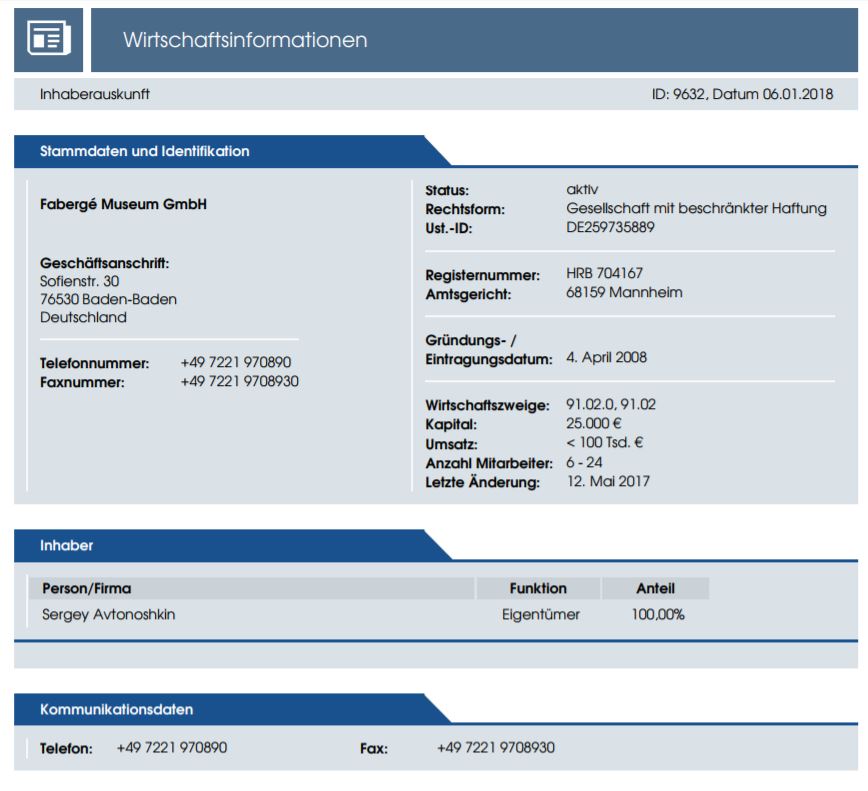
The museum in Baden-Baden today belongs (possibly nominally) a resident of this city Sergey Autonoshkin, says the "municipal scanner" with reference to the data of the German commercial registry. However, in April 2008, shortly after its founding and a year after the Rothschildovsky Egg was bought by Alexander Ivanov, the register contained data on the two other owners of the museum. They were Ivanov and Konstantin Goloshchapov, who brought 12,500 euros to the authorized capital of the museum.
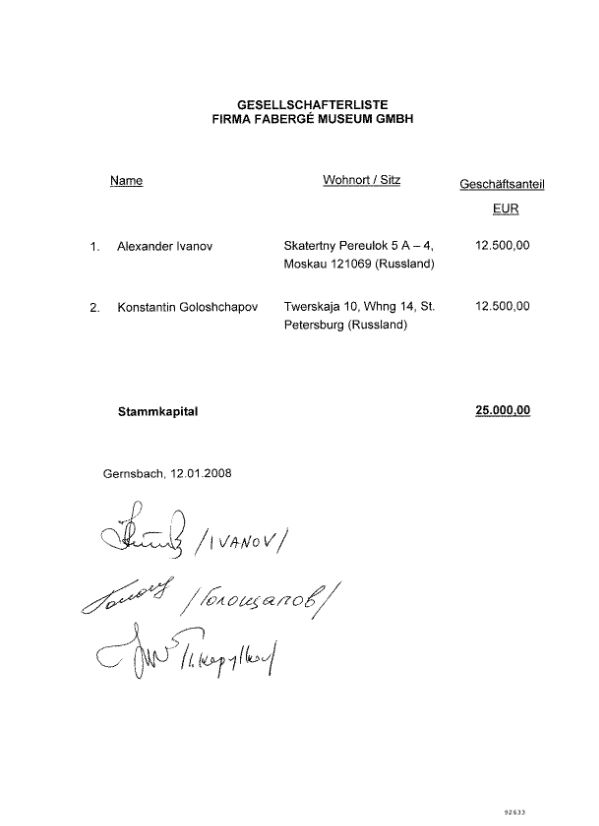
An extract from the German commercial registry, from which it follows that Sergei Autonoshkin is now the only owner of the museum in Baden-Baden:
The activists managed to find records of Ivanov’s business in the Russian Unified State Register of Legal Entities: it turned out that his cooperation with Goloshchapov began back in 2004, when they became co -founders of Alliancesinvest LLC. This company was liquidated in 2007. Now the only legal entity belonging to Ivanov is the Russian National Museum CJSC, which he owns together with his ex -wife Julia, the owner and producer of Ruselphilm LLC, which made films by order of the Zvezda and Culture.
Friendship that was not
In 2011, in a large publication about Alexander Ivanovo in Forbes magazine, sources of publication claimed that Ivanov “exaggerates” the scale of his collection of works of art, and “the purchase and sale of antiques in principle cannot bring income that would spend tens of millions of dollars on the purchase of Faberge.” The authors of the publication of the “municipal scanner”, claiming that most of his high -profile acquisitions, including the “Rothschild egg”, did not make Ivanov made with these anonymous assessments not with his own money, but at the funds from Putin’s massage therapist or through it from third parties. The "municipal scanner" claims that Alexander Ivanov actually works for Konstantin Goloshchapov. Another indirect evidence of their close connection “The Municipal Scanner” calls Ivanov made by Ivanov in 2010 that he plans to open a branch of the Faberge Museum in the Croatian city of Dubrovnik.
Alexander Ivanov, in correspondence with Radio, strongly rejected all the assumptions that the Rothschilda egg was bought by him with Goloshchapov’s money, but also stated that he did not meet him in 2003, but from 2007 to 2009 (more precisely, Ivanov could not recall) "during the rogue in Bari." According to Ivanov, he was never a co -owner of Alliancesinvest LLC, “does not know such an organization at all,” and he was not a sign with Goloshchapov in 2003.
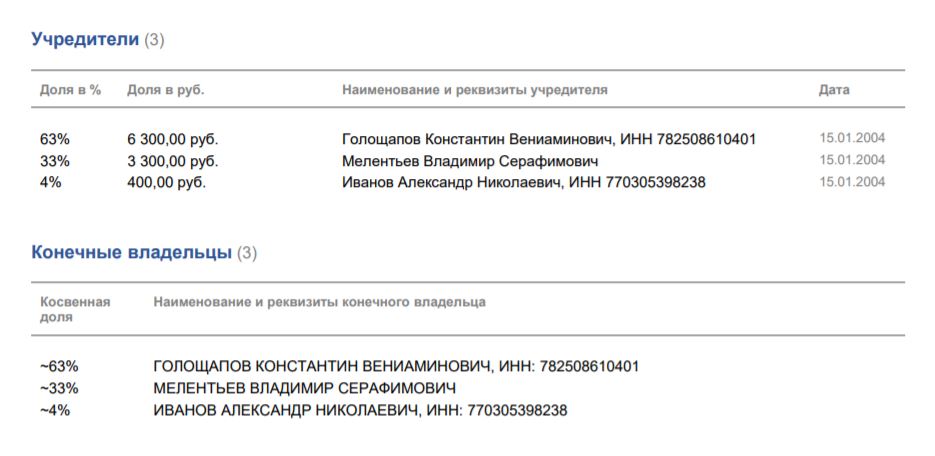
It is interesting that the extract from the Russian Unified State Register of Legal Entities received using the Contour-Focus service indicates that it was Ivanov and Goloshchapov that were co-owners of the Alliance in 2004. In addition to them, the founder of the company in the Unified State Register of Legal Entities is Vladimir Serafimovich Melentyev (below - a fragment of extract, you can download it completely at this link ).
Judging by his biography, Vladimir Melentyev in this story is not at all accidental. On the Internet you can find his mention as a "gentleman of the Order of Karl Faberge." This award was established by the International Faberge Awards Committee on the distant 1997 "with the support of a famous American billionaire." The story about the Order on the website of the Goodcoins.narod.ru collectors says that Alexander Ivanov was "the chairman of the Presidium of the Russian National Committee" of this organization. The "cavaliers of the Order of Faberge" on the now closed website of the committee ( preserved copy ) appear, in addition to Melentyev, both Ivanov himself and Konstantin Goloshchapov.
The administrator of the Faberge Awards Committee, according tothe archival data of the registrar , was a person with an email address in the domain of rnm.ru - at this address there is still a website of the Russian National Museum belonging to Ivanovo.
In the correspondence with Radio Liberty, Ivanov confirmed that Vladimir Melentyev really “knew” well, since he was the director of the German company Burda Moden (actively operating in the 90s and early zero years in the Russian market).
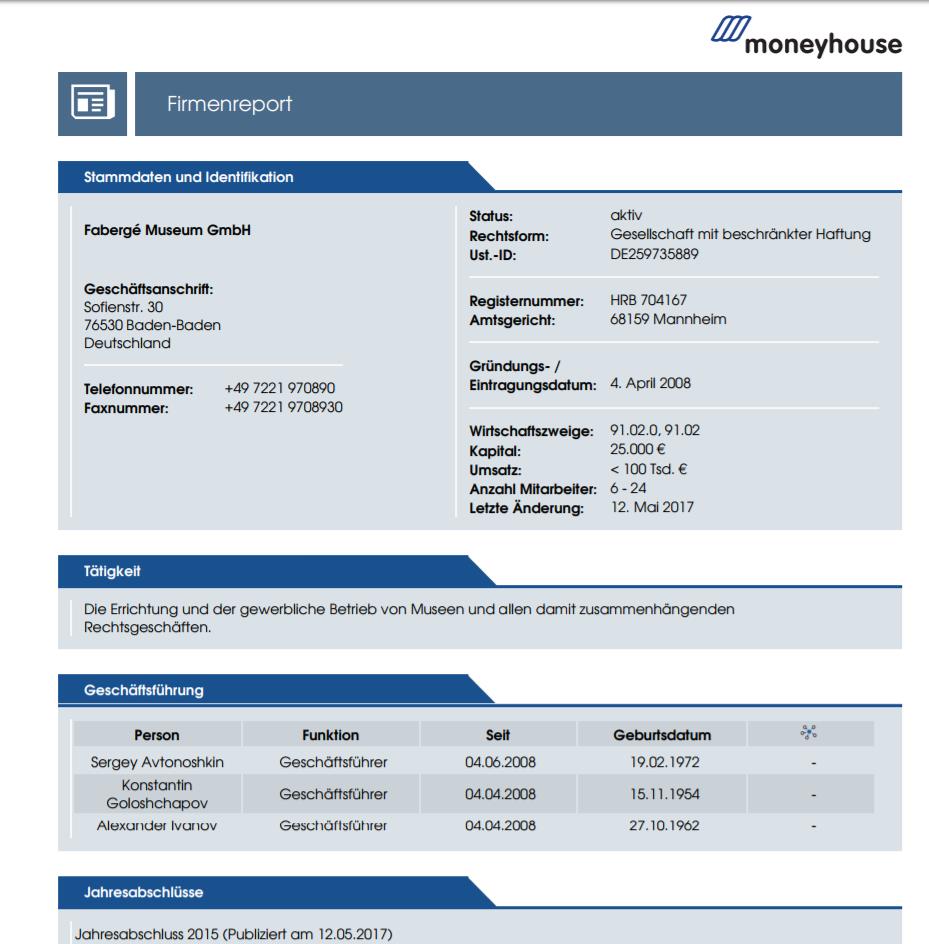
Alexander Ivanov also told Radio Liberty that his relations with Konstantin Goloshchapov had "divided" after a divorce from his wife Julia in 2013. As the agency of RIA Novosti then wrote , Julia Ivanova, according to the results of the divorce proceedings, departed 50% of Ivanov’s condition, including "more than 600 works of art from his collection." In a family conflict, says Ivanov, Goloshchapov "was on the side of his wife," but then the men made peace - Ivanov "realized that Goloshchapov was simply against the collapse of his family." At the same time, Alexander Ivanov called the allegations that Goloshchapov was or is one of the co-owners of the Faberge Museum in Baden-Baden, like the director of the museum Sergei Autonoshkin. Autonoshkin, says Ivanov, simply “a hired employee who receives a salary for his work,” and Goloshchapov “does not even receive salaries” and “there is nothing to do with the museum management, obtaining dividends, owning exhibits, etc. at all”. Now the directors of the Faberge Museum in Baden-Baden, according to the German commercial registry, are three people: Alexander Ivanov, Konstantin Goloshchapov and Sergey Autonoshkin, while the latter, as we have already noted, remains the only owner of it.
At the end of the correspondence with the Radio Liberty, Alexander Ivanov rejected the assertion that Konstantin Goloshchapov had any relation to the purchase of “Rothschild eggs”: “Neither Mr. Goloshchapov, nor anyone else has no other to buy the Rothschilda egg. This egg, like all objects at auctions, have always been bought and I have been bought by me personally and I only pay them. Rothschilda "is not my most expensive purchase." Konstantin Goloshchapov did not answer Radio Liberty sent to him.
He cannot explain his sources of funds to make such purchases
As one of the authors of the investigation of the “municipal scanner” Mikhail Maglov , Alexander Ivanov, with his answers to Radio Freedom questions, only confirmed the assumptions that he bought the “Rothschilda egg” for Goloshchapov’s money: “Public documents have accurately showing the joint partnership of Ivanov and Goloshchapov for at least 2003. It was after this that Ivanov tried to buy a bill, bought his famous well -known ones The exhibits learned about the narrow circle of the participants of the auctions.
With the release of the investigation of the “municipal scanner”, the news coincided with another collector of the products of Karl Faberge, already mentioned by Victor Vekselberg. According to the New Gazeta-St. Petersburg on Tuesday, the businessman is preparing to expand his Faberge museum due to demolition and new construction on the territory of the historical Shuvalovsky palace. The city defenders consider upcoming work illegal and have already turned to the Ministry of Culture and the Society for the Protection of History and Culture Monuments with a request to check the Napoleonic plans of Vekselberg, which intends to increase the attendance of the museum to 10 thousand people a day, and send an application to the prosecutor’s office according to its results.