
Translated material
Democracy under the blow
The level of freedom in the world is reduced by the twelfth year in a row
The non -governmental organization Freedom House, financed through grants by the US government, admitted that in 2017 the development of democracy has experienced the most serious crisis over the past decade. Guarantees of free and fair elections, defending the rights of minorities, freedom of the press and the rule of law were attacked around the world, said President Michael Abramovitz.
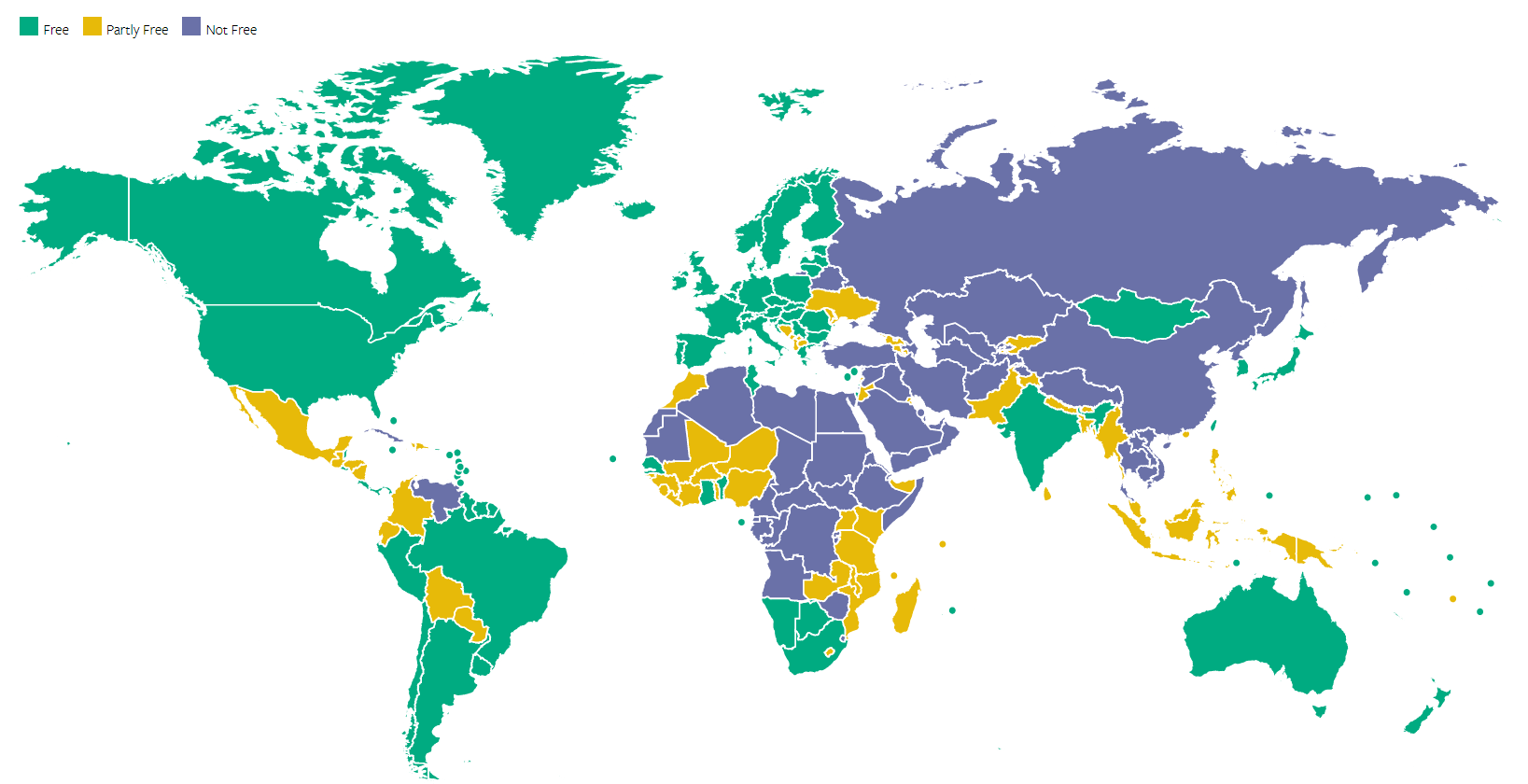
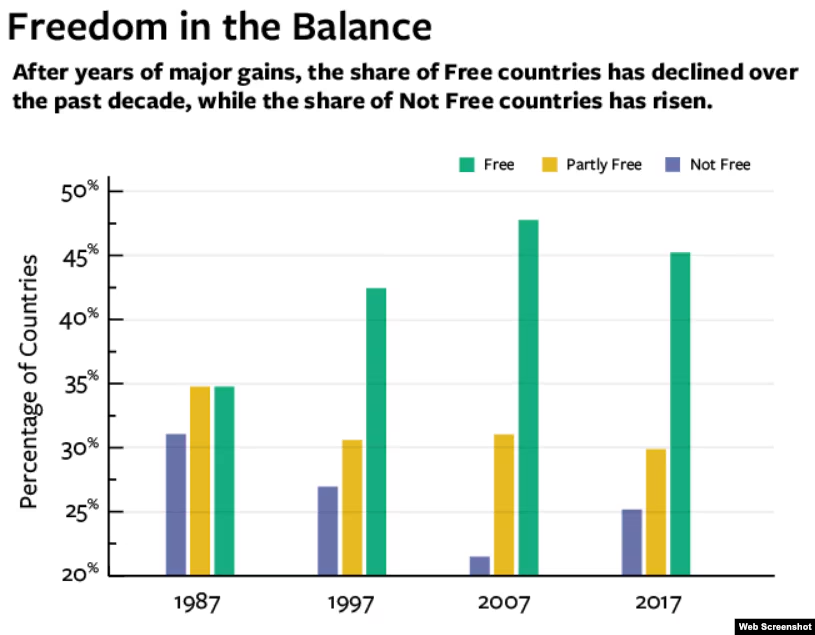
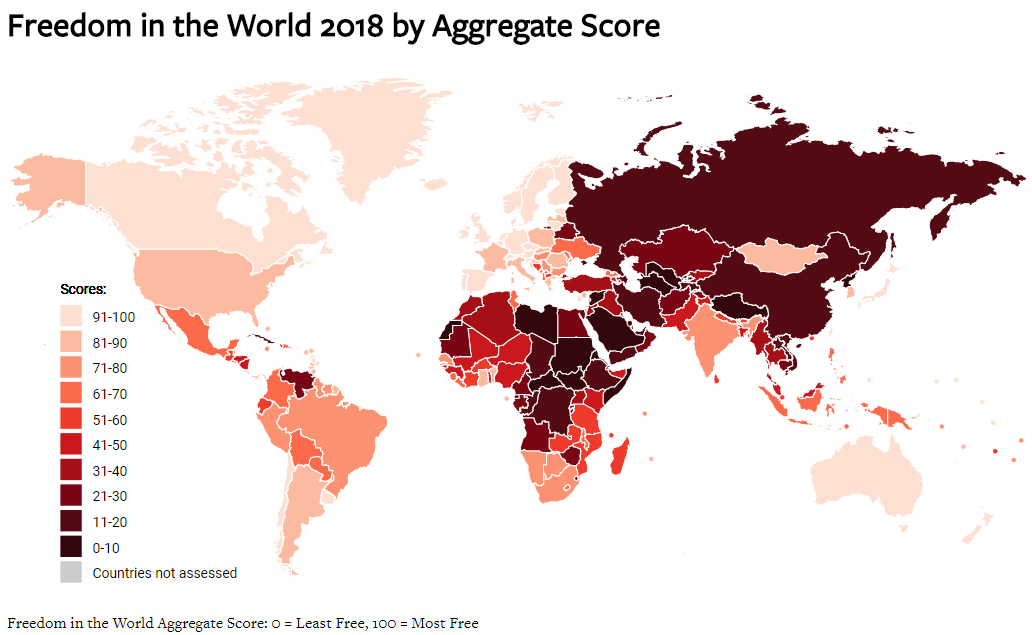
From the report a “Freedom in the world 2018: Crisis of Democracy” it follows that out of 195 countries 88 (45%) are “free” (USA, Canada, European countries, Brazil, South Africa, Australia), 58 (30%) states are “partially free” (Mexico, Bolivia, Ukraine, Pakistan) and 49 (25%) - “not free”. The latter, in addition to China, Venezuela, Sudan, Saudi Arabia, included Russia and most of the former republics of the Soviet Union.
According to the authors of the report, the policy of Russia and China causes anxiety, where the authorities, "taking advantage of the retreat of leading countries from the basic principles of democracy, increased repression and began to spread their pernicious influence on other countries." Moscow and Beijing suppress open debate, pursue dissidents and compromise social institutions, the study says.
The very idea of democracy and its development was tarnished by many, which is why dangerous apathy appeared in society
"Russia Vladimir Putin conducted misinformation campaigns before the elections in different countries, including the United States, France and Germany, developed ties with the Xenophobic political parties throughout Europe. In addition, [Moscow] threatened the closest neighbors or invaded their territory and was an alternative source of military assistance for Middle East dictators," experts from a non -commercial organization said. In their opinion, the main goal of Russia in this direction is to undermine trust in democratic states and destroy structures, for example, the EU, which unite them.
Mobile application Radio Liberty.It's not too late
As an argument regarding the influence of China, experts from Freedom House give a statement by the chairman of the country Xi Jinping, who last year stated that Beijing “paves a new path” for developing countries. "This is the path that includes politicized courts, intolerance to dissent and the predictable election result," the report says.
China has even greater ambitions and resources to achieve its goals than Russia. The authors of the study claim that for this, a device for propaganda and censorship with global coverage was created. Last year, Beijing used his economic ties to influence democratic countries (Australia, New Zealand), and also provided financial and diplomatic assistance in supporting "repressive governments" in Southeast Asia and Africa. "Moscow often plays the role of a spoiler, strengthening its position, undermining its opponents, but the scale and depth of Beijing show that the Chinese regime strives for really global leadership," the study says.
Subscribe to us in Telegram
The authors of the report noted that last year the decline in democracy occurred in 71 countries, and only 35 states were able to change the situation for the better. If we talk about the most not free countries, from the point of view of experts Freedom House-these are Syria, South Sudan, Eritrea, North Korea, Turkmenistan, Equatorial Guinea, Saudi Arabia, Somalia, Uzbekistan, Sudan, the Central African Republic and Libya. In these countries, either the civil war continues, either the absolute monarchy and the "oil kleptocracy" are preserved, or the "dictator" is in power, which no one is fighting with, the NPO claims.
Experts pay attention to the United States, which over the past year have lost their title of "champion and example [to follow in development] democracy." Freedom House noted that the US began to gradually decline by the upholding of political rights and civil freedoms. "The decline accelerated in 2017 in connection with the growing evidence of Russian intervention in the elections, violation of elementary ethical norms by the new administration and a decrease in the openness of the government," the study says.
As examples, experts gave Donald Trump to his relatives to state posts, lobbyists - to high positions, the president’s position in relation to Muslims, migrants and Latin American and attacks on the media. Despite the change in policy in the White House, experts note that the press and judicial institutions in the United States have retained their stable positions. Nevertheless, subsequently this can lead to the destruction of the basic principles of American democracy and shake the US position in the world, according to Freedom House.
Last year, a decline in democracy occurred in 71 countries
The authors draw attention to the fact that problems in democratic states lead to an increase in populism. Last year, populists from the extreme right -wing parties received places in the parliaments of France, the Netherlands, Germany and Austria. They continued to strengthen positions in Hungary and Poland, where laws were adopted that impede the activities of non -governmental organizations. “Perhaps young people are most afraid of the most fear who do not remember the long struggle against fascism and communism and can lose faith and interest in a democratic project. The very idea of democracy and its development was tarnished by many, which is why dangerous apathy appeared in society,” the study says.
The situation with the defending of freedoms in Turkey has worsened, the authors of the study believe. There, President Recep Erdogan, "increased and strengthened the repressions against his opponents, which began after the coup attempt in July 2016." Hundreds of media are closed, more than 150 journalists are in prison, as well as the leaders of the third largest party in parliament. Experts drew attention to Iran, Venezuela, Myanmar. In their opinion, corruption and repressive measures of the authorities of these countries threatened global stability, and also led to humanitarian crises. In addition, the DPRK was able to expand her nuclear program.
Freedom House draws attention to Afghanistan, Angola, Georgia, Iraq, Macedonia, Greece, Mexico and Saudi Arabia. According to experts, these countries in 2018 may "come closer to important turning points in their democratic trajectory." For example, in May, parliamentary elections will be held in May that will be able to check the stability of the political system using the example of competition between recently registered parties and candidates and politicians who already have power. In July, Mexico will take place in Mexico, as a result of which the president, deputies of the Congress and members of the Senate will be elected. According to the authors of the report, they "will serve as a referendum of confidence in the administration, which could not curb the unrestrained violence and corruption and has become more and more hostile to the independent media and activists of civil society."