
Translated material
From Latin America to Ukraine
How is the market for private military campaigns in the USA and France works: what is possible and what is impossible by law
USA
America not only gave its citizens the right to weapons, but still willingly buy their services
In the popularity of private military companies, their increased participation in modern armed conflicts, many accuse America. Say, she gave rise to a phenomenon that became a world phenomenon. The annual turnover of this business is calculated by billions of dollars.
It is generally accepted that the origin of private military companies (PMCs) occurred in the UK and the USA in the 80s of the last century. After the Cold War, the American Armed Forces took place restructuring and privatization. Private contractors and subcontractors took in them the place that the state used to occupy. Cold war professionals, not in demand by the bureaucracy, created private companies, collecting former military personnel for the protection, training, intelligence, operational and secret missions.
The trend of recent years: not only former "sea seals" and other masters of "distant and close combat", but also "white collars" - hackers, programmers, analysts, work in PMCs.
“The United States has opened the Pandora commercial box,” writes Sean McFeite, a former paratrooper of the US Army, then an employee of the private military company Dyncorp International, and now a researcher at the National University, in the work of The Modern Merceenary: Private Armies and What the MEAN For World Order (“Modern Mercenary: private armies and their significance for the world order”) - private warriors of all colors and shades came out of the shadows and are engaged in waging war for profit. ” I will add: all over the world - from Latin America and Africa to Syria and Ukraine.
Comparison with the Middle Ages, with countless feudal wars, in which the main role was played by the hastily armed frightened villagers, but professional fighters, who are wound up for the one who pays more, looks spectacular, but there is a reference point for America. There were always armed private contractors in honor.
From the very first day of its history, the American state betrayed citizens in their hands. The People’s Police defended independence, the second amendment to the Constitution guaranteed the right to keep weapons at home to protect itself and the family. But those who shot better than others could sell their services to the state. The pioneers of the Far West were not protected by Washington politicians and not even sheriffs, but hired rangers. The criminals were searched and shot without any trial "Hunters of their heads."
In the United States, the state always willingly delegated part of its functions to private contractors - including in issues of security and law and order. For example, since the 80s of the last century, the number of private prisons has been growing here. Now 133 thousand prisoners are serving in them - 8.5 percent of the total number.
Returning to the “man with a gun”: in 1893, to combat the labor and trade union movement that covered all the largest cities in the country, the White House began to use the detective agency of Pinkerton and other private companies. The armed employees of the local branches of the Pinkerton Agency (existing to this day) were guarded by strategrachers - those who went to work instead of the striking. Then the congress decided that this was a clear bust and adopted the law - the Antipinrtonic Act, which prohibits the state to hire private companies to maintain security and law and order. In other words, replace the police ... Perhaps the most famous - after the events in Iraq (more than that below) - the Blackwood company was engaged in eliminating the consequences of the Hurricane "Katrina", but in the pacification of racial unrest in Ferguson of the PMC were not involved. Inside the country, they are engaged in the training of pilots, infantrymen and sailors of the US Armed Forces, the protection of politicians and objects - no more, within the framework of existing laws and regulations. Their activities abroad are also limited, but, as Kevin Lanigan, an expert on national security legislation, in Iraq and Afghanistan, “Book Laws” and practice often did not coincide.
LETTER OF THE LAW
What is possible and what cannot be US contractors
The activities of PMCs are regulated by hundreds of legislative acts, official instructions, circulars and memorandums. These are tens of thousands of pages of regulations.
The main thing for American firms is to comply with the laws of their state. For example, in California, where the headquarters of Andrews International and Caci International, which are part of the “thirty” world PMCs of the world, the State Bureau of Security and Investigation issues licenses, registers companies, accepts a set of disciplinary rules. State regulators operate in other states. At the federal level, the actions of armed contractors are spelled out in at least a dozen legislative acts. They guarantee protection in the courts, but emphasizes the “auxiliary role” when working on the Pentagon, the State Department and other departments. At the same time, already at the level of prescriptions, the “federals” are prohibited from using PMCs in “Inextra time of state activity” (“Inherently Governmental Activities”) - primarily in military functions.
The International document “On the Code of Private Military and Security Companies”, signed in 2008 in the Swiss city of Montreo by representatives of 17 countries (including the United States, Great Britain, Germany, France, Canada, China, Ukraine and Poland), imposes the obligation to control the activities of PMCs, be responsible for their crimes, and prohibit them from participating in combat operations.
Reality, as usual, made its adjustments. In 2006, in addition to the Federal Law on Defense (DFARS), an amendment was adopted, allowing private contractors to use lethal weapons “outside self -defense” if it requires the fulfillment of contract obligations.
The war in Iraq from the very beginning did not go the way Washington politicians and generals suggested. Instead of a three -week operation, a protracted war. Three ways were drawn in front of the White House: to leave with shame, leaving the region in a state of chaos, to declare a mandatory military draft in America (as during Vietnam), which threatened with a political catastrophe, or to bet on private contractors, who are prohibited from participating in “direct” fighting, but who can use weapons “for self -defense and protection of objects”, and in addition, engage in The military training of the local army and the police and ensure the full amount of restoration work.
The total number of private American contractors from PMCs in Iraq exceeded 180 thousand, while the number of troops, even at the critical moment of this war, was no more than 168 thousand. In Afghanistan in 2008, the number of American contractors was from 130 to 160 thousand people. In the USA they don’t even know how much.
It is best to show the rapid increase in demand for PMCs on the example of Blackwood (now Academi). In 1997, the company was established by the former Sea Kitik, 27-year-old Eric Prince and the Ek Clark shooting instructor. Its name-“Black Water”-it owes the peat bogs on the border of North Carolina and Virginia, where a plot was purchased for the first military training training ground. The company received the first major government contract for the preparation of 100 thousand sailors immediately after the attack on the American destroyer Cole. If in 2001 the company received 735 thousand dollars from the American budget, then in 2005 the amount increased to 25 million, and a year later reached $ 600 million.
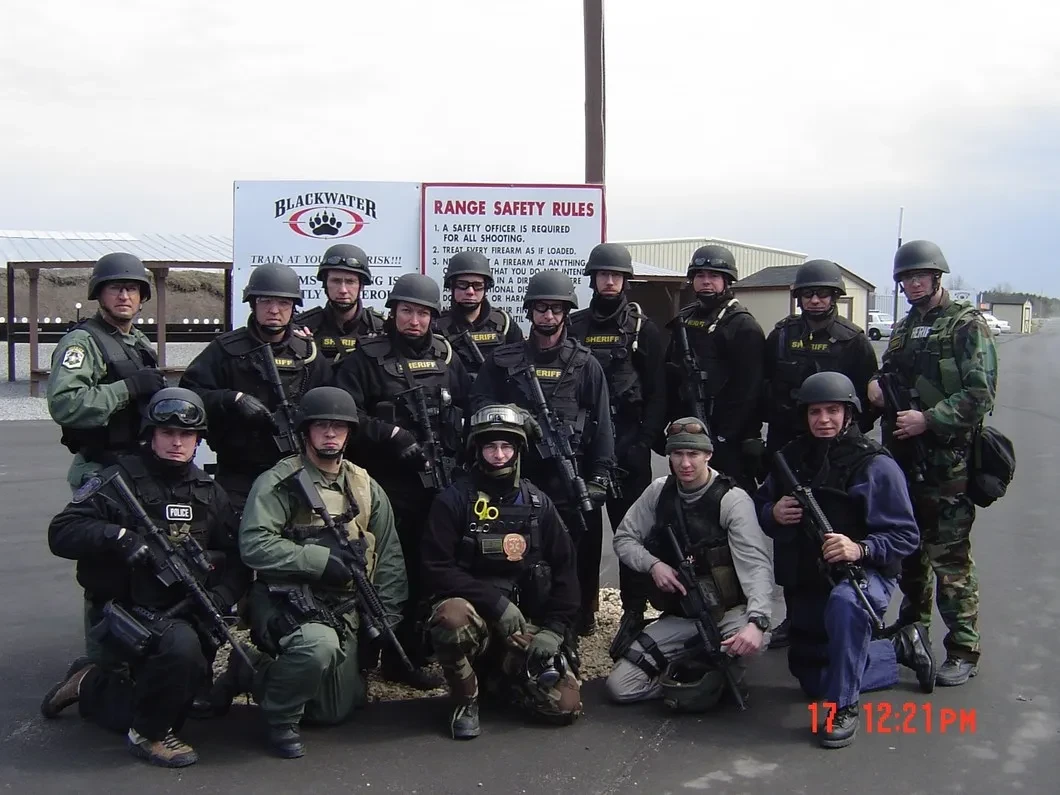
A grandiose scandal did not interfere with continuous growth. On September 16, 2007, the employees of the Blackwater then, guarding the diplomatic convoy of the State Department, initiated a shootout in the central square of Baghdad, which ended with the death of seventeen and wounded 27 Iraqi (among the victims there were children). It seemed to the guards that on the way they were waiting for a suicide with a bomb, and they opened fire. The Iraqi government demanded the guilty of guilty and expulsion of the company from the country.
Hearing in Congress took place. After this incident, the lawmakers for the first time seriously engaged in the accounting department of the PMC and were horrified by the released figures of the expenses “for training and reconstruction” of Iraq and Afghanistan.
The Russian media hastened to announce that "the criminals from" Blackwood "got away with it." In fairness, justice overtook them.
In April 2015, the former guard Nicholas Slutin was sentenced by the American court to life imprisonment, three of his colleagues received deadlines up to 30 years. The convicts were appealed.
Now, after the repeated “rebranding” “Blackwood”, as a result of the merger of several large PMCs under the auspices of the Constellis holding, the former company “Marine Cat” and the shooting instructor turned into the largest network of training centers for various branches of troops, it signs contracts around the world.
Alexander Panov, sob. Corr. "New", Washington
France
In Paris, the lobbyists of private military companies complain that almost the entire “world market” of PMCs is under the control of “Anglo -Saxons”
Since 2003, a punishment for mercenaries has been in force in France. At the same time, there are 130 registered "private military companies". So they are called the media, although they themselves prefer to be called "private security companies." Thus, it is understood that they do not participate in combat clashes.
The last loud scandal in which the French PMC was mentioned occurred almost seven years ago. In May 2011, in the Libyan city of Benghazi, when leaving the restaurant, a 48-year-old French citizen Pierre Mansili, one of the creators of the SECopex PMC, was killed.
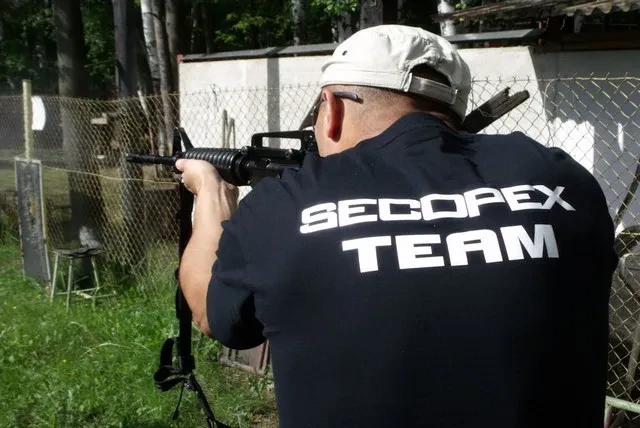
Later Robert Dul, another leader of Secopex, suggested that his comrade, who declared an ambiguous reputation as opponents of Gaddafi (including radical Islamists and drug traders), “became an obstacle” on the path of the “new interests” of the French leadership. Let me remind you that it was President Nicolas Sarkozy, who was working closely with Gaddafi, then became the main initiator of his overthrow. The responsibility for death Mansili took over the transition National Council of Libya (uniting opponents of Gaddafi). In his commander, the Council announced that Martia was mortally wounded during the arrest of "five Frenchmen (including himself. - Ed. ), Which carried out illegal activities that jeopardize the safety of free Libya." The Dula claims that exactly a month before his death, Marsiaed both of them were accepted in the Champs Elysees. And there they talked about the militants fighting with Gaddafi: that many people whom Sarkozy took in the Champs Elysees are radical Islamists.
The Dula also says that their company Secopex worked with Gaddafi and the rebels, as well as for money, it supplied information about jihadists to the Americans. It is extremely difficult to find out that in this story is true: if only because in any countries, the contacts of state structures with PMCs are “completely secret”.
In addition, representatives of private military companies cannot admit that they are in the territory of another state in order to fight. The French law on mercenaries provides for 5 years in prison and 75,000 euros of a fine for ordinary fighters and 7 years in prison and 100,000 euros for organizers and leaders.
After the death of Marsial, Secopex officially stopped activities. And now none of the 130 French PMCs (despite the fact that they all work abroad) is officially fighting anywhere, limiting himself to “training of military personnel”, engineering, security, ensuring the safety of sea vessels, etc.
“We are pursuing an ostrich policy,” the deputies emphasized, who in the winter of 2012 lobbied for the adoption of a law that allows private military enterprises to “get out of the shadows”. Deputies from the two main French parties prepared a report explaining the need for the adoption of the Law on PMCs, which, inter alia, allowed them to use weapons.
The speakers emphasized that they were not encroaching on the law on mercenarism: we are not talking about giving French PMC legal grounds for participating in foreign conflicts, but that these companies can use weapons “point”: when attacking pirates on ships, in the protection of French enterprises abroad, etc.
It would be difficult to say that the new law would formally legitimize the participation of the French PMCs in hostilities abroad, but although the authors of the report insisted that they were not talking about, they still put forward as one of the arguments that France is now overboard by 90% “enveloped” by American and English (“Anglo -Saxon” companies. Deputies estimated this market at $ 200-400 billion a year.
In the winter of 2012, the French media said that the state (in the person of the commander -in -chief of the sarcose, known for its business grip) is ready for the “controlled liberalization” of this sphere. It is ready, even despite the traditional objections of the highest military ranks, which are mostly opposed to the transfer of even part of the state monopoly on violence in private hands. But in May 2012, Sarkozy lost power.
Under Francois Hollande, in July 2014, the Law “On Private Activities to Protection of Ships” was adopted, allowing the French PMC to use weapons for this purpose. This law, according to the estimates of the Ministry of Transport, could not help French companies compete for dominance in the global PMC market: the Ministry of Transport estimated the annual cost of the private protection of French ships at only 12 million euros.
So so far the French PMCs who do not want problems use the “workarounds”: for example, they create branches acting on the basis of local legislation. The same deputy report mentioned by the French, but registered under the Hungarian legislation, the private military company Argus, which provides the protection of representatives of the EU in Libya. In 2012, the French created in London a private company Sovereign Global Solutions Ltd, the official mission of which is the counseling in the field of “ensuring state sovereignty”.
Of course, it would be much easier for French participants in this market if their activities were legalized. This would allow them to move from “point” operations to large -scale: PMC lobbyists do not get tired of reminding that “tens of thousands of fighters of American and British private military companies” are fighting in Iraq and Afghanistan. And even the largest French PMCs have an annual turnover in the size of some miserable few tens of millions of euros.
But further legalization of the French PMC is hardly possible - the state is not interested in providing them with real independence.
The era, when the French actually openly organized coupling in African countries, left. Now in the French "public opinion" there is a persistent rejection of everything related to "mercenary",
- In an interview with Le Nouvel OBS, retired General Patrick Dezhardan, who is now working as a security consultant, said. Allergy to French intervention was produced in African countries. The authors of the study in the newspaper Le Monde Diplomatique a few months after the adoption of the 2003 law, put forward the version that it is needed mainly in order to reassure “foreign partners”. The deputies who were lobbying for the legalization of PMCs spoke about the “symbolic meaning” of the law from 2012.
However, he has symbolic significance for public opinion-in France and abroad, and for those who use private services to perform “military-diplomatic tasks”, this law is an additional possibility of control over French mercenaries. In addition, the law was supposed to end a practice that existed at least until the beginning of the 2000s, when the “customers” of foreign operations with the participation of “private individuals” were “many centers”: not only the president, head of the Ministry of Internal Affairs, the head of the Foreign Ministry, but also the “gray cardinals” like Charles Paskua or Colonel Maurice Robert, a retired French counterintelligence officer in Africa.
PS
“The heterogeneous mass of French mercenaries” was the name of the above study by Le Monde Diplomatique. It stated that in Paris - from 80 to 100 mercenaries, regularly fighting at different points in the world and receiving from 4,500 to 7500 euros per month. These are mainly former military, most often paratroopers or fighters of a foreign legion. From the "mission" to the "mission" they are working as security.
Most likely, many of them are sent by the French PMC - but this was not received after the adoption of the law. French PMCs, in turn, are under intelligence.