
Translated material
Does the octopus have consciousness
Until recently, people believed that octopuses are disgusting creatures that sank many ships during the time of wooden flotillas. Naturalist and writer Sa Montgomery in her book “The Soul of the Osminoga. The secrets of the consciousness of an amazing creature ”talks about how the attitude of biologists to the inhabitants of the sea has changed in the 21st century. From this chapter of her book you will learn how the octopuses differ from us and how they look like other animals who love to play, learn new and know how to “make friends” with a person.
An unusually warm and sunny day in mid-March, when melting snow exposed the first dirt in New Hampshire, I arrived in Boston. The harbor was full of people who walked along the embankment or sat on benches, enjoying ice cream in horns. But I exchanged the affectionate rays of the spring sun for the wet half of the aquarium of New England. I had a meeting with a giant Pacific Octopus.
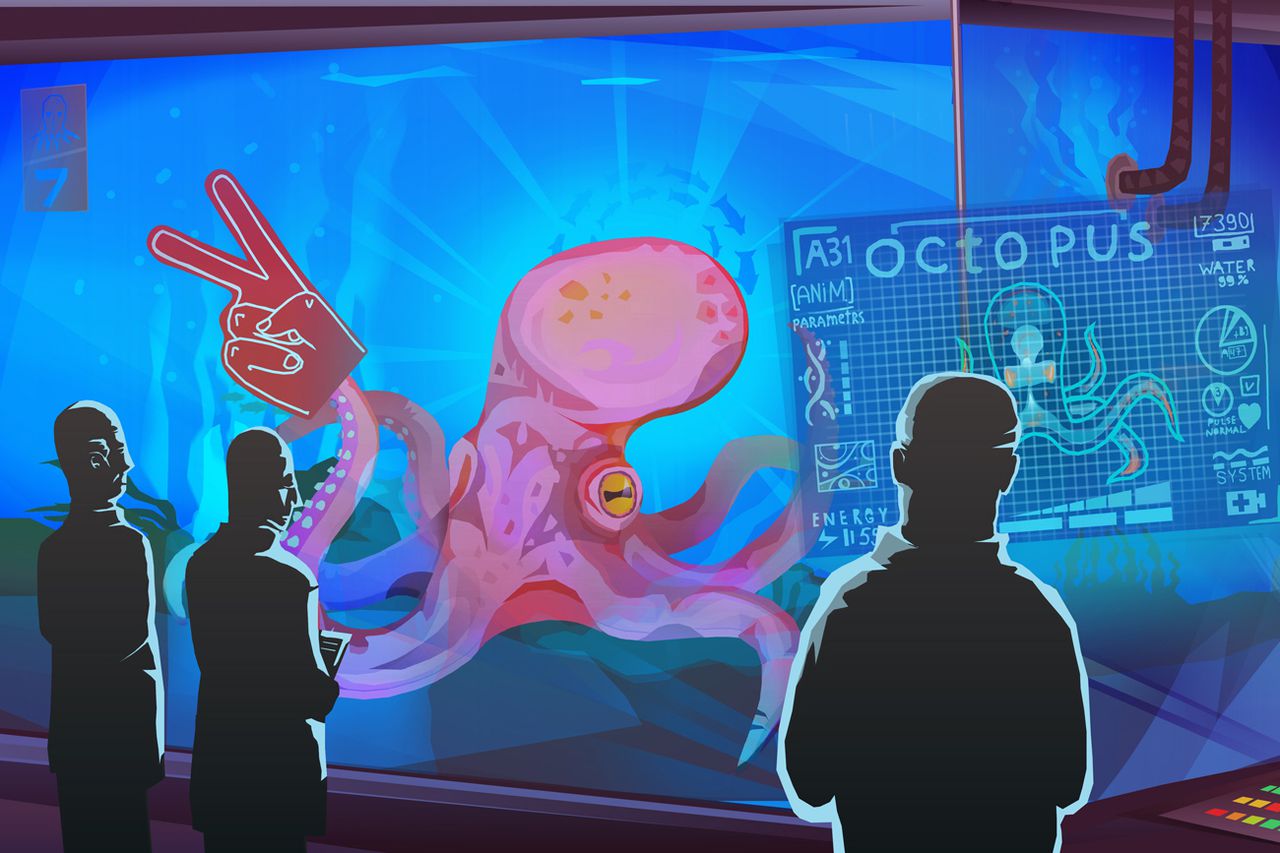
I knew little about octopuses - to honestly admit, and had no idea that their Latin name Octopoda came from the ancient Greek words “eight legs”. But what I knew intrigued me. Imagine an animal with poison, like a snake, with a beak, like a parrot, and ink, as in old feathers. The octopus can weigh as an adult man and stretch to the length of the “cadillac”, but at the same time he is able to squeeze his baggy, bored body through the hole the size of an orange. It can change color and shape and taste the skin. But the most amazing is his intellect. My meager experience of acquaintance with this animal confirmed the truthfulness of this fact: while visiting public oceanariums, I, like many others, had a persistent feeling that not only I looked at the octopus, but he also looks at me, and with no less interest.
Acquaintance with a reasonable mollusk
How is it possible? It is difficult to find an animal more unlike a person than an octopus. His body is arranged in a completely different way. First we have a head, then the body and limbs. The octopus has a torso first and only then the head and limbs. Their mouth is located in an armpit - or between the legs, if you consider their limbs not with their hands, but with their feet. They breathe water. Their tentacles are covered with hundreds of tenacious suction cups - structures, which have no analogues in the world of mammals.
The octopuses are not only on the other side of the great separation between vertebrates - mammals, birds, reptiles, amphibians, fish - and all the others, but among the invertebrates, they relate to such not too intellectual animals as mollusks, for example, slugs, snails and oysters. And the bivalve mollusks do not have a brain at all.
The separation between the human branch and the branch of Osminov occurred about 500 million years ago. If our branch has followed the path of evolution of consciousness, then why couldn't another branch?
The octopuses personify the great secret of the “other”: although they seem to us completely alien creatures, their world - the ocean - occupies much larger than the surface of the earth than land (70 % of the entire area of the planet, that is, more than 90 % of the territory suitable for life). Most animals on our planet live in the ocean. And most of them are invertebrate.
I wanted to get to know the octopuses better. Touch another reality. Explore a different type of consciousness, if one exists. What is it like to be an octopus? Does he have something in common with a person? Is such knowledge possible in principle?
Therefore, when the director of public relations of the Aquarium of New England met me in the lobby and led to get acquainted with Athena, I felt like I was a special guest in a different world. Although, in fact, it was on that day that I began to get acquainted with our own world - our native blue planet - a truly incredible and fantastic corner, in which I, who dedicated half a century to naturalistic research, finally felt at home.
Athena
Athena’s main caretaker does not turn out to be in place, and I get out: not every employee of the oceanarium is allowed to open a tank with an octopus, and not in vain. The giant octopus - the largest of about 250 species of octopus existing in the world - can easily defeat a person. With one sucker with a diameter of about seven centimeters, he is capable of lifting more than thirteen kilograms, and in a giant octopus there are 1600 such suction cups. With a bite, the octopus can inject neurotoxic venom, and its saliva can dissolve the flesh. In addition, an octopus can get out of an open aquarium and escape, and a fledgling giant is a serious problem for both himself and for the aquarium.
Fortunately, another caretaker is called to help me, named Scott Daud. A large man is a little older than forty, with laughing blue eyes and a beard with a gray back, Scott is a senior caretaker in a freshwater gallery located next door to a gallery of cold seas, where Athena lives. For the first time, Scott got into the oceanarium as a baby on the day of his opening on June 20, 1969 and since then he practically did not leave him. He personally knows almost every animal here.
The age of Athens is about two and a half years, weight - about eighteen kilograms, Scott tells me, raising a heavy cover on the tank. I climb three steps along a small mobile staircase and lean over the hatch. And here is Athena in front of me. It is about one and a half meters long. Her head - by the “head” I mean not only the head, but also the mantle, that is, the body that is where we are used to seeing the head in mammals, the size of a small watermelon. “Rather, with a melon,” Scott said. “When she came to us, her head was no more than Grapefruit.” A giant octopus is one of the fastest growing animals on the planet. Haging from an egg the size of a rice granny, in three years he can overtake an adult man in the length and weight of an adult.
As soon as Scott manages to open the lid, like Athena, who was sitting in the far corner of a 2500-liter aquarium, is already there. Her body blushes with excitement. Holding on two “hands” around the corner, the remaining six she pulls to us - the tips of her tentacles with white suction cups appear on the surface of the water. It looks like a person’s palm, revealed for handshake.
- Can I touch her? - I ask Scott.
“Of course,” he says.
I remove the wristwatch and a scarf, roll up my sleeves and immerse my hand in the water on the elbow. It turns out to be terribly cold - only 8 ° C.
The tentacles instantly set in motion and wrap their hand. I feel the touch of dozens of inquisitive jelly -like suction cups.
Not everyone will like this feeling. The naturalist and researcher William Bib considered the touch of an octopus disgusting. “Each time I have to make an effort to force myself to reach out and take up the tentacle,” he admitted. Victor Hugo described the contact with the octopus as a “embodied nightmare” leading to imminent death. “This creature closes with many vile mouths; Hydra fuses with a person; A person merges with a hydra. If the tiger can just gobble you up, the octopus - it’s scary to think! “To suck,” writes Hugo in his novel “The Truds of the Sea”. - Your muscles are swollen, tendons are twisted, the skin bursts under vile suction cups; Blood sprinkles and mixes with the disgusting lymph of mollusk. ” The fear of octopuses deeply rooted in the human psyche. “No other animal exposes a person more terrible death in the water element,” wrote Pliny the Elder in his encyclopedic work “Natural History” in about 79, “for the octopus wrapps up the human body with its tentacles, sucks through the suction cups, tears it into pieces ...”
But Athena touches me gently, although persistently. It looks like a kiss of an alien. In the end, she raises her melodious head above the surface of the water, turns to me with a left eye - the octopus also has a dominant eye, like people's leading hand - and looks directly at me. Her black pupil looks like a fat dash on a pearl ball. Her gaze reminds me of the gaze of Hindu gods and goddesses: serene, omnivorous, full of boundless, timeless wisdom.
“She is studying you,” Scott says.
I instinctively extend my hand to touch her head. “Soft as a skin, strong, like steel, cold as a night,” so described Hugo the flesh of an octopus. But, to my surprise, her head turns out to be silky and delicate, like custard cream. Her skin, dotted with ruby and silver specks, is similar to a reflection of the starry sky on the dark brown surface of the sea. As soon as I stroke Athena's fingertips, as her skin turns pale under my touch. White color means that the octopus is calm and relaxed; The Karakatits, the close relatives of the octopus, the females also whiten when meeting with other females, since they do not need to fight or run away with them.
Perhaps Athena even knows that I am also a female. The females of the octopus, like women, produce estrogen, so Athena could well feel my estrogen with skin. Octopuses can perceive the taste of the entire surface of their body, but the most developed taste receptors are in their suction cups. Thus, Athena did not just feel me - she tasted my skin and, perhaps, even felt my muscles, bones and blood under it. Although we met just a few minutes ago, this creature managed to study me better than many of my good friends.
She seems to study me with no less curiosity than I am her. She slowly wrapps my hands on my hands with tentacles - at first with small suction cups on the very ends and are already larger and more powerful closer to the head. I stand on the upper step of the stairs, bent at an angle of 90 degrees, like a half -open book, and suddenly I understand what is happening: it gradually draws me into my aquarium.
No matter how I wanted to get into her world, alas, this is impossible. Her lair is located under a rocky canopy, inside of which Athena itself can flow like water. I am limited by my bones and joints. If I stood on my feet, the water in the aquarium would reach my chest - but Athena drags me in the water head down, so soon I would simply suffocate. I ask Scott whether I can free myself from its capture, and he carefully tides her tentacles from my hands - while the suction cups make squelching sounds, like a small plunger in the sink.
[...]
Octopus
After Scott tore our tight hugs with Athena, she retired to her lair. I, with an incompetent step, went down from the stepladder and, stunned, stopped taking a breath.
- Wow! - I only managed to utter.
“How strange that she allowed you to stroke herself on the head,” Scott remarked. - Just amazing.
He said that the previous two octopuses who lived in the oceanarium, Truman and George allowed visitors to touch only their tentacles, but never to the head.
Athena’s behavior was especially striking, taking into account her character. If Truman and George were calm, unperturbed males, then Athena was not without reason earned the name of the ancient Greek goddess of war and strategy. She was a very irritable special - very active and easily excitable, as evidenced by the fact that her skin often became bugrous and stained red.
The octopuses are very different from each other in character. Therefore, caretakers often choose the names that reflect their features: for example, a female of a giant octopus, named after the American poetess Emily Dikinson, lived in Seattle Aquarium. This girl was so shy that she spent all the days, hiding at the rear wall of the aquarium, and almost did not show up to the eyes of the public. In the end, she was released into the ocean off the coast of Pucheget-Sound, where she was once caught. Another octopus was nicknamed “Larry in the output costume” in honor of the character of the computer game of the same name with elements of erotica: he loved to hug the caretaker too passionately, and as soon as the poor fellow torn from his body one annoying tentacle, he immediately wrapped it with two others.
The third female received the name of Lucretia Makel, because she took out to pieces literally everything that fell into her aquarium.
Octopuses understand that people are all different. They like someone, someone-no. And with those to whom they trust and who they know well, they behave completely differently. George, for example, treated visitors with some alertness, but with his caretaker Bill Murphy was friendly and relaxed. Before the visit to the Aquarium of New England, I looked at YouTube video shot in 2007: George swims on the surface of the water and gently feels Bill with his suction cups, while a lanky aquarist, leaning over the edge of the hatch, strokes and honors his head. “I consider George my friend,” Bill says to the operator. - We communicate every day, spend a lot of time together, and I like to take care of it. For some people, octopuses seem slippery and nasty, but I love them. In some ways they are just like dogs: George just loves when I caress his head and scales forehead. ”
The octopuses quickly find out who they are a friend and who is the enemy. In a study by the biologist of Roland Anderson in the Seattle Aquarium, eight giant octopuses were in contact with two strangers dressed in the same blue uniform. One person always fed animals, and the other only poked in them with a sharp stick. Not even a week has passed since the octopuses learned to distinguish these people by appearance, barely glancing at them from the water, even without the study of the tentacles. They instantly swam to the breadwinner, and from the offender tried to hide away. Some octopuses directed their funnel in the direction of the hated stimulus - leather a pipe on the side through which they throw a powerful stream and move in the water element in this way.
Sometimes an octopus may feel hostility to a particular person. Once, during the next evening bypass, a biologist in the Aquarium Seattle received instead of greeting a stream of salted icy water from a usually peace -loving octopus. Previously, this animal did not attack anyone. In the wild, octopuses use their funnels not only for movement, but also in order to push the interfering objects. Perhaps this octopus simply did not like the light of the flashlight that the biologist held in his hands. One girl-volunteer in the aquarium of New England was subjected to such attacks by the good man of Truman at every meeting. Then she entered the college and left a job in the oceanarium. A few months later, she came to visit, and Truman - who during this time did not dope a single person - immediately doused her with a powerful stream of salty water.
Does the octopus have consciousness
The very idea of octopuses as personalities who, along with us have thoughts and feelings, worries the minds of scientists and philosophers. Only recently many researchers recognized the possibility of having a consciousness in chimpanzees - and these are such close relatives of a person that there is even a blood transfusion between us. Back in 1637, the French philosopher Rene Descartes said that only people are able to think and, therefore, exist in a moral universe (“I think I mean”). This idea was so firmly rooted in modern science that even Jane Gudoll, one of the most authoritative primatologists in the world, was long afraid to publish some of her most intriguing observations of chimpanzees in the wild. Studying the life of these animals in the Gomba-Stim reserve in Tanzania for more than twenty years, she saw many times how monkeys deliberately deceived each other, for example, suppressed food screams when they discovered delicious fruits in order to enjoy them alone and not to call on the place of their brothers. She feared that colleagues would accuse her of anthropomorphism - attributing “human” feelings to objects of their research, which in zoology is considered mortal sin. Other scientists from the Gombe-Stem reserve, with whom I talked, also admitted that they have not yet published some of the results of their research on the 1970s to be sharply criticized by colleagues.
“People always seek to undumain the emotions and intelligence of other types,” Tony Lakass, director of the public relations of the aquarium, told me after our acquaintance with Athena. “Particularly strong prejudices against fish and invertebrates are,” Scott agreed with him. Tony and Scott and I walked along the bridges that encircle the giant ocean aquarium - a three -story tank for almost 760 thousand liters of water, in which the Rifting Community of the Caribbean was recreated. Sharks, slopes, turtles and flocks of tropical fish, like fantastic visions, soared next to us while we walked and - contrary to all scientific taboos - discussed the mind of animals.
Скотт вспомнил историю об одном осьминоге, чья изобретательность и грабительские повадки могли бы составить достойную конкуренцию хитрости шимпанзе в Гомбе-Стрим. «Наши биологи исследовали особый вид камбалы и поставили аквариум с ней метрах в пяти от резервуара осьминога. Каково же было удивление учёных, когда рыба вдруг начала исчезать — одна за другой. Биологи установили наблюдение за аквариумом и сумели поймать преступника с поличным. Им оказался их головоногий сосед! В отсутствие людей он выбирался из аквариума и преспокойно ел камбалу. Когда осьминога поймали на месте преступления, у него был очень виноватый вид. Пряча глаза, он поспешно ускользнул к себе домой».
А Тони рассказал о Бимини, крупной самке усатой акулы-няньки, которая когда-то жила в Гигантском Океанском аквариуме. Однажды акула напала на пятнистого угря и плавала по аквариуму с торчащим из пасти хвостом жертвы. «Один из дайверов, который хорошо знал Бимини, подплыл к ней, погрозил пальцем и хлопнул её по носу, — сказал Тони. — Бимини немедленно выплюнула угря изо рта». (Угря срочно доставили к местному ветеринару, но, к сожалению, его не удалось спасти.)
С нашей бордер-колли Салли однажды приключилась похожая история. Она нашла в лесу мёртвого оленя и решила перекусить. Когда я рявкнула «Фу! Выплюнь!», она мгновенно отрыгнула падаль. Я всегда гордилась послушанием своей собаки. Но возможно ли добиться подобного от акулы?
Акулы не охотятся на рыбу в аквариуме, потому что их досыта кормят. «Но голод — это не главный мотив, которым они руководствуются, чтобы съесть или поранить других животных», — отметил Скотт. Однажды стая помпано (другое название — трахиноты) — округлых серебристых рыбок со спинными плавниками в форме косы — резвилась у поверхности воды в Гигантском Океанском аквариуме. Они подняли невероятный шум и гам. Тогда одна из песчаных тигровых акул поднялась со дна и начала атаковать рыб — она кусала их за плавники, но не убивала и не ела: по-видимому, они её просто раздражали. «Она кусала их не как хищник, а как главный по аквариуму, который хочет навести порядок», — уточнил Тони.
«Даже если б львы умели говорить, мы бы всё равно их не поняли» © Людвиг ВитгенштейнС точки зрения многих людей, наши аргументы могли прозвучать как настоящая ересь. Скептики правы в том, что поведение животных часто можно неверно истолковать, как бы они ни были на нас похожи. Несколько лет назад я посетила исследовательский лагерь Бируте Галдикас на Борнео, где выпущенные на волю орангутаны учились жить в дикой природе. Вместе со мной приехала одна девушка, очарованная этими прекрасными животными, — новичок-волонтёр из Соединенных Штатов. Увидев мохнатых рыжих красавцев, она бросилась к ним обниматься. Но одна взрослая самка сбила её с ног и повалила на землю. Девушка не понимала, что, в отличие от людей, орангутанги не жаждут обниматься с незнакомцами.
Заманчиво было бы предположить, что животные мыслят и чувствуют так же, как мы, особенно когда мы хотим им понравиться. Один мой приятель, работающий со слонами, рассказывал мне о женщине, которая гордо именовала себя «коммуникатором с животными». Как-то раз она посетила в зоопарке агрессивного слона и, проведя с ним сеанс телепатической связи, заявила смотрителю: «Видите, я ему понравилась! Он хотел положить голову мне на колени». Любопытно, что отчасти женщина верно истолковала его порыв: слоны действительно иногда кладут голову на колени людям. Но только для того, чтобы их убить. Они сминают человека своим мощным лбом точно так же, как вы давите окурок сигареты носком ботинка.
В начале XX века австро-британский философ Людвиг Витгенштейн верно подметил: «Даже если б львы умели говорить, мы бы всё равно их не поняли». В случае с осьминогами пропасть была бы ещё больше. Лев — такое же млекопитающее, как и мы; осьминог — совершенно иное существо с тремя сердцами, с мозгом, опоясывающим пищевод, и слизью вместо волос. Даже их кровь отличается по цвету от нашей: она синяя, поскольку кислород там переносится медью, а не железом.
В классической книге «Домик на краю земли» американский натуралист Генри Бестон писал, что «животные нам ни братья меньшие, ни рабы», а «особенные создания, одарённые диапазоном ощущений, давно утерянным человеком, либо чувствами, ему недоступными: они живут в мире голосов, которых мы никогда не услышим». «Это другие племена, подобно нам пойманные в сети жизни и времени, товарищи по несчастью в преодолении земных невзгод». Для многих людей осьминог — это не просто представитель другого народа — это пришелец из далёкой и грозной галактики.
Но для меня Афина была больше, чем просто животное. Она была личностью, которая мне очень нравилась, и, возможно, даже порталом в другое измерение. Она помогла мне по-новому взглянуть на феномен разума, познакомила с иной его формой, а также побудила исследовать ту часть нашей планеты, которая до сих пор оставалась для меня неизведанной, — необъятный водный мир.