
Translated material
How many “million” salaries are in Russia?

Boris Titov
Presidential Commissioner for Entrepreneurs' Rights
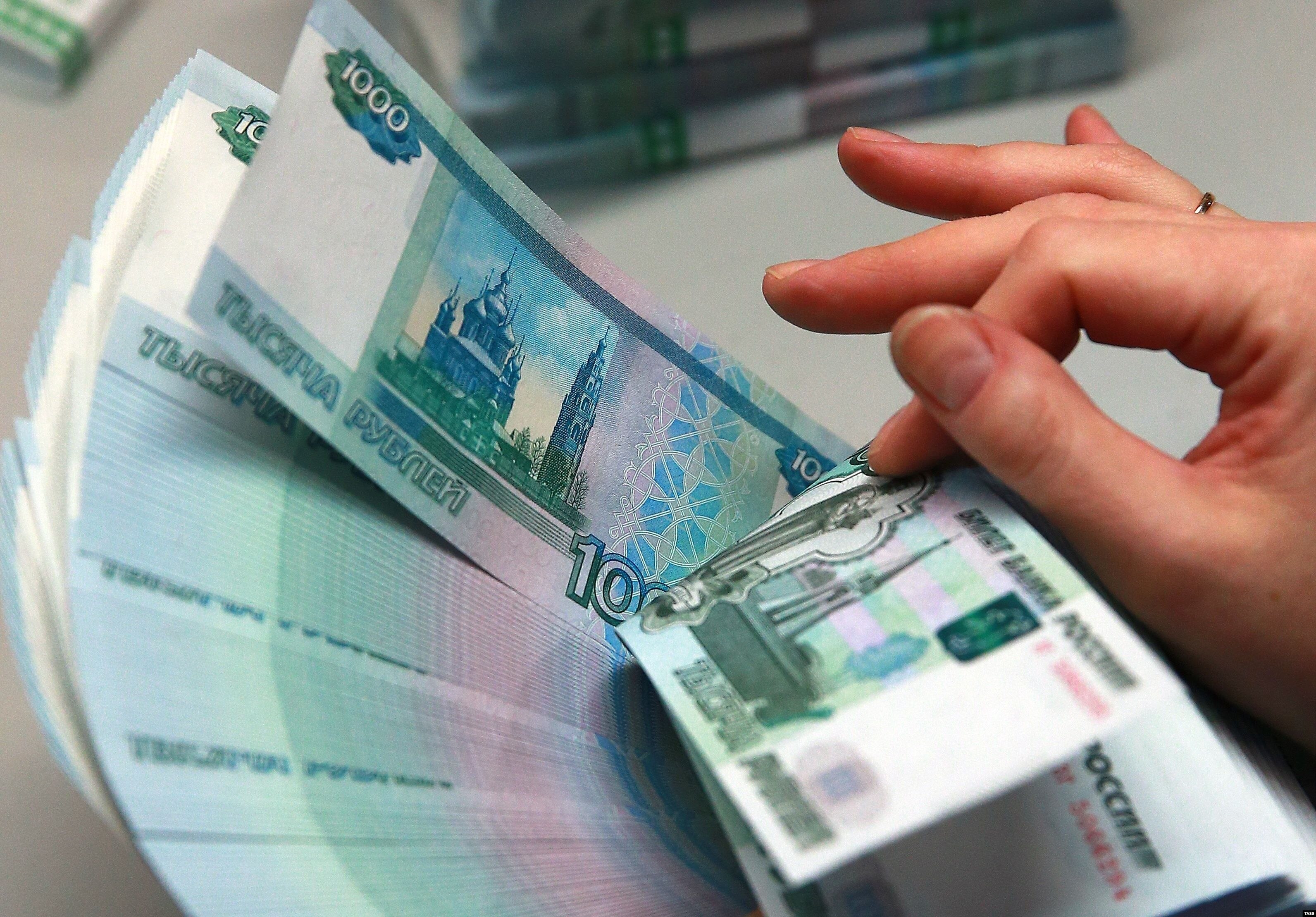
“We offer the total level of [social] contributions [business] to reduce to 15% ... those who receive high salaries should pay more [in the form of income tax] . We offer that part of the salaries that exceeds the level of one million rubles a month, tax 25% at a rate of 25% and the intended purpose of letting these funds to pay for pensions to citizens born until 1967”
Source: TASS Yes, but ... the Ministry of Finance has so far offers a different way to reduce the tax burden on businessDuring the “Meeting with Business Representatives of the Ulyanovsk Region,” the business ombudsman spoke of a decrease in the general tax burden on companies and enterprises. To bring the total payment for them on social insurance contributions “up to 15%” would be reduced exactly twice.
Today, their total rate is 30%of the wage fund, which employers are obliged to transfer to their employees to extra -budgetary funds of the state - pension (22%), as well as compulsory medical (5.1%) and social (2.9%) insurance. “In other countries there is no such load, and here we are just losing in competition,” Anton Siluanov , Minister of Finance of Russia, also admitted the other day .
So far, the government discusses plans to reduce the total rate of business insurance premiums from 30% to 22%, but while increasing the rate of non -income tax for the highest salaries in the country, but value added tax (VAT) - from the current 18% to the same 22%, which will inevitably affect prices.
But how many additional revenues to the Pension Fund could have been given almost doubling the personal income tax rate (from 13% to 25%) for the highest salaries, but only in that part that exceeds one million rubles a month, as Boris Titov himself explained Radio Liberty on the eve of January 22? It can be assumed that there are some expert assessments that, apparently, has the business ombudsman, since he made such a proposal. For our part, we will try to imagine at least the overall potential of a hypothetical solution based on open statistical data.
In Russia in Russia, only 4.13% of all workers earn more than 100 thousand rubles per month, and only in 17 regions out of 85 their share is higher than this average in the country. Such estimates are given by RIA Rating in the “rating of the regions of Russia on salaries - 2017” , which was presented in early December, which was compiled on the basis of Rosstat data.
Where does such a gap come from? The fact is that only a few regions “provide” the relatively high average indicator-the first five rating was made up by the Yamalo-Nenets AO (where more than 100 thousand rubles are earn monthly 23.47%of all employees), the Chukotka AO (17.05%), the Nenets AO (15.14%) and the Magadan region (14.76%). Exactly the relatively high “average” salary “provides” precisely the few groups of the highest paid employees in the country.
Let us turn to the direct estimates of Rosstat regarding how exactly the earnings of different levels are distributed in the country . For comparison, Rosstat shares all the salary statistics into 10%groups of employees: from the first (minimum) to the tenth (maximum). And we will see that only about 30% of the working population in Russia in Russia in 2017 exceeded the “average” “average” in the country of 38.9 thousand rubles per month:
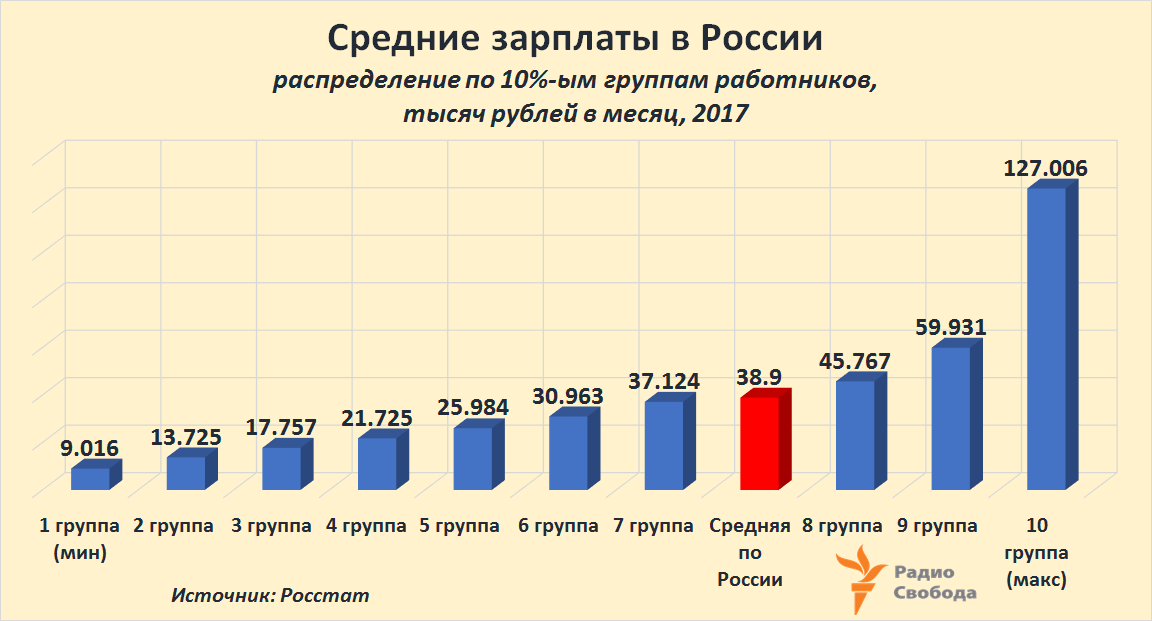
However, Rosstat himself gives an exact assessment here - 67% of all employees observed by statistics have a salary below than the average in the country. Moreover, this indicator has not changed much since 2000. A third of the total amount of the observed salaries accounts for only 10% of the highest paid employees (with maximum salaries), and by 20% of such employees - almost half of the total amount. And this ratio also changes little over time:
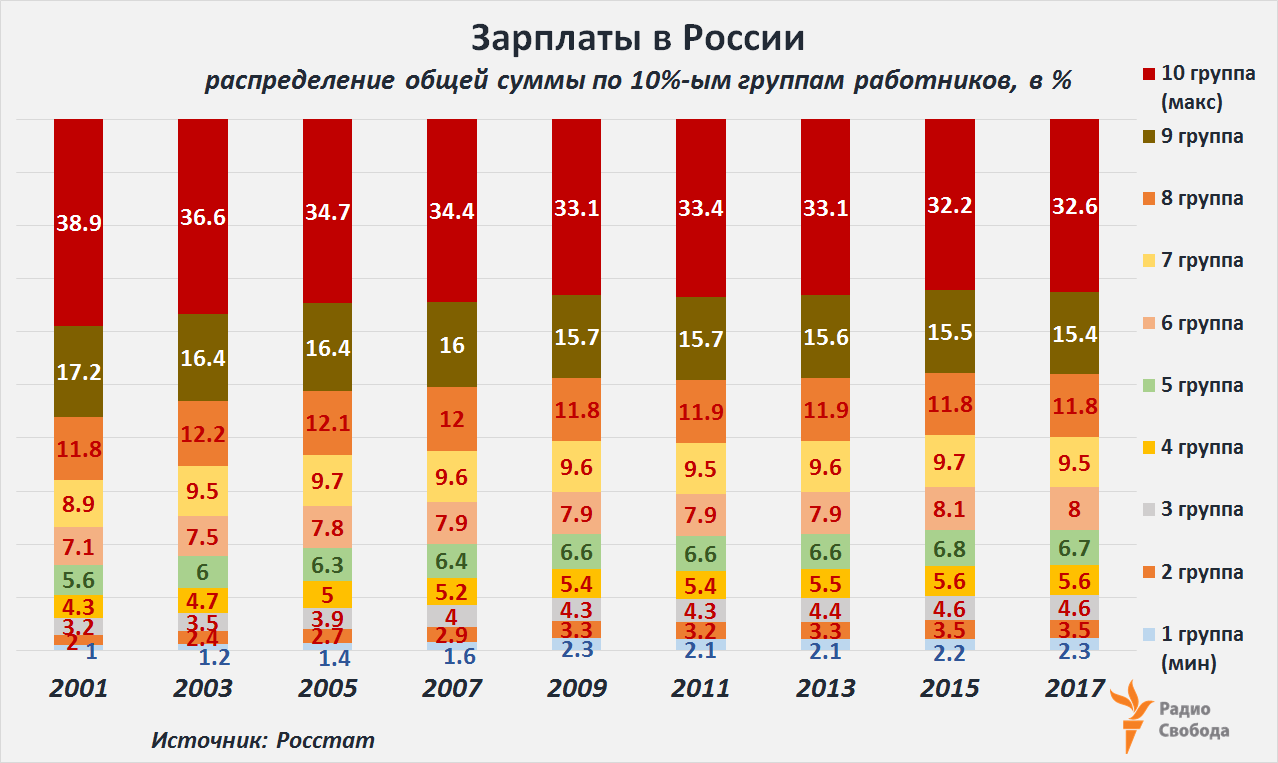
With regard to the highest salaries, Rosstat uses the indicator “over 250 thousand rubles per month”, not crushing it further, that is, it is not possible to allocate “millions” salaries within this statistics segment. But in 2017, the share of such workers (with salaries of more than 250 thousand rubles) amounted to 0.5% in the total mass of working in the national economy observed by Russian statistics:
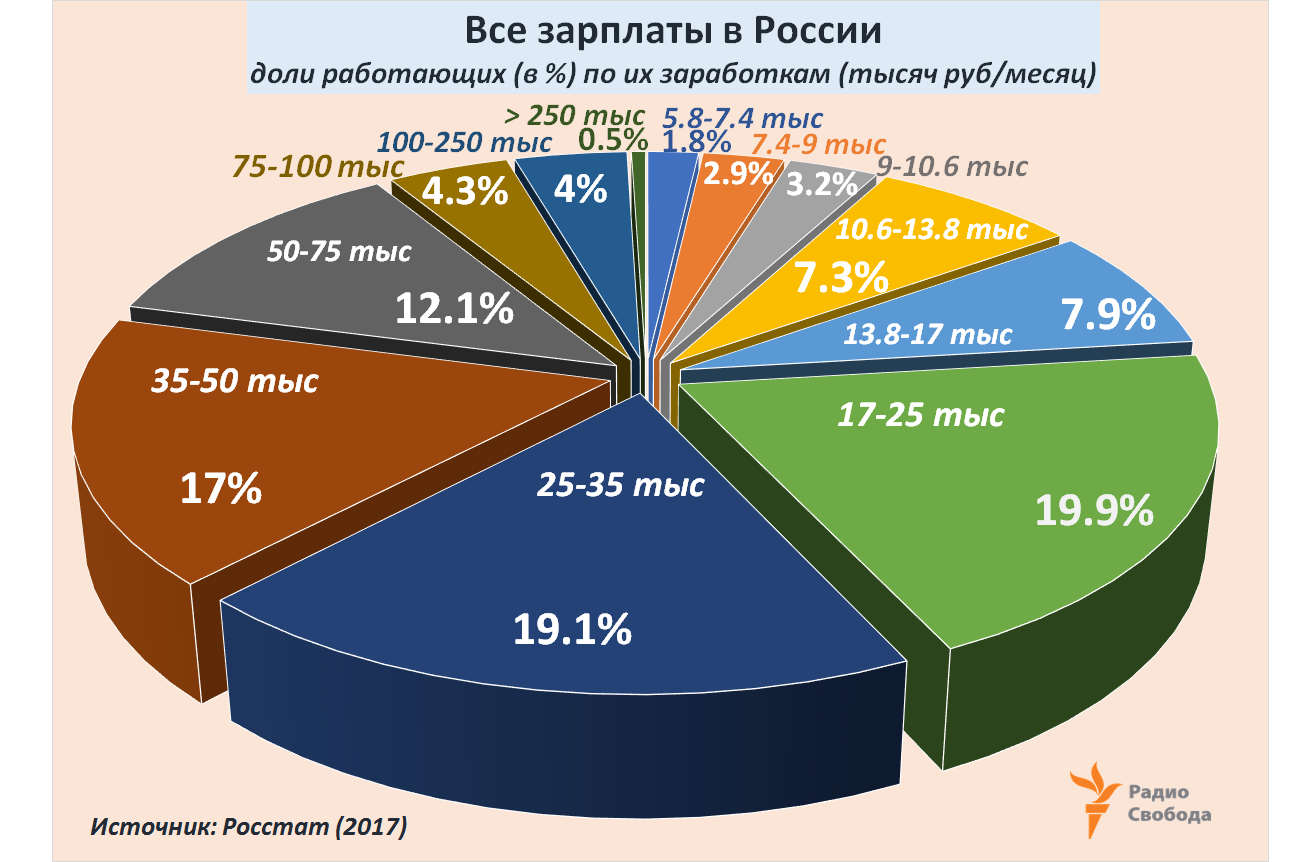
With such a structure, the growth of the average salary in the country even by 10–20% of the vast majority of workers may simply and not notice, since it will be primarily caused by increasing the earnings of small groups of the highest paid workers.