
Translated material
"Wojikali", or the end of the Duumvirate
90 years ago, in January 1928, the first wave of a tough attack on the NEP began. The country entered in the critical period of its history
In 1928, the coordinate system was set, the code of Stalin's history that lasted at least another twenty -five years - until the leader of the leader.
Farm without reserves
Over the years of the NEP, after the Civil War and the Military Communism, in Soviet Russia there was a compromise between the authorities and the owners (primarily the Middle and small in the village and the city). However, a new contradiction between the needs of industrial modernization and the interests, very heterogeneous, millions of private owners have become a source of serious political and social shifts. Market imbalances, which increased voltage, managed to smooth for some time due to state reserves of gold and currency. It is no coincidence that the password of the economic policy was a “farm with reserves” (Nikolai Bukharin).
At the same time, Joseph Stalin, referring to the example of Peter I, dreamed of the idea of forced development of the country. The immoderate industrial impulse very quickly exhausted the accumulated resources, and hence the limited margin of strength of the entire Nepov system.
* In the period from July 1927 to January 1928, 2 thousand tons were prepared less than in the corresponding period of 1926-1927
The grain -preparatory crisis of 1927-1928*provoked by exaggerated ambitions of the authorities, their own (these ambitions) and put it under attack. The Kremlin was confused and in the hope of fulfilling the broken export plan - the source of the currency - answered with repression against the holders of commodity grain, and got involved in the "Extremely".
At the same time, it turned out that the levers of adjustments to the main course are practically absent.
Two socialisms
The Political NEP never came. The party and the state merged. The mechanism of fractional compromises - this surrogate of multi -partyism under the party itself - was dilapidated after the crushing defeat of the “left” opposition. In the struggle of Duumvirate, Stalin - Bukharin, a deep crack arose during this struggle.
Only the spontaneous resistance of the owners could now stop the autonomous voyage of power on the waves of political voluntarism. The explosion of indignation in response to an extraordinary policy at first gave the hope that the authorities would make concessions. Throughout 1928, a social confrontation was observed, which was accompanied by complex political maneuvering and a viscous struggle at the “top”. The country faced the fork: it was possible to move both towards “state socialism”, functioning in a market environment and not denying a multistract economy, and in the direction of emergency “state socialism” with a “disconnected” market. The NEP proved Stalin, two aspects: the controlling role of the state and the freedom of private trade. The first regulator was, in his opinion, more important than the second.
The Stalinist environment really never trusted the private sector of the economy, was inclined to force pressure, rigid regulation, and ultimately the redistribution of property in favor of the public sector. True, in order to change the structure of the Nepov society, it was necessary to increase political muscles, to form a new, free of the inertia of NEP, a young activist column. It was impossible to ensure a turn without it. The Chekist apparatus worked well in a calm atmosphere, but he was not able to cope with the possible chaos.
Leader traps
The Bukharin group openly stated that emergency measures would inevitably lead to a civil war. Speaking for their cancellation, Nikolai Bukharin, Alexei Rykov and Mikhail Tomsk, offered a program of concessions to the peasantry: raising purchase prices, increasing production mass for the village, differentiated tax, lifting cards, contracting crops, etc.
As soon discovered, the first and second waves of emergency measures (January-April, April-June 1928) failed. It seemed that the Neonep is returning with a triumph.
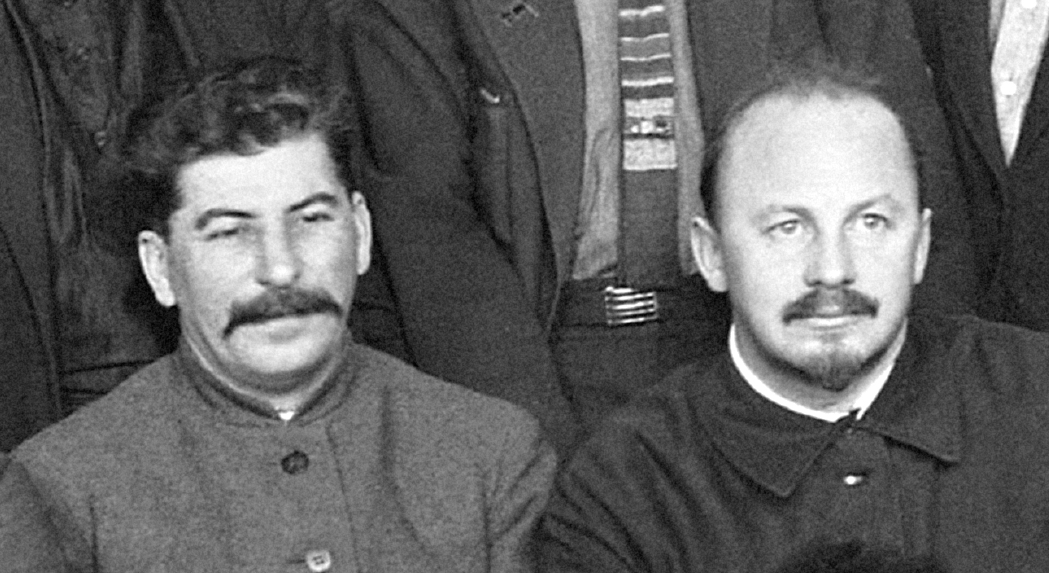
Supporters of the leader soon called performances
Bukharin Groups "Winding Shakalov" Photo: ITAR-TASS
In the name of maintaining his influence, Stalin took a centrist position: between supporters of the continuation of the emergency, power pressure on the upper layer of the village, on Nepmanov and those who called to return to the market, where the state was only one of the players, albeit the largest. However, the political behavior of the party leader, who, during the time of the intermediary between those and others who could reconcile, “play” left or right, both sides predicted erroneously.
Stalin was preparing for political improvisations and waited. Political intrigue, the desire for thorough knowledge of the technology of power has become the meaning of his life. He seemed to understand that social crises poorly fit into the system of good intentions of the leadership and develop according to their own laws, weakly succumbing to the stabilizing efforts of the state. The hardware power suffered by Stalin became a more effective instrument of political survival than following this or another course. During one 1928, the Secretary General managed to rebuild the lower outline, and pass all the main personnel of the middle level through its “special sector”. Both capitals of the country, the main public organizations and the media were taken under the control of Stalinists. This was the part of the work that none of the main opponents paid attention to.
** In May 1928, a trial was held in the city of Shakhty by specialists "pests" accused of intentional disruption of coal production
*** We are talking about courts over representatives of the party and state apparatus accused of "disruption of work", "collective booze", "bow with kulaks", "financial embezzlement", "moral decomposition"
At first, the “rebirth” and corruption were not taken at first, and the juggling of the so -called right slope. It was easy to please these traps skilled by Stalin. Millions of embittered people were very far from complex doctrines. They needed a direct answer to simple questions: who is to blame for the crisis, who prevents the movement forward? The search for "enemies" is a kind of valve through which discontent can be released. The mechanisms that have arranged a question that matured in the million masses became the “Shakhty case” about the pests in the Donbass **, whose shade was obvious, the campaign against corruption - the “Smolensk Outloich”, Sochi and Astrakhan processes ***.
These “affairs” were needed for cleaning personnel resisting the plan of frantic industrialization and pressing the fist. The search for real and imaginary “enemies” very soon captured the whole society. The process of stratification of the elite into supporters of Nepovsky reformism and apologists of the jump began. It was relevant that was not a fundamental orientation in the world of big policy, but what horse should be put on in its personal political game.
Against the "right bias"
The question is still being discussed whether the events of 1928 were a conspiracy of the state elite. Lev Trotsky absolutely had no doubt about this: officials launched the struggle with the new owners for the main share of national income. Later, historian Stephen Cohen, not without irony, not without irony, not without irony: the existence of a “conspiracy of bureaucrats” would mean that this “new class” decided to commit life with collective suicide. And really, is it really a comfortable life in Nepovsky society that arranged less bureaucrats than full stresses, or even serious dangers of the dictatorship? Moreover, the crisis, the growing inertia of the economic jerk and emergency measures turned violence into a “crutch” of politics. Heads of a very definite type were pushed to the surface. Behind them were “anti -bourgeois”, prone to extremism of the Lumpen and economically low -power layers, casting oblique glances at rich neighbors. Poor people became not only a support for the advance on non -state ways, but also a catalyst for a new course. And the ideology of “assault and onslaught”, demonstrative anti -preschool actions of the authorities, “affairs” against corrupt officials and pests, switched discontent to the channel of the enemies, consolidated a different alignment of forces. It was only necessary to take the last step - to indicate who these "right -handed ones" are.
About the "right" danger, Stalin beat the alarm for the whole year. However, the anonymity of the accusations led to the fact that people perceived these enemies as something invented in the Kremlin. Therefore, calls to fight them at first did not give the expected effect. “The right slope is sucked out of the finger,” said the engineers of one Saratov plant. In Tula, they generally adopted a resolution in defense of these hard -to -acting “enemies”. It seemed that the last of them were already expelled from Moscow or the USSR. For more than a year, the question of new enemies and their center hung in the air.
By the end of 1928, when it became clear that the Neonep program does not work (or does not have time to work) that the Stalinist environment was not going to slow down the rates of industrialization, and there was a new crisis, an increase in speculation, under the leadership of Stalin, the campaign against the “right -wing” began. At first, Lazar Kaganovich said that the Bukharin group joined the “right bias”. That is, after the discrediting of the “right slope”, including the hands of Bukharin and his like-minded people, they were directly connected with this slope (the Bukharin residents still refused to recognize themselves as “right”). Emelian Yaroslavsky, Peter Postyshev, Andrei Zhdanov and others were included in the choir of the leading “exposure”. Further, Karl Bauman went, who characterized the performances of the Bukharin group “The howl of Shakalov” (cf. with the current “Jackal at the embassies”). Then followed the cut -off of the Bukharin group from the leadership of the party and the state. The path to final repressive blows on the system of market relations was opened.
But even in conditions when the “revolution from above” became inevitable, the tendency of adaptation to a new course appeared, that is, the soft version of the inevitable redistribution of property. The episode with the breeder Polnikov, who, on private property, owned a leather factory in Shui volost, is indicative in this regard. Representatives of the volost authorities advised fingers to hand over the plant to the state voluntarily. He agreed and concluded an agreement with the volost executive committee, in which he was promised: to restore it in electoral rights, to accept the union members, not to take away the land, to give the children the opportunity to study, to appoint the director of the plant.
There were few such facts, but they showed in which direction the process could go in principle if the process itself was important, and not to bewitted with violence. But, as Kaganovich stated, our state is "not a legal state, its laws are determined by expediency at every particular moment."
Stalinism, or, more in Russian, Stalinism-this is what he gave 1928. Stalinism is an extreme and pure manifestation of extraordinary, war with their people. For two and a half decades, such an order reigned in the country (that is, the state of things), in which death became the norm, lawlessness has become the norm, betrayal has become the norm, fear has become the norm. Saving themselves, many abandoned parents, teachers, betrayed friends for their salvation. A funnel of mass repressions delayed not only the millionth “target groups” of enemies appointed by the authorities, who had no place in the turned, abnormal Stalinist state, but also all who managed to capture. However, from today's point of view, the whole horror of the situation was not in the twistedness of the Stalinist state and not even in the millionth arithmetic of repressions, but in the speed, invisibility for the eye and the visible lightness with which this turn occurred - a “howling shakals” dried out for society. That is why 1928 continues to attract the attention of historians: not so much as a “point of no return”, but as a moment when something else could be changed.
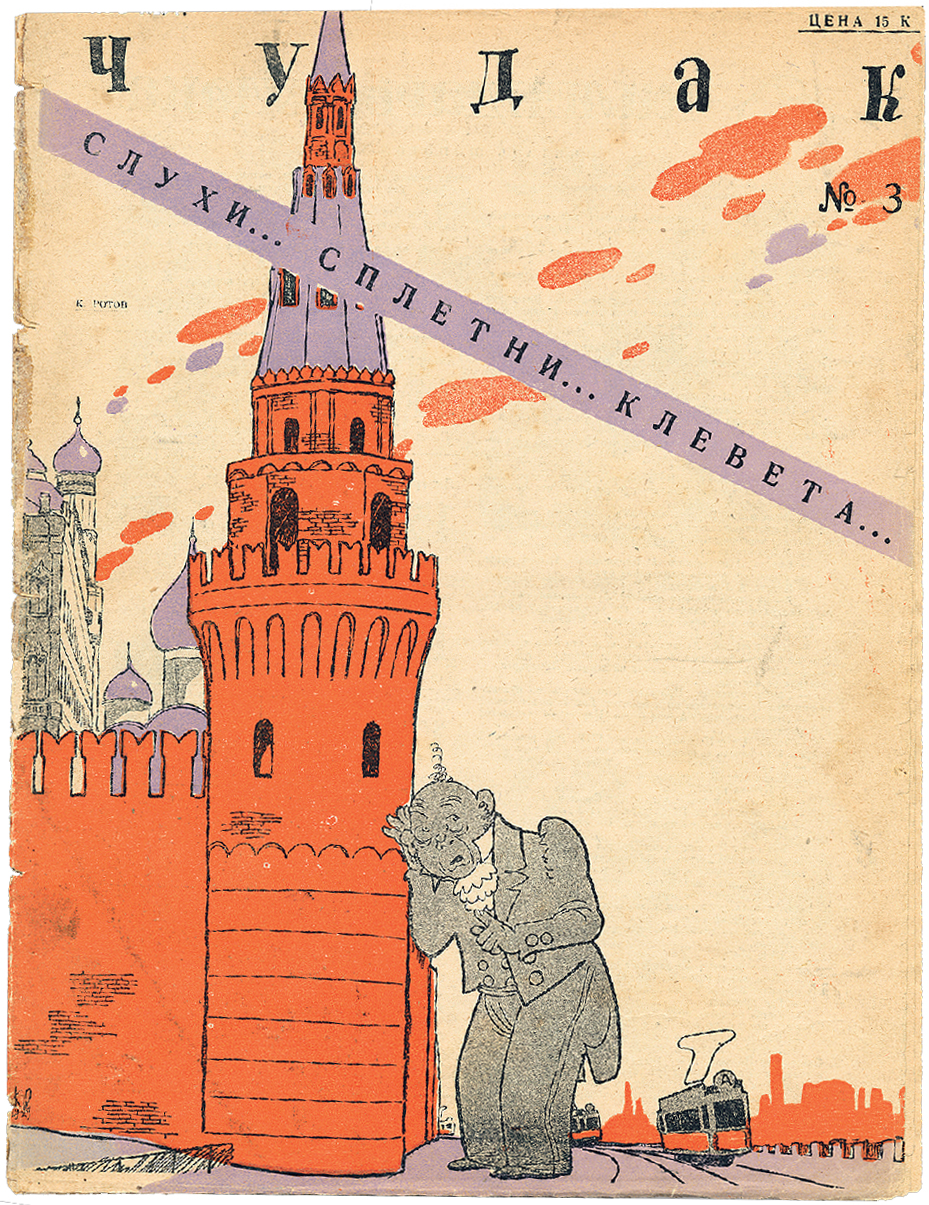
In 1928, the magazine "Chudak", which was edited by Mikhail Koltsov, ridiculed foreigners as passionately as it is done by our Kremlin power and its propagandists now. The drawing belongs to the famous artist Konstantin Rotov, who was then declared a German spy and hit the Stalinist camps.
First published in NT No. 5 of February 4, 2008