
Translated material
Czech Republic: Unsolved Zeman
According to the results of the second round of presidential elections in the Czech Republic, the current head of state won
Milos Zeman, who has a reputation as a pro-Russian politician and Euroskeptics, opposing the entry of the Czech Republic in the euro zone and the reception of migrants, received 51.36% of the vote following the second round of elections, and his rival, ex-chairman of the Academy of Sciences Irji Dragosh, a supporter of the pro-European and pro -atlantic course,-48.63%. The results of the elections were published on the evening of January 27, the Republican Statistical Administration. Thus, Milos Zeman was re -elected for a new term. His opponent has already recognized his defeat. The turnout of voters in the second round amounted to more than 66%.
We offer readers a portrait of 72-year-old Zeman, published in NT in April 2015.
According to the Constitution, the president of the Czech Republic, the parliamentary republic, performs mainly representative functions. But Milos Zeman is not that. With his loud political statements, he won the laurels of an independent leader and one of the most consistent allies of Moscow in the European Union. Zeman is against sanctions. Zeman-sends invitations to a commemorative ceremony in honor of the 70th anniversary of the liberation of Auschwitz. Finally, Zeman, unlike most European leaders, goes to Moscow for May celebrations on the occasion of the 70th anniversary of Victory. And yes, Zeman “will not allow any ambassador to intervene in the program of his foreign visits” - this is a quote from a response to criticism from the US ambassador in Prague, replicated by the Russian media. So who are you, Milos Zeman?
Zeman’s excessive political independence prompted the Czech government to begin work on legislative amendments in order to significantly limit the powers of the president, completely excluding his influence on political life. But there are still no amendments. And Zeman is still there. And if so, the question of the political credo of the Czech president is by no means idle.
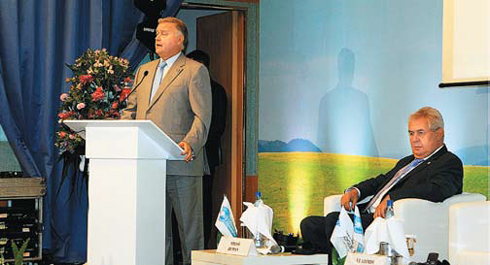
Yakunin is associated with a long -standing friendship.
In the picture: Rhodes Forum, 2014
Your own among strangers
After last fall, Milos Zeman invited a group of heads of state and governments to visit Prague at the end of January (2015)-to participate in the conference on the Holocaust dedicated to the 70th anniversary of the liberation of Auschwitz by Soviet troops, a diplomatic incident occurred. The invitation meant that the Czech Republic, one of the countries of the European Union and NATO, could come to Russia President Vladimir Putin, whose relations with the West since the beginning of the Ukrainian crisis deteriorated sharply. The Czech President’s office quickly gave the answer to all the puzzled questions: they say that the Jewish Congress organizes the Holocaust conference, which asked the Czech authorities to adopt the event and his guests, with which Prague agreed. And if so, then invitations can be sent on behalf of the owner of the “site” - the president of the country.
These explanations did not reassure the Czech public and the media. Even if we are talking about diplomatic formalities, then it falls too well in the context of the controversy around Milos Zeman. And this polemic has been going on in the country for more than one month. Almost the main role in it is played by the attitude of the President of the Czech Republic to the current policy of Russia.
In September 2014, Zeman took part in the International Forum “Dialogue of Civilizations” on the Greek Island of Rhodes. The organizer of this annual action is Vladimir Yakunin - the head of the Russian Railway Corporation and one of the close associates of Vladimir Putin.
Yakunin regularly invites the Czech president to such events, and he does not refuse. Journalists were not able to get a clear answer from the president’s office about the motives of such close cooperation. Press Secretary of Zeman Irji Shepherd to questions about Yakunin answers briefly: "Yes, they are familiar." It is not surprising that in the Czech media there are guesses about the degree of influence of the Kremlin on the Prague City. Until these, we quote the heading of one of the articles dedicated to Zeman on the Aktualne.cz information portal - "Do Russian special services manage us?"
Press Secretary of Zeman Irji Shepherd to questions about Yakunin answers briefly: "Yes, they are familiar." It is not surprising that in the Czech media there are guesses about the degree of influence of the Kremlin on the Prague City
Speaking in Rhodes (by the way, in Russian - like English, Zeman owns it well), the president of the Czech Republic, in particular, said: “It is necessary to cancel sanctions (against Russia), they are redundant. They bring the effect, the reverse of the one that their authors counted on. Between civilized states, a dialogue is needed ... ”These words caused a violent reaction in the Czech Republic - after all, at the official level of Prague, in the person of the Czech Foreign Ministry and the government, it is in solidarity with Western sanctions against Moscow. And in itself, the participation of the head of state in an event organized by a person, which is part of the “sanctions list”, from a diplomatic point of view looked at least scandalous.
However, this is only the beginning. During the fall of last year, Milos Zeman has repeatedly performed on foreign policy issues - so much so that the Kremlin could only applaud. According to Zeman, there is a civil war in Ukraine, and there is no evidence of Russia's intervention in the Donbass conflict. He repeated similar in early November 2014 and in an interview with Czech radio. True, the Czech President did not limit himself with Ukrainian events: in the course of the conversation, he doubted the presence of political prisoners in Russia, and the Pussy Riot group described in non -parliamentary expressions. Talking about how the word “pussy” is translated, savoring his not very accurate translation into Czech, he used obvious vulgarisms several times.
The response to the Revelations of the President was the protest shares in the center of Prague and a number of other cities. Participants in these shares showed symbolic “red cards”, demanding the removal of Zeman from the political field.
On the same day, namely, on November 17, on the day of the 25th anniversary of the 1989 velvet revolution, Prague students, to whom Zeman came to the company of the presidents of four neighboring countries-Slovakia, Austria, Hungary and Poland-threw him eggs and tomatoes. The guard barely managed to obscure the president with open umbrellas. According to a survey of public opinion carried out immediately after these events, the rating of the head of state collapsed in a month from 58% to 37. And has not returned to the previous values until now.
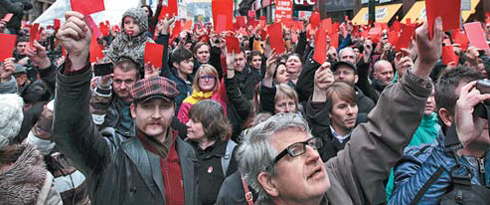
Demonstrators show the Red Card to President Zeman, Prague, November 17, 2014
Man from the people
After all these events, Milos Zeman backdered. But only partially. For example, he reacted to the open letter of the former Soviet dissident Viktor Finberg - one of the participants in the protest on Red Square against the invasion of Czechoslovakia in 1968. In a conciliatory tone, the Czech president promised the indignant human rights activist to ask the fate of the Russian political prisoners, without failing to add that we should talk "about real political prisoners." He almost agreed with the remarks by Prime Minister Boguslav Sobotka and the Foreign Minister of the Chechen Republic of the Chechen Republic Lubomir Zayralek, who urgently advised the president to coordinate his spontaneous statements on foreign policy issues with the position of the office. Indeed, according to the Constitution of the country, the main responsibility for the development of foreign and domestic policy is still in the government.
However, according to Czech political analysts, we are talking about the favorite reception of Zeman. First, arrange a commotion on the political stage, then temporarily go into the shadows and perform conciliatoryly, then again go on the offensive. This has happened more than once over the years of his presidency. Perhaps such a courage gives him the fact that he was elected in January 2013 at the first direct elections of the head of state in the history of the Czech Republic. Before that, the president chose parliament.
For Zeman, both vulgarisms, and a defiantly pro -Russian position in the Ukrainian issue - first of all, a way to draw attention to his person, act as a “person from the people”. And to contrast yourself with the “Prague cafe” - this is how the liberal, more educated part of society is called on Czech political jargon. The meaning of such a “self -patient” can be translated so - “common beer against the intellectual cafes”.
But no matter how translated - Milosha Zeman is hard to call a fundamental politician. Back in the 90s, when he headed the opposition social-democratic party, Zeman became famous for the sharp anti-corruption and social, left rhetoric, which allowed him to win the parliamentary elections. Having become the prime minister, he unfolded the program of privatization of the banking sector, and his office was involved in a number of corruption scandals.
The observer of the newspaper "Magdarzhsk Novina" ondrzhi, the time recalls that Zeman's position in Ukraine was not from the very beginning of the Prochrevskaya. In the spring of 2014, when Western politicians were indecisive after the annexation of Crimea, he suddenly spoke out for the introduction of NATO troops into Ukraine. But when the position of the West in relation to Moscow became more stringent, he began to advocate the abolition of sanctions and a dialogue with the Kremlin.
To go against the liberal mainstream and at the same time be in sight - all this, apparently, flatters the pride of the president. And, of course, it increases its authority in the eyes of the “beer 4th category”-as the Czech Republic calls the least wealthy and little-educated, spontaneously left-wing part of the electorate. There are many nostalgiars in the times of socialism (until 1989), as well as fans of the “strong hand”. In this role on the Czech stage, they are ready to see Zeman, and on international - Putin seems authority to them.
The liberal political scientist Irji Pege believes that purely personal negative factors affect the behavior of Milos Zeman: the president’s famous tendency to alcohol and his character with obviously narcissistic features.
And indeed the evidence is one of the first scandals of his presidency. In May 2013, Zeman looked clearly impressed during the ceremony with one of the symbols of Czech statehood - the coronation relics of the former kings. The presidential office explained the strange facial expressions and non -hardeous gait of Zeman with a “viral infection”. Newspapers, however, drew attention to the fact that he came to the ceremony directly from the Russian Embassy - from a banquet on the occasion of Victory Day. Since then, the expression "presidential virus" has become for many Czechs the ironic synonym for a drunk state ...
The Czech Republic is a parliamentary republic, and the president here is not a dominant post. That is why Zeman now and then try the strength of the borders of Czech democracy
Statement for strength
Although addiction to alcohol, and self -love is inseparable from the figure of Milos Zeman, to explain his behavior only by this means to simplify the situation. He is an experienced and smart politician who puts at the forefront of the preservation and extension of his power. But still this power is small: the Czech Republic is a parliamentary republic, and the president here is not a dominant post. That is why Zeman now and then tries to the strength of the border of Czech democracy. So, last year, during the parliamentary crisis, he managed to hold his “government of experts” in power for six months - as the president himself called him, and his criticism “Zeman's friends”. Then the head of state tried to arrange an intra-party coup in the ranks of the Social Democrats that won the elections in order to make the premium not their leader Boguslav Sobotka, with whom Zeman has tense relations, but his close Governor of South Moravia Mikhal Gashek. This plan broke, and Milos Zeman again went into the shadow, lick the wounds - political and not only: just then the president fell in his residence (according to the versions of the media, being very impressive), while damaging the knee. Since then, he has been walking with a cane.
Having gained strength, Zeman moved to a new offensive. This time - focusing on foreign political problems.
A significant part of the Czechs is aware of the danger to democracy, which comes from the president. Otherwise, thousands of people would not show Zeman the “red card” on the streets of Prague on the day of the 25th anniversary of the “velvet revolution”. Although in fact, if you turn off the rally emotions, the color of this card is still not red, and yellow is only a warning, and not removal from the game field. In the early care of the head of state, only the right -capacity opposition is interested in, which lacks parliamentary and senatorial seats. The Czech law on impeachment is very complicated.
However, with all the “balls” in his favor, Zeman seemed to miscalculate: by going on the attack in his foreign policy radicalism, he is unlikely to be able to count on the approval of even the inert and silent majority. And here neither Vladimir Putin nor Vladimir Yakunin can help his Czech friend.
For the first time a publication in NT No. 12, dated April 13, 2015
Photo: Flickr.com, David W Cerny/Reuters