
Translated material
Return the concentration camp of Germany
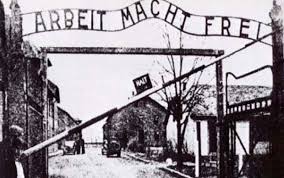
The Poles are not involved in the Holocaust, to call concentration camps in Auschwitz or Maidanek “Polish” criminally - as well as distributing or supporting “Bandera ideology”. These are the most resonance of the provision of amendments adopted by the Polish Sejm to the Law on the Institute of National Memory . Israel and Ukraine expressed a sharp discontent - each of these countries on their own.
One of the amendments approved by the Sejm involves a monetary fine or imprisonment for up to three years for those who "publicly and contrary to facts attribute responsibility or partial responsibility for Nazi crimes to the Polish people or the Polish state." The law applies to both Poland citizens and foreigners and does not depend on exactly where the punishable acts were committed.
Particular attention in the law is paid to the use of phrases "Polish concentration camps" or "Polish death camps." This is a rather long -standing conflict . Indeed, outside Poland to the camps created by the Nazis on its territory during the occupation - from September 1939 to the beginning of 1945 (Auschwitz - Auschwitz, Maidanek, Treblinka, Sobibor), sometimes similar expressions were used. The geographical location of the camps was meant. However, as the Deputy Minister of Justice of Poland Patrick Yaki stated during the consideration of the bill , "the crimes of German Nazism are attributed to the Poles. Until now, the Polish state has not had an effective tool for counteracting such insults."
Crimes of German Nazism are attributed to the Poles
The emergence of an "effective instrument", however, immediately brought a diplomatic conflict to the Polish authorities. The Ambassador of Israel to Poland Anna Azari said that, according to Israel, new amendments can lead to the fact that the surviving victims of the Holocaust can be subjected to judicial persecution for their testimonies - if it concerns the participation of Poles in war crimes. Azari noted that although the Israeli government condemns the adoption of a new Polish legislation regarding the Holocaust, it also understands that such death camps as Auschwitz (Auschwitz) were not built by the Poles. Soon after, President of Poland Andrzej Duda - he must sign the law after his adoption by the Sejm and the Senate - said that he could recommend a revision of a number of his provisions.
Be that as it may, the Sejm’s decision caused a lively polemic in Poland and abroad. The journalist and sociologist, the former dissident Pyotr Patsevich notes that the law in his new edition derives from among the potentially persecuted those who violate him "within the framework of artistic or scientific activity", but not educational activities. In other words, according to Patsevich, Polish history teachers may be under pressure, talking about such sad pages of the past as a pogrom in barefoot . Supporters of the new legislation subjected Patsevich strict criticism. Former press secretary of the Ministry of Justice Sebastian Kalet :
ORDYNARNE KLAMSTWO. Zamiast posypać głowę popiołem nad faktem, że elim il rp pozwoliły na to, abozy # rzeczywiście myślą, że polska odpowiada za holocaust? pic.twitter.com/juno7bcxp2
- Sebastian kaleta (@sjkaleta) January 29, 2018
"An ordinary lie. Instead of sprinkling with ash over the fact that the elites of the third republic (post -communist Poland. - RS) allowed that the death camps are called Polish, we are misleading about the law. Maybe they really think that Poland is responsible for the Holocaust?"
Israeli historian Havi Dreyfus , professor of Tel Aviv University, heading the Holocaust Center in Poland, however, shares Pyotr Patsevich’s fears : “This law can create an atmosphere in Poland when people begin to speak on these topics. Beautiful scientists work in Poland, who helped change the perception of many aspects of the Holocaust. And that they and their students are now now They will be forced to think twice before taking up such topics, I consider a big problem. ” Dreyfus admits that the concentration camps in Poland "really had nothing to do with Poland or any Polish power," but it recalls that the attitude of the Polish population towards Jews during the years of the Nazi occupation was, to put it mildly, ambiguous.
The vast majority of these people were not killed directly at the hands of the Germans
On the one hand, more than 6,700 Poles are recognized in Israel by the “righteous of the world” (honorary title, awarded to representatives of other peoples who saved Jews during the Holocaust). On the other hand, out of almost 250 thousand Polish Jews who tried to hide from the Nazis in rural areas, no more than 10%survived the war. “The vast majority of these people were killed not directly at the hands of the Germans, but were killed either by local residents, or they were given to them by the Polish auxiliary police or directly to the Germans, who then killed them,” says Havi Dreyfus.
Israeli politician Yair Lapid , deputy of the Knesset and leader of the Esh Atid party, entered Twitter on a skirmish with the Polish embassy in Israel:
I am a Son of A Holocaust Survivor. My Grandmother Was Murdered in Poland by Germans and Poles. I DON'T NEED HOLOCAUST Education from You. We Live with The Consequences Eryt in Oour Collective Memory. Your Embassy Should Offer An Immediate Apology.
- יאיר לפיnk (@YairLapid) January 27, 2018
Twitter of the Poland Embassy: "The purpose of the bill is not to" whiten "the past, but to protect the truth from slander." Yair Lapid: "I am the son of the Holocaust surviving. My grandmother was killed in Poland by Germans and Poles. I do not need you to teach me the history of the Holocaust. We live with its consequences all the time - in our collective memory. Your embassy should immediately apologize."
Another Israeli, the former ambassador of this country in Poland Vais , in an interview with the Polish publication, Dziennik asks painful questions: “Maybe I am too good about the Poles because they once saved me? But as about those who were not saved, but rather gave me to death? But then I recall the names of the Jewish Suds or Employees of the Polish Polish [post -war] state security that killed the Poles in Stalin's times. " In other words, the bill, mainly supported by the deputies of the ruling nationalist party "Law and Justice" and the populist "Kukiz-15", again-against the will of its initiators-dedicated the attention of society to the same problems that the Polish film "Ida" was dedicated to the Academy Award in 2015. His plot is an attempt by the Polish nun, who learned that her parents were Jews killed during the war, to find out the circumstances of their death. It turns out that the family Lebenstein was killed by their Polish neighbor. One of the main roles in the film is the aunt of the main character who, in the post -war years, became a communist prosecutor, on whose conscience there are many innocent victims.
After the party "Law and Justice" came to power in Poland, the Polish authorities pay increased attention to issues of historical policy . This also applies to the history of Polish-Ukrainian relations, which became the subject of another amendment approved by the Sejm besides the Law on the Institute of National Memory. This amendment provides for such a punishment - up to three years in prison - for the propaganda of "Bandera ideology." This is how triumphantly reported her acceptance by Pavel Kukiz , a former rock musician, and now the leader of the Kukiz-15 association:
Sejm właśnie przegłosował ustawę k%2715 zakazującą propagowania bankuzmu w polSse! Czekališmy OD 6 Lipca 2016 Ale Się doczekaliśmy! Nareszcie! pic.twitter.com/njfhtsxrdv
- Paweł kukiz (@pkukiz) January 26, 2018
"The Sejm approved the K-15 bill, which prohibits the propaganda of Banderism in Poland! We were waiting for July 6, 2016 (the date of the first introduction of the bill to the Sejm.-RS) and waited! Finally!"
The adoption of the bill caused a critical reaction of the Ministry of Foreign Affairs of Ukraine: “It is sad that the Ukrainian theme is again used in the domestic policy of Poland, and the tragic pages of the general historical past continue to be politicized. We are categorically not acceptable for another attempt to impose a unilateral interpretation of historical events,” the statement of this department said. Many Ukrainian users of social networks also in sharp expressions commented on the actions of Poland. Some asked the question, what, in fact, is the "Bandera ideology." Others stated that de facto is the ideology of liberation:
But the director of the Institute of National Memory of Ukraine Volodymyr Vyatrovich accused the Polish side of violating freedom of speech:
"The law on" Bandering "now approved in Poland is dangerous not for Ukraine, but for Poland. This is a serious step to turning freedom of speech and the implementation of party censorship. Not only Ukrainian authors fall under the law, but also Polish - those who wrote about the UPA, not counting its activity criminal."
The polemic regarding the activities of the Ukrainian rebel army during the Second World War, and above all the Volyn tragedy , has been conducted between Ukraine and Poland for several years, then calming down, then flare up again. As the Ukrainian historian Georgy Kasyanov noted during the next exacerbation in an interview with Radio Liberty , “unfortunately, in Ukraine and Poland there are politicians and certain segments of society that are interested in conflict. They pursue their specific political interests, but for the sake of these interests they are ready to complicate relations with neighbors. While such political interests are doomed to talk in such a thing in such a way. Mutual accusations.